



Hello, everyone
This is Enta.
I've been in Nagano for the past few days.
That said, they're currently doing a reverse-winding installation near our office.
According to the design, the counter-winding process adds 20%, but will that be enough?
That's the gist of it.
Reverse-spin installation is really tough, isn't it?
But that's beside the point.
Anchor Material Inspection
Material inspection is extremely important in ground anchor construction.
This is important for other construction projects as well, but it’s especially true for critical structures.
That’s why the parts that disappear become particularly important.
When using the anchor body measurement scale, the most important factors are, as expected, the fixed length and the free length.
After all, the key to ground anchor construction is the anchorage section.
If this part is wrong, there's no point in even discussing it.
That's why this part is especially important.
The fixed length is the portion from the tip cap to the boundary between the fixed section and the free length; we measure the length to ensure this area remains clean.
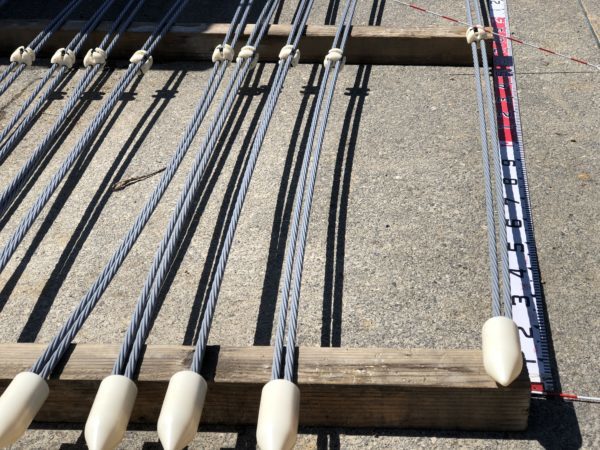
Check the placement and length of the spacers against the drawing.
Similarly, we will measure the free length.
However, please note that the free length also includes the excess tension length.
It seems similar to free length and tension allowance, but it’s actually different.
That said, since it’s an extension of the same PC strand, the structure is the same, but it appears differently on the drawings.
Since the material inspection is conducted to verify that the materials received match those specified in the drawings, please keep them separate.
Once the material inspection of this prestressing steel is complete, it will be used as a head component.
The head section must be kept as dry as possible to prevent it from getting wet from rain or water.
In particular, all materials other than the head cap are raw materials.
Since the raw material has not undergone any anti-rust treatment, it will rust immediately.
It really is just a split second!
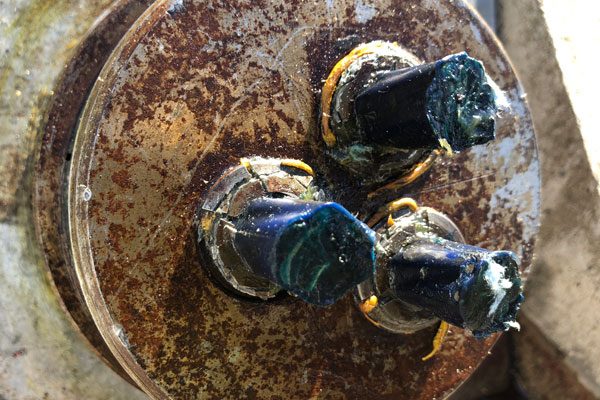
Even just moisture can cause rust.
Therefore, when inspecting materials, it’s best not to take them out of the bag if possible.
Put it in a bag as soon as you take it out.
Also, please be very careful, as the wedges tend to come loose easily.
Material inspection for ground anchor work is a real challenge.
I don't know what it is, but each one is just so heavy, lol.
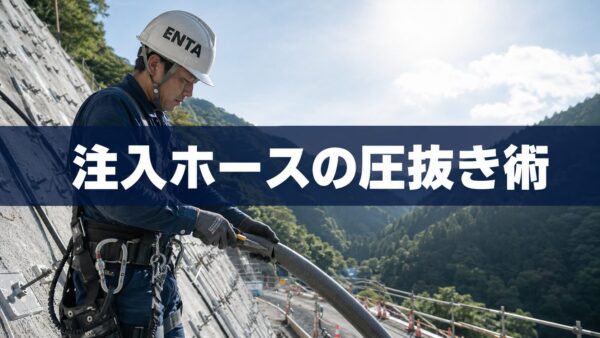
We even stretch out the anchor body to inspect it. Depending on the situation, we might even have to rewind it lol.
Be very careful, as it's quite common to get your hand caught in the machine at times like that.
See you later.


Thanks for your hard work. I can't help but wonder why I'm doing the exact same things every day as on Enta's blog. It's almost as if someone's watching my every move... lol
I just realized I was wrong this time.
According to the drawings, the free length up to the pressure plate is 20 centimeters, and the tension excess length is 1.0 meter. But the part sticking out from the slope is actually the anchor excess length. Because of the old-school way of thinking, we ended up passing the “photo” inspection with an excess length of 1.2 meters and an anchor length of that same length. The government office didn’t even notice, though...
Some reflections ^_^
I was taken aback by a post on Entablog.
Thank you for your hard work.
As long as I'm the anchor, it'll probably be pretty much the same, lol.
The way PC strands are laid out varies depending on the job site and circumstances, doesn't it?
Well, I think this "failure"—if you can even call it that—isn't a big deal, so it's fine.
It's not a big deal, lol
Let's go through everything step by step!