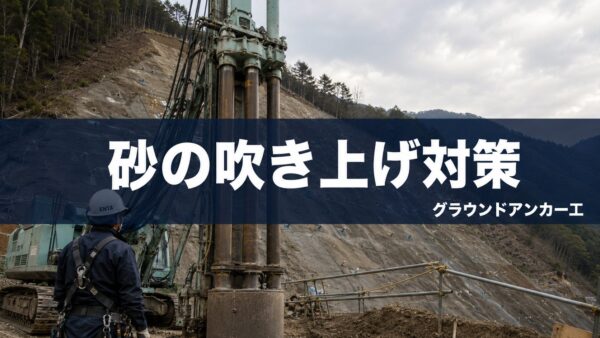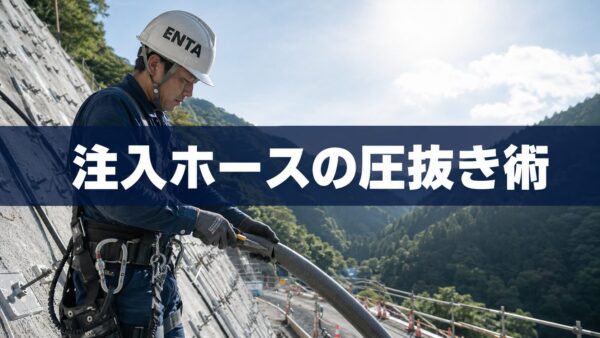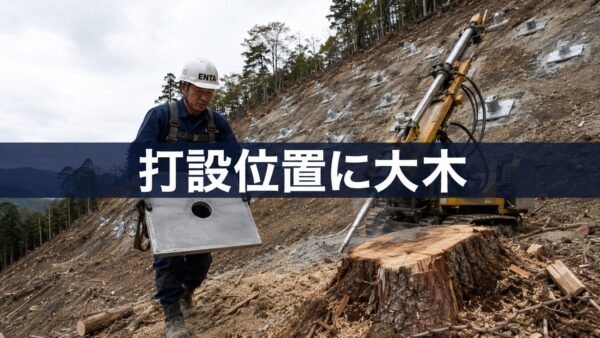


Hello, everyone.
This is Enta.

In a survey conducted at the recent “K&i Web Academy” event,
"How to Check the Anchorage of Ground Anchors (Excluding Slime)"
I received the following feedback.
I thought I'd write about this topic this time.
Click here for K&i Web Academy
Conclusion: The attachment point cannot be confirmed!
That's the point.
This applies strictly to the construction work.
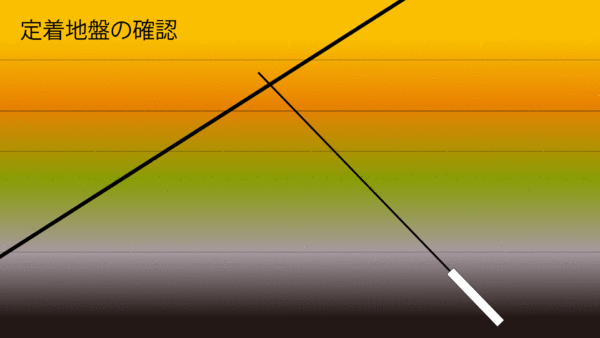
This is a cross-sectional view of the ground anchor's anchorage section.
Suppose we set the anchorage to the black areas in the soil type shown above.
The only way to collect soil samples from this site is through exploratory drilling.
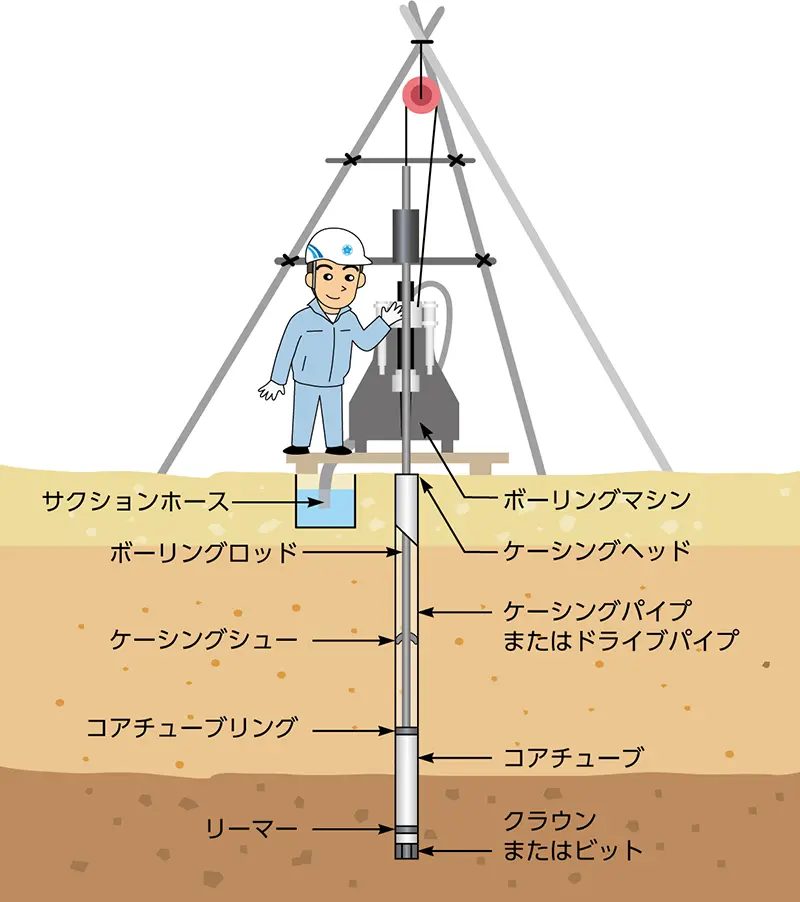
For example, if you use this rotary drilling machine to take samples at the same drilling angle as the ground anchor, you can verify the anchorage zone.
Other than that, it's basically not possible.
However, samples can be collected using a rotary percussion method as long as the direction is horizontal.
However, it seems that this is limited to roughly horizontal at best. (Going downward requires quite a bit of skill, depending on the condition of the slope.)
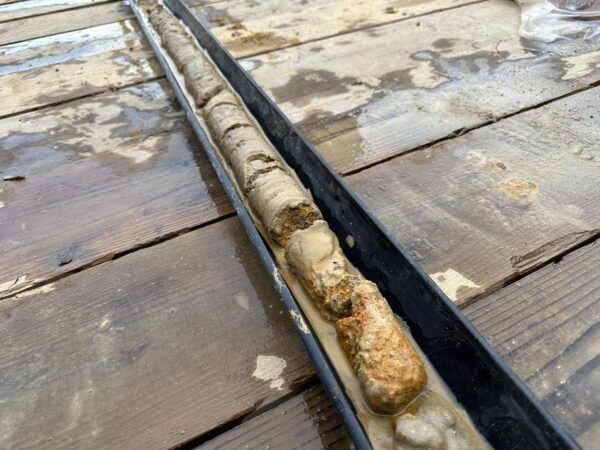
I Tried Core Drilling Using the Wireline Sampling Method!
Therefore, it is generally not possible to check the condition of the mounting section.
You can't rely on slimes at all, so don't trust them.
This is just a reference document that allows you to identify similar colors on a soil column diagram.
Can you tell by the hydraulic pressure of the core drill?
People say that, but that's a lie too, lol.
It's not exactly a lie, but when the drill crew has drilled a few holes, I can definitely tell by feel that the rock gets harder starting at XX meters.
However, since that's just a matter of personal perception, it's not very reliable.
It is true, though.
I'm adjusting the hydraulic pressure little by little as I work on it, so it's not consistent.
Just one small pebble can really change the feel of the drilling.
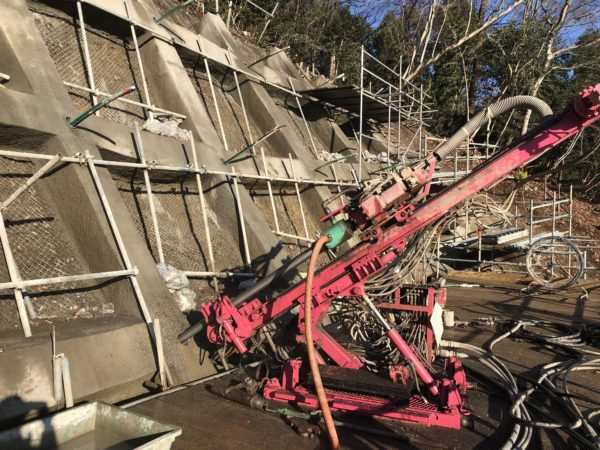
Going forward, as major companies move to automate their drilling machines, I believe the data collected during that process will prove valuable in the future.
I imagine you can't see anything yet.
After all, we’re just designing and drilling based on the design column diagram.
See you later.
The deadline is Friday, October 18, 2024.