

Hello, everyone.
This is Enta.
I imagine you’re doing things like centering (threading) with frame work—how do you go about it?
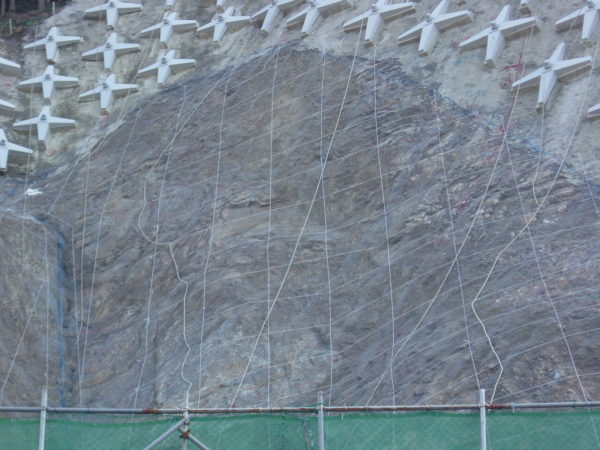
This is the standard method, but basically, you start by setting the vertical alignment.
For the vertical threads, stretch the thread vertically.
We recommend aligning this warp thread reference with the main measurement line, if possible.
The "main measurement line" refers to the section under consideration—that is, the section for which the design is being performed.
This generally corresponds to the standard cross-section shown in the drawings.
Please be aware that there are sometimes two or three of them.
If there are many cross-sections,The part with the largest cross-sectional areaThat's fine.
*The part with the largest cross-sectional area = the part with the longest slope length*

Basically, we use a laser rangefinder to determine the upper point (start of the survey line) and the lower point (end of the survey line) along the main survey line, and then set up the survey line.
Please take a good, close look at it.
What matters is whether it looks straight.
Even if you use a telephoto lens, depending on the mountain, the view might not be straight.
The most important thing about this centering process is,Does it look straight!?
Can you see it?!
The ultimate deciding factor is appearance!
Once you have established the main reference line (vertical), please extend it according to the design pitch.
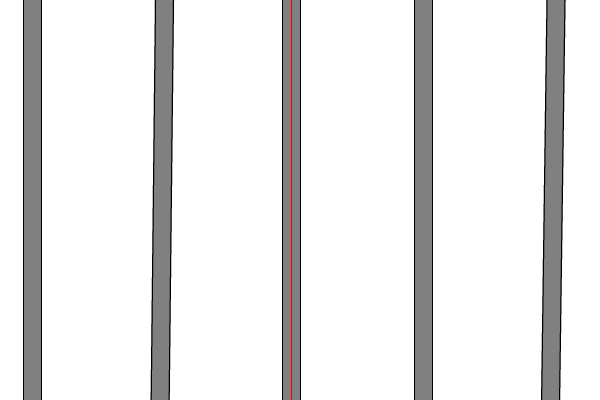
Please consider this red line in the middle to be the main measurement line.
It's fine to position the main measurement line in the center or at the edge of the frame.
Nothing will change structurally.
Does the picture above look a little off to you?
There are a few spots where I shook my head to the right once, and some parts where the pitch is slightly off.
If you’re already feeling this sense of unease, there’s a possibility that this legal framework won’t be established properly.
Since slopes are always uneven, situations like this happen quite often.
Even in situations like that, stand facing the string (vertical beam)Check to see if it looks straightPlease do so.
You might be thinking, “If you focus only on that, your pitch will go off!” but that’s just a small part of it.
That's fine.
In the end, the only thing they check during a legal inspection is the appearance!
As long as it looks good (i.e., the vertical and horizontal lines are neatly aligned), you’ll hardly ever get any complaints.
By the way, in all the inspections I’ve undergone so far, I’ve never been cited for the pitch of the legal framework. (Since there are tolerance limits and such, it’s definitely fine.)
But changing a 2-meter pitch to a 3-meter pitch just won't work, lol.
If you step back a bit and think, “The frames are lined up nicely!” then you’re probably good to go.
When it comes to legal frameworks, appearance matters!
There are also some tips for horizontal frames, but I'll save those for next time.
See you later.