Hello, everyone.
This is Enta.
The number of visitors is back to normal lol
I'm guessing that most of you reading this blog have a lot of bookmarks, so,
After the migration from Ameblo, it seems like everyone else migrated along with us.
I'm so happy!
Thank you so much!!
It was worth the effort to make the switch.
But that's beside the point.
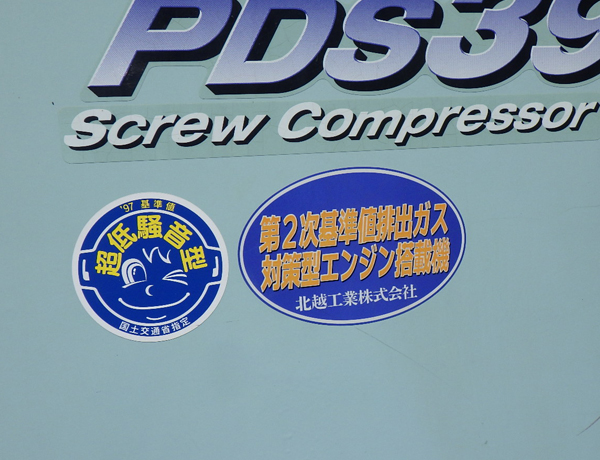
You've seen this before, haven't you?
For those whose main focus is management, this goes without saying, but,
This is a sticker indicating compliance with vehicle emissions regulations.
Well, it’s pretty much exactly what it says, but,
Regulating harmful substances, such as CO2 emissions in exhaust gasesSo that's what you're suggesting, right?
This is currently the fourth edition of the standards.
I think the machines you all actually use generally handle about the second or third stage.
Even our generator is only at the third-stage emission level.
The fourth generation will likely become mainstream in a few years.
So, what this all comes down to is,
Tier 1 Threshold Values (October 2003–) (Unit: g/kWh)
| Rated Output | NOx (nitrogen oxides) | HC (Hydrocarbons) | CO (carbon monoxide) | PM (Particulate Matter) | Black Smoke |
|---|---|---|---|---|---|
| 19 kW or more Less than 37 kW |
8.0 | 1.5 | 5.0 | 0.8 | 40% |
| 37 kW or more Less than 75 kW |
7.0 | 1.3 | 5.0 | 0.4 | 40% |
| 75 kW or more Less than 130 kW |
6.0 | 1.0 | 5.0 | 0.3 | 40% |
| 130 kW or more Less than 560 kW |
6.0 | 1.0 | 3.5 | 0.2 | 40% |
Secondary Standards (October 2006–) (Unit: g/kWh)
| Rated Output | NOx (nitrogen oxides) | HC (Hydrocarbons) | CO (carbon monoxide) | PM (Particulate Matter) | Black Smoke |
|---|---|---|---|---|---|
| 19 kW or more Less than 37 kW |
6.0 | 1.0 | 5.0 | 0.4 | 40% |
| 37 kW or more Less than 56 kW |
4.0 | 0.7 | 5.0 | 0.3 | 35% |
| 56 kW or more Less than 75 kW |
4.0 | 0.7 | 5.0 | 0.25 | 30% |
| 75 kW or more Less than 130 kW |
3.6 | 0.4 | 5.0 | 0.2 | 25% |
| 130 kW or more Less than 560 kW |
3.6 | 0.4 | 3.5 | 0.17 | 25% |
Third-Stage Standards (October 2011–) (Unit: g/kWh)
| Rated Output | NOx (nitrogen oxides) | HC (Hydrocarbons) | CO (carbon monoxide) | PM (Particulate Matter) | Black Smoke |
|---|---|---|---|---|---|
| 19 kW or more Less than 37 kW |
4.0 | 0.7 | 5.0 | 0.03 | 25% |
| 37 kW or more Less than 56 kW |
4.0 | 0.7 | 5.0 | 0.025 | 25% |
| 56 kW or more Less than 75 kW |
3.3 | 0.19 | 5.0 | 0.02 | 25% |
| 75 kW or more Less than 130 kW |
3.3 | 0.19 | 5.0 | 0.02 | 25% |
| 130 kW or more Less than 560 kW |
2.0 | 0.19 | 3.5 | 0.02 | 25% |
Fourth-Generation Standards (October 2014–) (Unit: g/kWh)
| Rated Output | NOx (nitrogen oxides) | HC (Hydrocarbons) | CO (carbon monoxide) | PM (Particulate Matter) | Black smoke (measured by opacimeter) m-1 |
|---|---|---|---|---|---|
| 19 kW or more Less than 37 kW |
4.0 | 0.7 | 5.0 | 0.03 | 0.50 |
| 37 kW or more Less than 56 kW |
4.0 | 0.7 | 5.0 | 0.025 | 0.50 |
| 56 kW or more Less than 75 kW |
0.4 | 0.19 | 5.0 | 0.02 | 0.50 |
| 75 kW or more Less than 130 kW |
0.4 | 0.19 | 5.0 | 0.02 | 0.50 |
| 130 kW or more Less than 560 kW |
0.4 | 0.19 | 3.5 | 0.02 | 0.50 |
So the machines are selected based on criteria like that, right?
This means that once you receive this certification, you’ll be able to use it in construction projects.
To put it another way, this means you can't use it without this certification.
For this certified machine, you can contact the manufacturer using the model number, type, chassis number, etc., to
You can see which certification it has received.
By the way, the engine type for the spray machine is not included.
It's fine to use it. (Setting aside safety concerns and the like.)
Some of the anchor drilling machines have been brought in, while others have not.
When buying used machinery, these are the points you should definitely keep in mind.
See you later.