

Hello, everyone.
This is Enta.
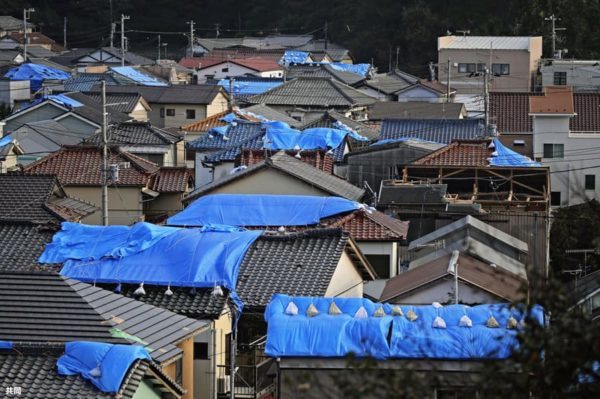
https://www.nikkei.com/article/DGXMZO50123410U9A920C1CC0000/
There was a discussion about repairing the roofs of homes belonging to people affected by the disaster.
The reason is that part of the roof has collapsed, and we want to take measures to prevent rainwater from getting in.
However, that requires manpower.
Given that it’s difficult to even find a contractor willing to do the repairs, what’s the best temporary solution?
As you can see in the photo, many of the roofs have blue tarps draped over them for the time being.
But this does raise concerns about the wind, doesn't it?
So, we’re placing sandbags as shown in the photo.
It's not that this method is necessarily bad.
There isn't a problem, but since blue tarps aren't very weather-resistant and tend to deteriorate quickly,
While some people may have to wait over a year for recovery, it was pointed out that blue tarps are unlikely to hold up.
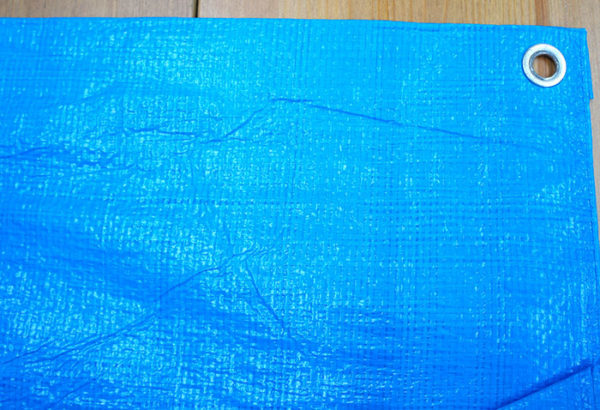
Most of us in the civil engineering field know this, but,
There are flimsy, cheap imported blue tarps and sturdy #3000 blue tarps.
There are certain standards for service life based on this thickness.
| Gauge | Thickness | Service Life |
|---|---|---|
| #3400 | Approximately 0.28 mm | Approximately 10 to 16 months |
| #3000 | Approximately 0.26 mm | Approximately 9 to 12 months |
| #2500 | Approximately 0.19 mm | About 7 to 9 months |
| #2200 | Approximately 0.17 mm | About 5 to 7 months |
| #2000 | Approximately 0.15 mm | Approximately 3 to 6 months |
| #1500 | Approximately 0.13 mm | About one month |
| #1100 | Approximately 0.10 mm | About one month |
Reference: https://www.kensetsu-shizai.com/
Basically, if you use the No. 3000, it will last for nearly a year.
However, for now, let's factor in safety here.
It's a double-layer of 3000-series.
This is because, as public works contractors, we stretch blue tarps across slopes (cliffs) in cases of landslides or mudslides, or as a preventive measure.
Since the government's plans may be more than a year away, we use two sheets stacked together in such cases.
By doing so, we ensure safety in the event of rain.
Next up is dealing with the wind.
Since blue tarps are easily blown away by the wind, people often place sandbags next to them, don't they?
While that’s certainly an effective measure, if possible, I’d also recommend using a green net.
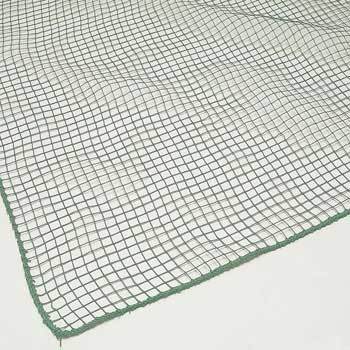
You know those green nets you often see at golf courses and places like that.
Place this on top of the blue tarp.
The reason is that, with a blue tarp and sandbags, the weight of each sandbag is transferred to only one point.
For example, place four sandbags at the corners of a 1-meter-by-1-meter sheet.
If a sudden gust of wind blows into the center, the center could be pushed upward, causing the sandbags to come loose.
Let's say we drape a green net over this and place sandbags on top.
Even if wind blows through the center, the force is distributed across the net, so it can be mitigated to some extent.
This is actually quite common in civil engineering when it comes to typhoon preparedness.
We use the net to distribute the force.
Think of it as covering a larger area rather than focusing on a single point.
This is what it looks like when you apply this concept to houses and other structures.
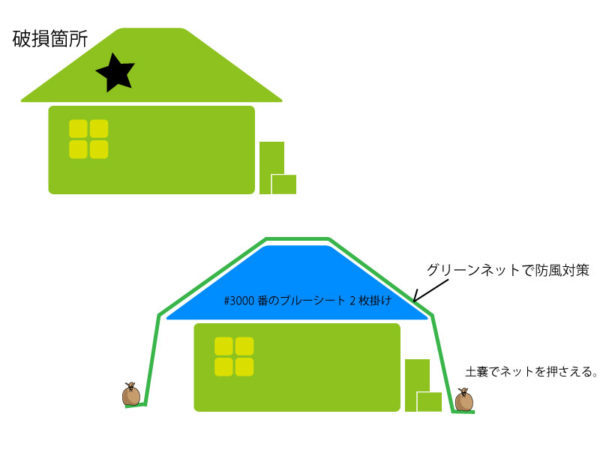
Here's what it looks like when you zoom in a bit.
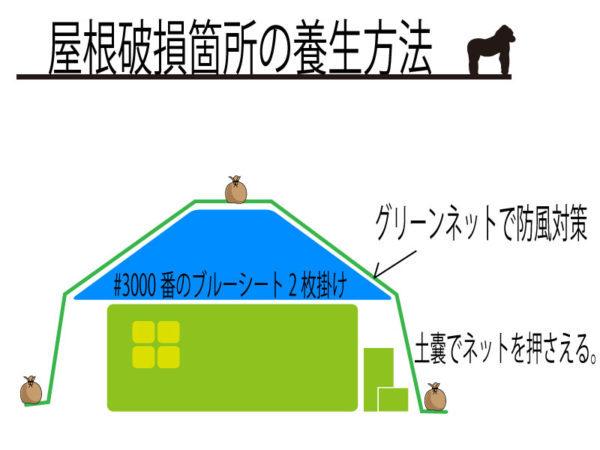
Please cover the areas that aren't damaged as well.
The reason is that if one part is damaged, there is a possibility that other parts are also damaged.
It’s safer to do the job right the first time than to carry out temporary repairs over and over again. (I’m writing this with the ultimate goal of a permanent repair in mind.)
Here’s a tip for hanging two blue tarps:
Align the four corners and tie them together with a rope or similar material. (Wire, twine, zip ties, etc., are also acceptable.)
It's definitely best if the two pieces don't shift.
Cover the roof with a tarp. (It would be best to focus on the damaged areas, if possible.)
We'll stretch a green net over it.
If possible, it would be even better to join the green netting and blue tarp together using grommets or similar fasteners. (Don't worry about the grommets' strength.)
If the green netting reaches the ground, please place sandbags or similar items there.
The tighter you stretch the green netting, the more weight will be placed on the blue tarp.
Although the illustration above shows sandbags on the roof, they are not required.
I'd say that, if there are two of you, it would probably take about half a day to clean one house.
And now, let's talk about money. (All information sourced from the internet.)
Cost of Materials
Requirements: Two layers of blue tarps (10 m × 10 m), 100 m²; two green nets (10 m × 5 m)
2 blue tarps = 8,000 yen × 2 = 16,000
2 Green Nets = 7,000 yen × 2 = 14,000
Total = 30,000 yen (includes materials and shipping)
Labor costs (Since the work is actually completed in half a day, this amount includes costs for planning and safety equipment.)
Starting at 25,000 yen per person
2 people × 25,000 yen = 50,000 yen
If you add the above together,
80,000 yen per household (for the entire roof of the house)(Price per 100 m²)
Miscellaneous Expenses: 20%
= 80,000 yen × 1.2 ≈ 96,000 yen
Per square meter (960 yen/m²)
Labor costs: 500 yen/m²
Material cost: 520 yen/m²
Overhead: 20% (labor costs)
Approximately 110,000 yen for the entire roof of a house (per 100 square meters)In that case
I think that's a reasonable price.
*Please note that there may be slight variations depending on the number of sandbags.
*If you install the green netting only in certain areas (just the damaged sections), you can keep the cost down.
*The cost will be lower if the affected area is smaller.
*If material costs are cut in half and the area per square meter is reduced, the amount of labor required will also decrease, so the labor rate per square meter could drop to around 20,000.
If you're preparing a temporary structure for a typhoon, this method is very effective (when done correctly).
This is a temporary method commonly used at civil engineering sites. (Although it does require quite a few sandbags.)
It's definitely worth a try, but please do so at your own risk.
See you later.
*Please note that the measures described in the article above are strictly limited to civil engineering projects. It is unclear whether they would be effective for every home.
While this is an effective method, please proceed at your own risk.
I assume no responsibility whatsoever. Please be advised.

Construction Protection Netting, 5 m × 10 m, 25 mm Mesh, Green Netting, Fall Prevention