

Hello, everyone.
This is Enta.
It really feels like the end of the fiscal year!
Things have been pretty hectic.

The quote is running a little late... lol
That said, since I’ve already submitted the safety documents before getting the quote, they tell me to go ahead and get everything ready lol
It's kind of like, "Oh, oh..." (laughs)
My older seniors, whom I've known for a long time, are basically ordering me to "Just do it!"
Thank you. I'll do my very best!
When I say that, they're like, "Enough with the excuses—just do it!" lol
My senior is so strict!! lol
But that's beside the point.
The height of the ground level is higher than the drilling location.
This is a common question regarding the location of the ground support when drilling with a crawler-type rotary percussion drill.
"How many centimeters below the drilling position should I go?"
Actually, when drilling with a crawler-type rotary percussion drill, the position shown above is ideal!
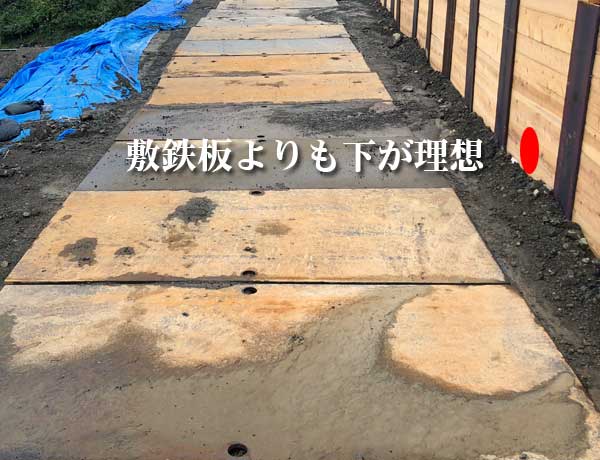
If possible, it would be easier to work on the area shown in red in the photo if it were lowered a little more.
At the very least, it's a wash.
When the ground level is lower than the drilling location, it’s really difficult to connect the casing sections.
No matter how many machines I defeat, I often end up having to stand on tiptoes, so please place them as low as possible.
And there are also drawbacks to placing it at the bottom.
Drilling fluid accumulates at the drilling site, making it incredibly soggy.
Therefore, as a countermeasure, we would like you to install an open-cut ditch.
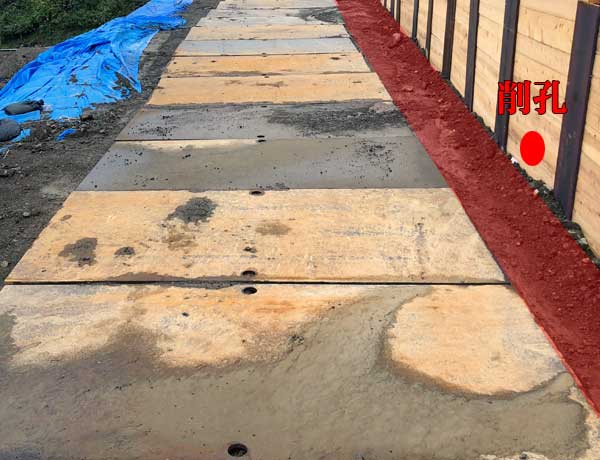
The light red area is the unlined ditch.
If it's about 50 cm wide and slopes in a consistent direction, that would be perfect.
If a large hole is drilled at the far end, the drilling fluid will accumulate there.
It will be absorbed naturally.
As long as you minimize the release of grout slurry, you shouldn't have any issues with hexavalent chromium or pH levels.
Please return the grout wash water and other similar fluids for treatment.
See you later.