Hello, everyone.
This is Enta.
Part 1: Daily and Monthly Pay Systems、In Part 2, there are three pay options for artisans to choose fromI wrote about that.
This time, we're taking it one step further.
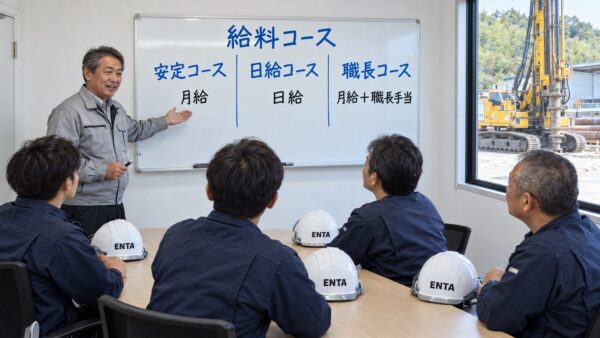
What exactly are companies paying their craftsmen for?
Number of days worked. Qualifications. Responsibilities as a foreman.
Of course, they're all important.
But just because construction is halted due to rain doesn't mean that person's skills disappear, does it?
So, I’d like to explore the idea of a “craftsman subscription service.”
This is not the official name of the compensation system; rather, it is intended to ensure that skilled personnel and a construction workforce are available throughout the year.
Even if work on the job site is halted by rain, the craftsmen’s skills won’t disappear.
For example, imagine a situation where you hear an unusual sound while drilling.
Someone who notices an anomaly and stops it. Someone who organizes the points that need to be checked. Someone who explains to junior staff why they stopped it.
Shouldn't this kind of work be factored into salary evaluations? (Well, I guess I'm getting a little too nitpicky here, lol.)
If you only count the amount of work completed, the time the machinery was idle doesn't easily show up as a result.
But perhaps it makes more sense for the company to evaluate those decisions and the training as well.
The same goes for organizing the warehouse, checking supplies, and making arrangements for the next job site.
We assign tasks for days when employees aren’t on-site and have them complete them within their scheduled work hours. This way, we turn rainy days into opportunities to maintain their skills.
Of course, it’s not as if everything will be solved just by providing a job.
The company needs to plan its annual workload and labor costs. Should we consider how to structure salary payments with all of that in mind?
So, if you decide in advance what needs to be done even on rainy days, it makes it easier to hire people, huh? lol
How Weather Risks Are Categorized: A Look at Overseas Systems
From what I've found, there were systems in place overseas as well to offset revenue losses caused by weather.
According to the working conditions regulations for the construction and civil engineering sectors published by the Australian Fair Work Ombudsman, when work cannot be performed at any location due to inclement weather, regarding regular working hours:Up to 32 hours over 4 weeksApparently, there is a provision requiring payment.
However, there are specific fields of application and conditions set forth in Article 24, so this does not apply unconditionally to all construction workers.
Separate provisions are also in place regarding mid-year hires and part-time work.
According to information from the Federal Employment Agency, there is a “seasonal short-time work benefit” available for industries such as construction to compensate for wage reductions resulting from temporary and unavoidable declines in work volume from December through March. This program is also subject to certain requirements regarding the business and employment.
That doesn't mean you should just bring it to Japan as is.
What I’d like to highlight is the mindset of not treating the risk of work coming to a halt as a problem that affects just a single craftsman. (I wrote about this in Part 2.)
It should be noted that even in Japan, it cannot be uniformly determined that “if it rains, both wages and allowances are zero.”
According to the Ministry of Health, Labor and Welfare, when work is suspended for reasons attributable to the employer, employees must be paid a suspension allowance equal to at least 60 percent of their average wages. Regarding the treatment of work suspensions due to rain, it is necessary to confirm the specific circumstances of the suspension and the terms of the employment contract.
Whether or not you say, "I don't know about that!" about this part really shows what kind of business leader you are... lol
Structuring Salaries in the Construction Industry Using Base Pay, Skill-Based Pay, and Performance-Based Pay
What follows are my personal thoughts.
We categorize salaries into the following four types, not just daily or monthly pay.
| The Salary Section | Items to Be Evaluated | Approach to Payments |
|---|---|---|
| Base Salary | Continuing to perform the assigned duties | Fixed Monthly Fee |
| Skill- and Responsibility-Based Pay | Skills, Certifications, Foremen, Training Coordinators | Fixed Allowances Based on Position and Grade |
| On-Site Performance-Based Pay | Contributions to Quality, Work Planning, and Improvement | Varies depending on the conditions set in advance |
| Profit Sharing | Company-wide Results | Bonuses Based on Performance and Company Policies |
You can plan your monthly budget based on your base salary, and the fixed portion will increase as you acquire new skills and take on more responsibility. Additionally, you’ll receive a bonus if you achieve results.
Here's the combination.
For example, if the base salary is 280,000 yen, the skill allowance is 30,000 yen, and the foreman’s allowance is 30,000 yen, the fixed portion totals 340,000 yen per month. In months when a performance-based bonus of 20,000 yen is paid, the total is 360,000 yen.
We’ll distribute that profit share on a flat-rate basis annually, starting the following fiscal year, in the form of a subscription. Alternatively, starting the following month, we’ll pay out approximately 10% of the profit each month as a subscription based on the number of months worked on-site.
I was thinking, “Maybe it would be a little easier on the company if we paid out the profits over several months instead of all at once?”...

・・・・・・
・・・・・・・・・・
・・・・・・・・・・・・・・・
・・・・・・・・・・・・・・・・・・
・・・・・・・・・・・・・・・・・・・・・
Actually...
I actually wrote even more than this!
Like the examples above: "Just do this," "Just do that."
Wouldn't this make it even better?
Maybe the craftsmen will get motivated and really give it their all?
I wrote down a bunch of ideas, but I deleted them all!!!!
No way!
No way!
As I'm writing this, I'm wondering, "Who's in charge of this, anyway?"
If we go into that much detail, who's going to manage it all?
We're already short-staffed as it is.
Anyone can write theoretical musings!
But in reality, it's impossible.
I think a success-based fee structure is a good idea, don't you?
However, in reality, there are good work sites and bad ones. You can’t judge them all the same way.
Skilled craftsmen tend to end up working on difficult jobs.
That would create a sense of unfairness.
And above all, if we adopt a success-based compensation system on a per-site basis, we’ll conduct monthly financial closings and calculate profit margins for every aspect of the business.
It's tough for small construction companies, and there's no way I'd do that lol.
We only check the overall profit here, too. (We just get a rough idea of each site, lol.)

In the end, the current design is the simplest.
Daily wage system, daily-wage-to-monthly-salary system, monthly salary system
Whether it's every year or once every three years, we have to redraft the contract every time we want to make a change.
We'll decide after reaching an agreement.
You can easily create it by setting a unit price based on an annual income of around 5 million yen and simply allocating that amount, and
I think these three payment methods are the ones that let you make a decision without having to do any tedious calculations.
Assuming an annual salary of 5 million yen and a standard company with two days off per week, we will compare three types of pay structures: monthly salary, daily wage, and a combination of daily and monthly pay.
1. Calculation Conditions
-
Annual Income: 5 million yen (including tax, gross)
-
Two days off per week (Saturdays and Sundays)
-
Number of working days per year: 260 (52 weeks × 5 days, excluding holidays and paid leave)
-
Bonus: None (Annual salary is paid over 12 months)
-
Overtime Pay and Various Allowances: None
| Pay System | Monthly Salary (Gross) |
|---|---|
| ① Fixed monthly salary system | 416,667 yen |
| ② Daily Wage System | 384,615–423,077 yen |
| ③ Daily and Monthly Pay System | 317,461–416,667 yen |
*Calculated based on an annual income of 5 million yen, no bonuses, and 260 working days per year.
*The daily wage applies when working 20 to 22 days per month.
*The daily-to-monthly pay system applies when there are 0 to 5 days of absence out of the 21 scheduled working days per month.
*The method for calculating deductions for absences varies by company.
*This figure does not include compensation for public holidays, paid time off, or days off due to rain, nor does it include overtime pay.
*All amounts are before taxes and social insurance premiums.
It's a simple calculation.
I think a fixed monthly salary system offers better value.
If the number of working days per month increases, it’s quite likely that ② and ③ will also increase.
However, when you factor in annual precipitation probabilities and natural disasters, I think you’ll see that, in the end, a monthly salary is actually the safer option.
Although, there's a chance I might lose some freedom... lol
That is, if we imagine a craftsman as a free spirit, lol
By the way, our company uses an annual salary system.
Especially for more experienced employees, the pay is typically based on an annual salary, with overtime and business trips adding to that amount, so it does end up being ↑↑↑↑↑↑ higher than the initial figure.
If I just think about which payment method is better, I still think a monthly salary is better.
As long as you’re employed by a company, it goes without saying that you have to follow certain rules, but as long as you stick to them, salaried workers in the construction industry are very fortunate and well-treated.
From a modern perspective, I wonder if companies tend to pay people on a daily wage basis when it comes to those who are risk-averse?
See you later.
A pay stub from 30 years ago for a slope construction supervisor!

![Will “Craftsman Subscription” Change Salaries in the Construction Industry? Examining Fixed Salaries, Skill-Based Pay, and Performance-Based Pay [Part 3]](https://norimen.net/wordpress/wp-content/uploads/2026/10/8a3ec972ee9f25ca49037b908efbc485.jpg)