Hello, everyone.
This is Enta.
I was actually planning to write about how to set up a zabuton frame.
I'm sure some of you are thinking, "Is this still going on?" But after the money comes the construction (lol).
No matter what anyone says, there’s this absolutely outrageous contractor—or is it a foreman? Well, it’s pretty much a foreman.
A while back, I saw a segment on *Zabuton* that was really bad, so I told the director, “This isn’t good, is it?”
But the director told me, "This is good enough," in a kind of irritated tone lol
I guess the construction company is probably just being a little cocky.
He was a pretty old director, but this is exactly what you’d call a “toxic old man.”
The young craftsmen working on the site seemed to be building a zabuton frame for the first time...
Anyway, it really didn't live up to the "zabuton" concept. Even though it had a set direction, it was pointing all over the place.
It's a pitiful sight.
To prevent that from happening, I think it’s best for someone who knows how to do it to explain it, so I’ll write down how to set up the zabuton frame.
Also, about next time... (lol)

But that's beside the point.
Have you heard of a catch basin?
It’s read as “shūsui seikō.”
It’s not something slope engineers are very familiar with, but for anchor contractors and drilling contractors, it comes up every now and then, doesn’t it?
To be honest, I haven't actually done much construction work myself, but I have served as a site representative for general contractor projects on two occasions in a construction management capacity.
So, I guess the one thing I really understand is money (cost estimation), huh? (lol)
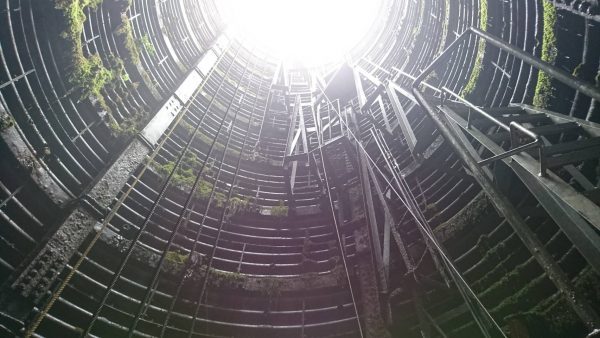
That said, since the drilling process is the same, it’s not really something to worry about, but I don’t have the tools I need for a small collection well.
As they say, "Leave it to the experts"—people who specialize in collection wells really do have a wide range of expertise, don't they?
We've got quite a collection ourselves, though.
When someone asks, “What is a collection well?” a simple explanation is that it is used to efficiently collect spring water in landslide-prone areas,
This refers to a facility in which a vertical well is dug, followed by horizontal drilling, to collect water in a single location and drain it.
The well is approximately 3.5 meters in diameter, and a water collection borehole will be drilled inside it.
We will drill water collection boreholes on the mountain side and drainage boreholes on the river side.
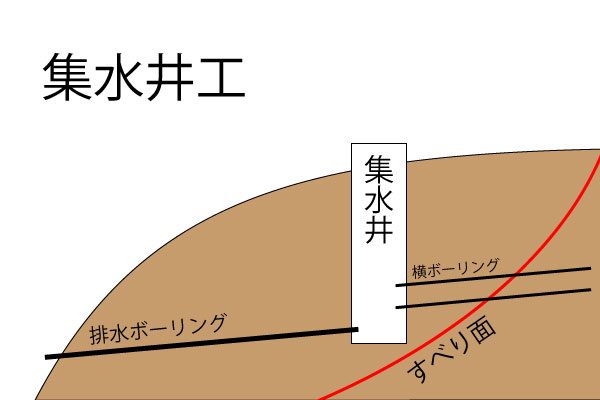
It looks something like this.
The depth of a catch well varies depending on the region and location, but I’ve heard that they can be as shallow as about 10 meters or as deep as over 30 meters.
Based on my own experience, I've only ever done it in shallow water, around 15 meters deep.
I think it must be pretty tough when things get complicated.
Are you referring to hydraulic hoses in particular?
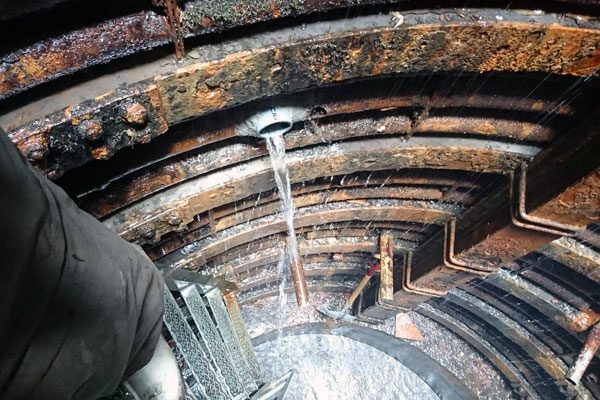
If horizontal drilling hits the right spot, it can produce an incredible amount of water.
Since we went to all that trouble to drill the holes, I really hope we get a lot out of it, right? (lol)
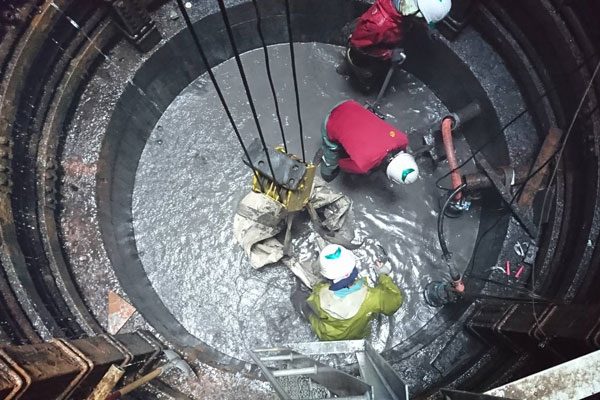
Once drilling is complete, the final step is to remove the drilling slurry.
They are loaded into drums or flexible containers and removed by crane.
We do this kind of work even in places you don't usually see (lol)
This is what a catch well looks like.
Going forward, we’d like to focus more on drilling for these types of projects, so we’re hoping to expand our machinery a bit further.
See you later.