Hello, everyone—especially those of you who aren't involved in slope construction.
This is Enta.
There sure aren't many construction contracts being awarded!
What's going on? With public works projects...
Seriously, if things keep going like this, I think there’ll be a string of bankruptcies.
Also, since the minimum wage has gone up, companies that employ technical interns at the minimum wage should be careful.

But that's beside the point.
This time, I’m writing this not for slope contractors, but for people who aren’t general contractors.
Pros, feel free to skip this one lol
The term “slope” that we in the industry use is a general term for a cliff.
Or rather, "cliff" is the general term, and "slope" is the specific term.
"Cliff" is the correct term, isn't it?
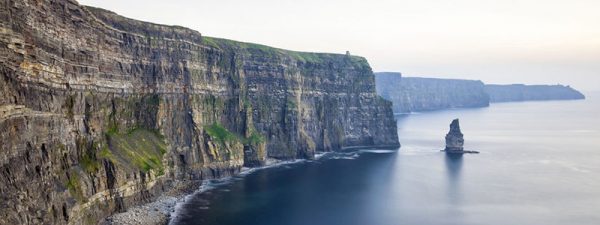
This is a cliff, too.
That's a cliff with a spectacular view.
People often ask me, “Is the cliff near my house going to collapse?”
So, basically, IEven a cliff that has never collapsed before will eventually collapse....is what they say.
I believe that, fundamentally, there is no cliff that won't collapse.
If certain factors come into play, it could collapse at any time.
Is the probability of collapse 10%, 60%, or 80%?? I don't know, though.
The recent heavy rains in western Japan have caused landslides on mountains that had never collapsed before.
As seen on TV, the mountains where construction work—such as the installation of retaining walls—has been completed have remained largely intact.
The reason is that the slopes we, as slope contractors, work on are often actually there to protect the surfaces of mountains that have already collapsed.
The chances of slipping are pretty low by now, lol
The reason it's so low is that it's already collapsed, so there's nothing left to collapse, but they're still putting up formwork and stuff, lol.
This means the likelihood of it slipping after installation is extremely low. (We also apply pressure to the embankment using support frames and other methods.)
Cut slopes are a separate matter. (This refers to the slopes on either side of a highway, for example.)
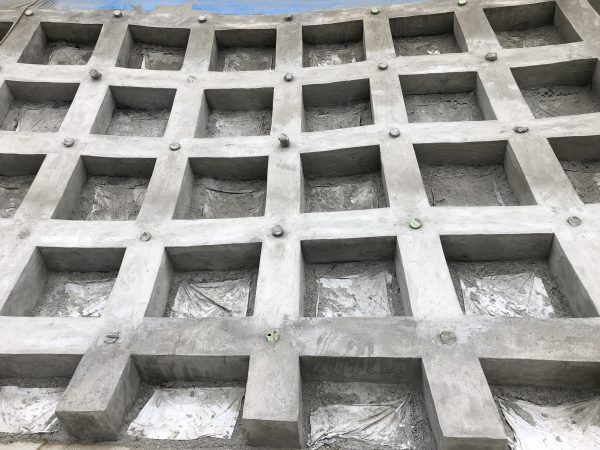
If the hill behind your house hadn't collapsed long ago, and
If the mountains on either side have collapsed, there is a high probability that the mountain behind you will be the next to collapse.

Even if two cliffs are exactly the same, the one that’s prone to collapse is the one where parts of it eventually crumble.
So, what should we do about it?
When people ask me that, the simplest answer I can give is, “I’ll just move.” lol
This would be ideal, but it doesn't quite work out that way.
Generally speaking, when a cliff behind a private home collapses, it is usually what is known as a surface collapse.
Surface collapse occurs when the mountain itself becomes saturated by rain or other factors (absorbing a large amount of water and losing all air), and
This is a phenomenon in which water lifts and washes away the soil and sediment on the surface of a mountain, causing it to collapse.
Therefore, although it occurs at a relatively shallow depth, it’s only natural that houses collapse because they are vulnerable to lateral loads.
Houses may be sturdy enough to withstand tremors like earthquakes, but they’re vulnerable to impacts coming directly from the side.
It feels like the house is buckling.
Simply put, as long as you avoid saturation, draining the water (to an unsaturated state) is the best approach.
Furthermore, if appropriate reinforcements are added, the likelihood of collapse will be significantly reduced.
Since I've been getting a lot of questions like this lately, I decided to write this for the general public, but please keep in mind that this is just an example.
That’s because I can’t really tell for sure without checking the size of the mountain and the condition of the topsoil, and,
The reality is that there are very few things that are clear to begin with.
Even regarding the cliffs that we, as slope contractors, typically work on, we don’t have a clear understanding of them.
It's just that I'm quantifying my experience, and I figure this much should be enough.
They say the safety factor is 1.2 times, but there are actually some aspects of this that make you wonder...
During the design process, we also draw what’s called a “projected skid line”—this mysterious line that indicates where the car might skid—but honestly, I’m not entirely sure what the point of it is.
I can't design it without drawing this line, lol.
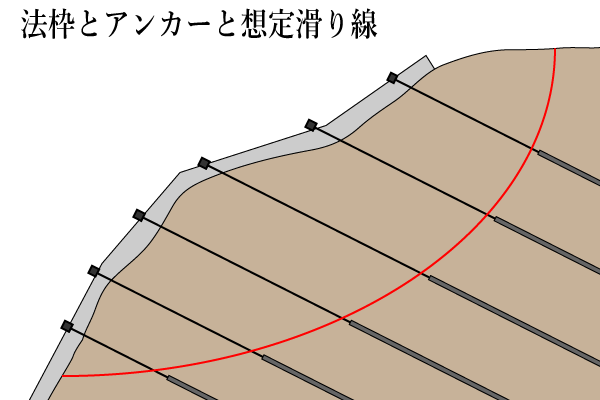
That's just how ambiguous this world is.
However,One thing I can say for sure is that there’s no mountain that won’t crumble.That's it.
There's a chance you could slide down the hill behind your house, too.
However, while I think it should be fine as long as the slope is 30 degrees or less, the risk isn't zero.
Lately, even the dry-stone walls have been crumbling left and right, and even the L-shaped retaining walls are breaking, lol.
The causes include changes in rainfall patterns compared to the past and aging infrastructure.
There’s nothing we can do about this, but we still need to repair and reinforce these structures to ensure our survival and prevent them from becoming a hazard!
If you're concerned about the hill behind your house,
Please have a slope stabilization specialist (not a general contractor—a company capable of design and survey work) take a look at it.
Also, it's best to have at least two or three companies take a look at it.
And steer clear of salespeople who rush you or try to make you anxious. They’re probably just amateurs, lol.
I recommend choosing a place that can thoroughly explain in detail why things turn out this way and why this construction method is the best.
These days, it’s a good idea to consider hiring a contractor just to get a second opinion.
See you later.