Hello, everyone.
This is Enta.
What Is Cement-Water Mix Design? | A W/C Ratio of 50% Is the Standard for Slope Construction
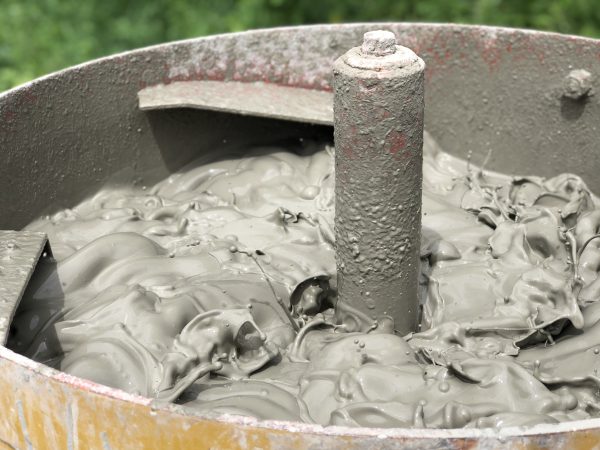
To begin with, what is cement milk?A paste-like grout made by mixing cement powder and waterThis refers to the use of grout in slope stabilization projects—specifically in ground anchor work, rock bolting, and rebar insertion—where it is injected into drilled holes to secure anchors or rebar to the natural ground.
The key to the formula isW/C Ratio (Water-to-Cement Ratio). This is expressed as “mass of water ÷ mass of cement.”
- The W/C ratio isSmallWith less water, it produces a firmer, high-strength cement slurry.
- The W/C ratio isLargeThe more water there is, the better the workability, but the strength decreases.
In slope stabilization projects involving ground anchors and rock bolts,W/C=50%is widely used as a standard mix design (NEXCO Design Guidelines, Japan Geotechnical Society’s “Design and Construction Standards for Ground Anchors,” etc.). To make the mixture stiffer, adjust the W/C ratio within the range of 40–45:%; to make it softer, adjust it within the range of 55–60:%.
I received a question the other day asking, “What’s the basis for the 1,230 kg per cubic meter figure for cement slurry?”
It's always been like this, so I never really thought about it lol
There’s a solid basis for using sprayed sand, but I’ve never seen cement slurry, have I?
Basis for the Calculation of 1 m³ = 1,230 kg | Derived from the Specific Gravity of Cement (3.15)
The figure “1,230 kg of cement slurry per 1 m³” is a number that comes up all the time in industry cost estimates, but surprisingly, a lot of people can’t actually explain where it comes from when asked, lol.
The trick isThe specific gravity (density) of ordinary Portland cement is approximately 3.15This stems from the fact that a specific gravity of 3.15 is a representative value used as a standard in JIS R 5201 (Methods of Physical Testing for Cement).
Here is the calculation for the amount of cement required to make 1 m³ (= 1,000 L) of cement slurry, based on a W/C ratio of 50:1 and a TP3T mix.
| Calculation Steps | 式 | Results |
|---|---|---|
| ① Target Volume | Volume of cement + volume of water = 1,000 L | — |
| ② W/C=50% | Water mass = 0.5 × Cement mass (C) | — |
| ③ Cement Volume | C ÷ 3.15 | L |
| ④ Water Volume | 0.5C ÷ 1.0 | L |
| ⑤ Coalition | C/3.15 + 0.5C = 1,000 | C(0.3175 + 0.5) = 1,000 |
| ⑥ Solve for C | C = 1,000 ÷ 0.8175 | 約1,223 kg |
| ⑦ Rounding Up | Round to the value used for calculation | 1,230 kg |
In other words, “Strictly speaking, it’s somewhere between 1,223 kg and 1,225 kg, but we rounded it up to 1,230 kg to make it easier to use in calculations,” which isThe Truth Behind the 1,230 kg. Back in the day, this derivation used to be routinely included in formulation tables and design documents, but at some point, it just became “that 1,230 kg figure”—the kind of thing where only the number remains.
So, let's do the math and see...
Conditions: ordinary cement, W/C = 50%
When this is the case,
Ordinary cement, specific gravity 3.15
Ordinary cement: 1,230 kg ÷ 3.15 = 390.5 L
Water: 1,230 kg × 501 TP3T = 615 L
390.5 + 615 = 1,005.5 L / 1 m³
To be exact, it's 1,225 kg, but should we round it up to 1,230 kg?
To be honest, this is about all I can think of—does anyone know anything about this?
I would appreciate it if you could let me know.
Back in the day, there used to be plenty of supporting evidence in books.
Before we knew it, it had disappeared through a process of constant simplification.
Back in the day, it was a hassle to figure things out based on loss rates and such, but now I’d actually like to have that feature, lol.
Digitalization has its pros and cons, doesn't it...
Practical Mix Design Calculations | Quick Reference Table by Water-to-Cement Ratio
In actual field conditions, a W/C ratio of 50% is often not sufficient. Fine adjustments are necessary based on the condition of the natural ground, injection pressure, the length of the anchor, and the season (air temperature). Commonly used W/C ratios include:Amount of cement and water required per 1 m³I'll put this in a quick reference chart.
| W/C ratio | Amount of Cement (per 1 m³) | Water Volume (per 1 m³) | Total Mass (Specific Gravity) | Main Uses |
|---|---|---|---|---|
| 40% | Approximately 1,398 kg | Approximately 559 kg | Approximately 1,957 kg/m³ | If you want to achieve high strength, set the fixing unit to a firmer setting. |
| 45% | Approximately 1,313 kg | Approximately 591 kg | Approximately 1,904 kg/m³ | Slightly firmer than standard; suitable for cold weather, etc. |
| 50% (Standard) | 約1,230 kg | 約615 kg | Approximately 1,845 kg/m³ | Standard Mix Proportions for Ground Anchors and Rock Bolts |
| 55% | Approximately 1,159 kg | Approximately 637 kg | Approximately 1,796 kg/m³ | If you want to improve injectability, use a long rod, etc. |
| 60% | Approximately 1,094 kg | Approximately 656 kg | Approximately 1,750 kg/m³ | Relatively soft; used as a grout material for soil improvement, etc. |
*The above figures are calculated using ordinary Portland cement (specific gravity 3.15) as a theoretical value per 1 m³, without accounting for wastage. In actual quantity takeoff, thisLoss Rate (approximately 5–101 TP3T)will be added on top of that.
For a practical method of calculating cement slurry that takes loss rates into account, see a separate article.How to Calculate Cement Slurry and the Loss RateI've summarized them here.
At our construction site, when we change the mix design, the values specified in the design documents (water-to-cement ratio) are the primary consideration, but within that range,"Rate of increase in injection pressure," "curing status of the anchor," "curing rate as a function of temperature"I'll make fine adjustments while keeping these three points in mind. It's all based on rules of thumb, but this is"Anchor That Holds Tight"Since this is what distinguishes it from an “anchor that leaves you feeling a little uneasy,” the blend is something you shouldn’t underestimate.
👉 Related Article: A Comprehensive Guide to Formula Calculations is Calculating Cement-Water Mix Proportions | A Slope Engineer Explains Quick Reference Tables by W/C Ratio and How to Determine Proportions on Site This document compiles everything, including a quick reference chart for W/C ratios ranging from 40 to 60 and TP3T.
See you later.