Hello, everyone.
This is Enta.
Speaking of health tips again—what exactly is briquette coal?
Since that came up, I thought I'd give it a try.
Here is the briquettes we use on site.
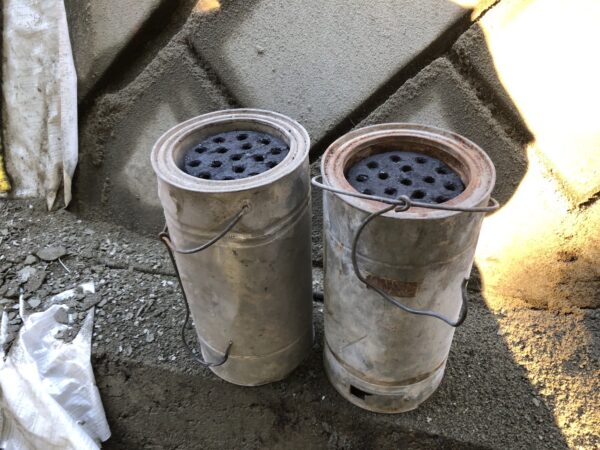
We burn briquettes inside this cylinder.
What exactly is briquette coal, anyway?
So, to put it simply...
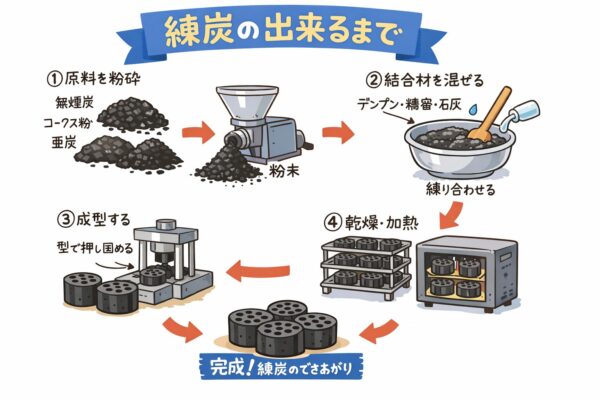
It's made by grinding anthracite, coke, and lignite into a powder, adding a binder, and molding it, isn't it?
Its distinctive feature is the hole in the center, which allows it to continue burning while maintaining a constant temperature for a long time.
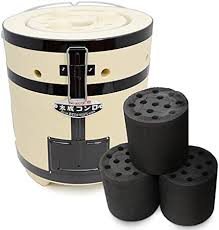
Generally, briquettes are used to roast mochi or for heating, but in cold regions and during the winter, they are used for convalescence.
You can adjust the burning time by adjusting the vents at the bottom.
Ventilation openings fully open: About 6 to 7 hours
Vent half-open: About 12 to 14 hours
Assuming that the winter spraying is finished by 4:00 p.m., we’ll cover the entire area with blue tarps.
Then, place the briquettes underneath.
The idea is to keep it burning as much as possible during the coldest hours of the day to maintain the surrounding temperature to some extent.
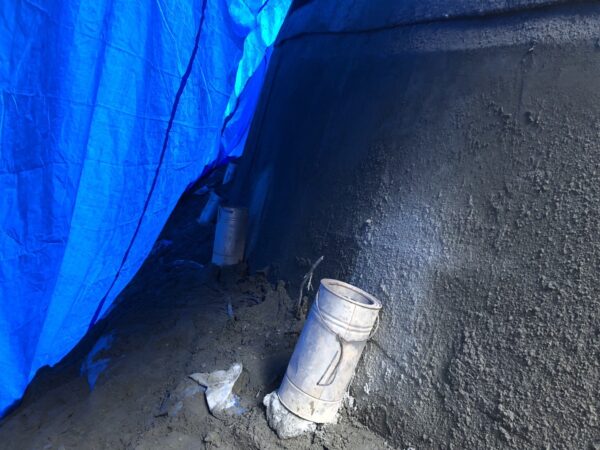
This site is in a part of Nagano Prefecture where it gets pretty cold—temperatures drop to nearly minus 10 degrees—but by burning briquettes, the temperature never drops below zero.
Once it gets past 8:00 a.m., the temperature will gradually rise, so you’ll want to keep it for at least 12 hours or so, right?
Assuming the initial curing takes about 6 hours, the surface will harden within 6 hours after spraying, provided the temperature is high enough.
If you place briquettes primarily in the areas where the spray was applied that day, it’s a very effective way to protect the surface during the winter.
However, since there is a risk of fire, it is also important to secure the sheet firmly and take precautions to avoid touching the briquettes.
It’s even safer to secure the sheet while also protecting the area around the briquettes.
Let's make sure to take good care of ourselves from now on!
See you later.