

Hello, everyone.
This is Enta.
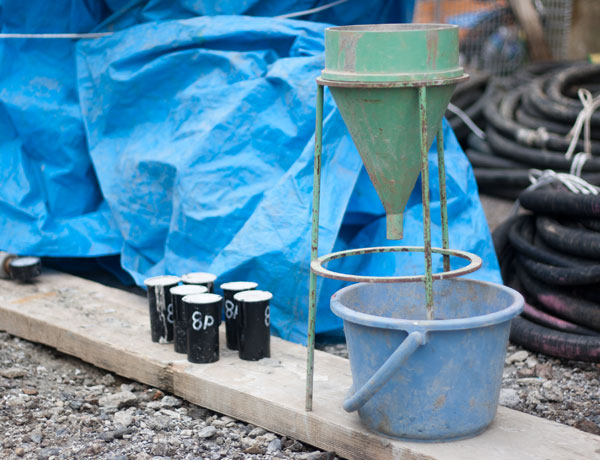
Do you know how flow tests are conducted?
Since there are actually quite a few people who don't know this, I'll explain it.
However, I think a video would probably make this easier to understand.
That said, I can't take a picture right away, so I'll just describe it in words this time lol
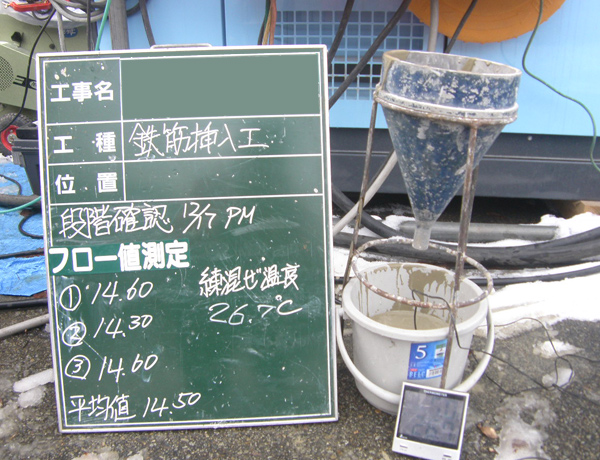
This is what a flow cone for cement slurry looks like, right?
When you look down from above,
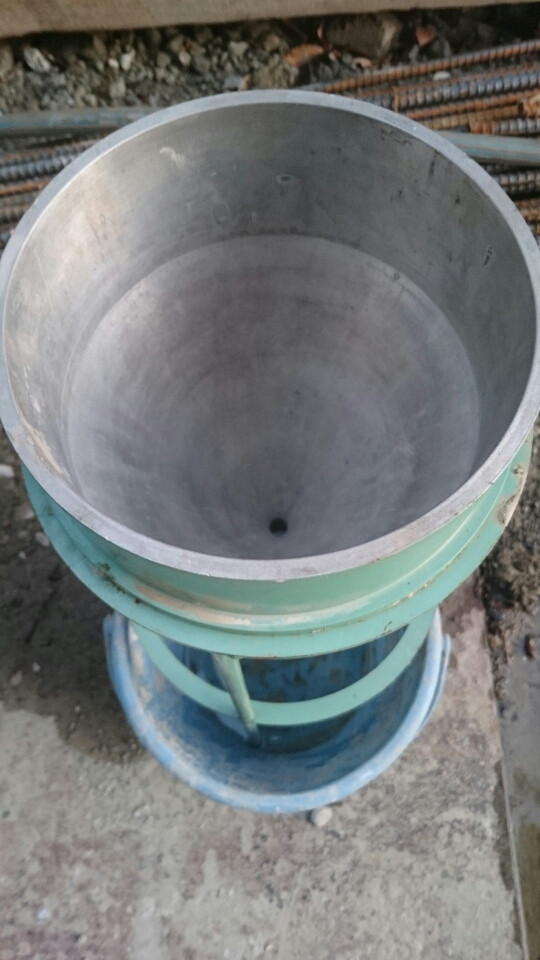
It slopes straight down, forming a cone at the bottom.
Pour the cement slurry up to the junction between the vertical and conical sections.
When doing so, please use your finger to plug the hole from below to prevent the cement slurry from spilling.
If the flow cone is not level, it becomes difficult to make a determination at the boundary.
For this reason, when you purchase a flow cone, a centering jig (point gauge) is included.
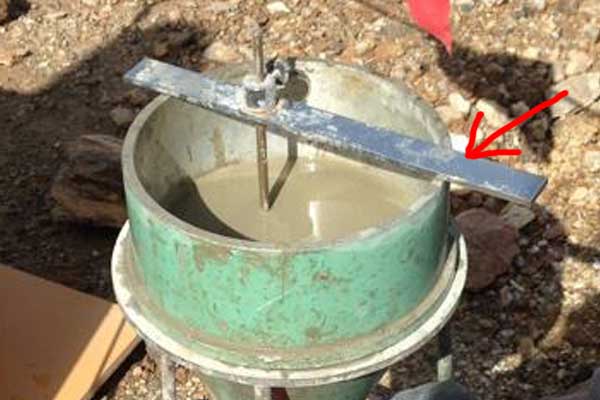
I'll move this roughly to the center.
As you pour the cement slurry, stop as soon as it starts to stick to the tip of the jig (point gauge)!
Now that we have the approximate amount, we'll start measuring.
Start the stopwatch at the same time you release your finger.
The cement slurry flows smoothly into the bucket below.
And the moment you see the hole, stop the stopwatch.
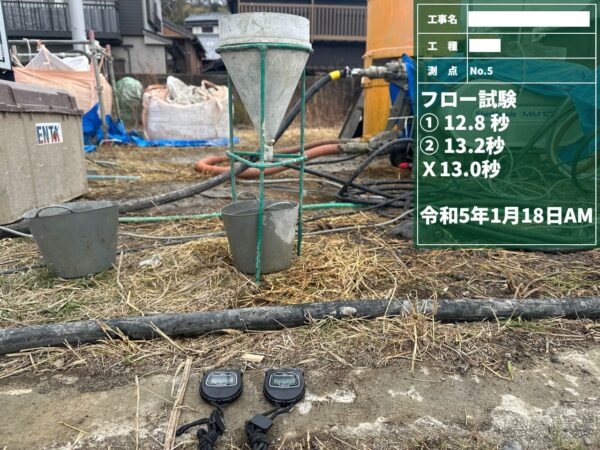
Then repeat that twice.
Measure the cement slurry produced by the same mixer twice and record the average value.
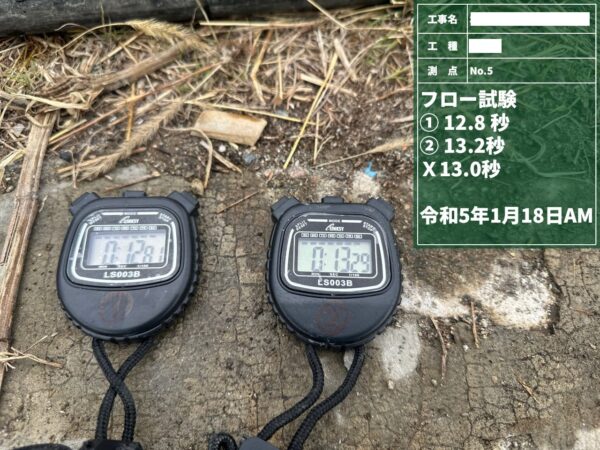
The second decimal place doesn't really matter lol (it's within the margin of error).
That's it.
Please do this twice on the day of pouring—once in the morning and once in the afternoon.
So, that's about it.
Next time, I'll record a video of this lol
And I'm going to redo a small part of the cement slurry mixing too, lol.
If I happen to have misinterpreted something or used the wrong method in the future, please let me know.
I think it would be great if we could all work together to create a model video for now.
This is just the bare minimum, okay!? lol
See you later
Flow Rate Measurement JSCE-F521-1999