Hello, everyone.
This is Enta.
I've returned from Hokkaido and have started a new development project.
If it existed, I’d definitely want it, but it doesn’t exist in this world lol
For now, I'm starting production using cardboard and 3D CAD.
I'll let you know again if possible.

But that's beside the point.
The Crack SeriesThat's it.
Up until the last time,
1. Spraying during periods of extremely high temperatures
2. The rock lines in the rock section and the sedimentary section were clearly visible.
3. Overhang (a section of a rock face where the slope extends over your head like a roof overhang.)
4. There was some spray loss.
5. Plastic spacers.
6. After spraying, the pile slid down.
7. Nighttime temperatures drop to near 0 degrees (or below freezing).
8. The sand is bad.
6. After spraying, the pile slid down.
This is also a common occurrence, but I don't think it happens very often during spraying.
I guess it's after the spray application, huh? lol
During the rainy season and other times when it rains heavily, the mountains become saturated with rainwater.
If that happens, the cohesive force of the soil inside the mountain will no longer be sufficient to keep the mountain intact.
As soon as the adhesive strength weakens, the mountain flies right off.

Let's say everyone is holding hands, and the person in the middle falls over.
When that happens, the people on either side hold on until the very last moment, and then let go.
Think of those joined hands and that tenacious strength as a kind of adhesive force.
I think it'll fall over with a loud thud the moment you let go.
That's the general idea.

If you're working with sprayed mortar or similar materials, cracks will appear left and right when the formwork is pressed.
Vertically. It hits hard, one after another, vertically, and finally explodes with a huge bang all over.
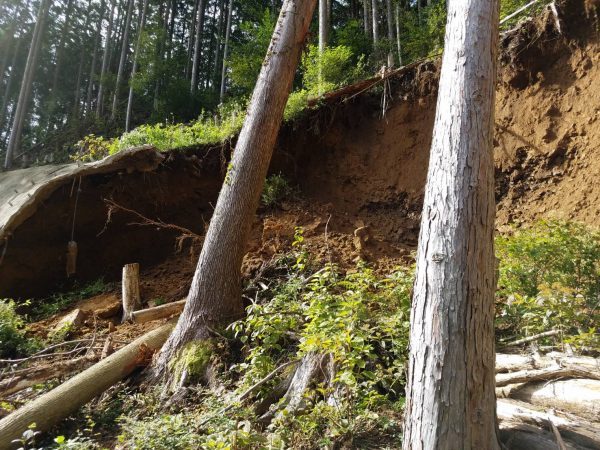
Therefore, it is essential to pay close attention to any cracks or deformations that may appear in the sprayed surface after application.
If there is a horizontal crack, please repair it. Make a V-cut and fill it with mortar.
If it is a vertical crack, please inspect the surrounding area.
See you later.
Why Do Cracks Form in Mortar? (Part 1)
Why Do Cracks Form in Mortar? (Part 2)
Why Do Cracks Form in Mortar? (Part 3)