Hello, everyone.
This is Enta.
The machine is coming back today, so I'm going to organize and clean up the warehouse.
If I’d just done this regularly, this wouldn’t have happened...
From now on, I plan to make sure I have a designated spot for everything.

But that's beside the point.
Why Do Cracks Form in Mortar? (Part 1)
Up until the last time,
1. Spraying during periods of extremely high temperatures
2. The rock lines in the rock section and the sedimentary section were clearly visible.
3. Overhang (a section of a rock face where the slope extends over your head like a roof overhang.)
4. Spray loss occurred
5. Plastic spacers
6. A pile of material slid down while we were spraying.
7. Nighttime temperatures drop to near 0 degrees (or below freezing).
8. The sand is bad.
I have explained items 1, 2, and 8.
Last time
I explained that the spots most prone to cracking are likely numbers 1, 2, 5, and 8. (Opinions may vary.)
Next, regarding point 5.
It’s always been the rule to place the last wire mesh in the center of the sprayed layer, so,
If spacers are used and the spray-applied thickness is 100 mm, the metal mesh can be installed at the 50 mm mark, such that
I was using plastic spacers.
The spacer itself is 100 mm, and the design thickness is also 100 mm—just enough to neatly conceal the top of the spacer.
It also served as proof that the design-specified spray thickness of 100 mm had been achieved.
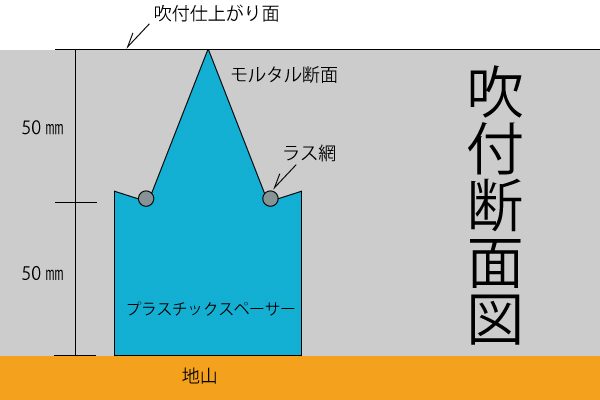
Normally, for reinforcing bars, a concrete cover is specified to prevent rust (corrosion), but
Since this spacer is made of plastic, it won't rust.
(I seem to remember that back in the day, there was a sales pitch about how it wouldn't rust and you could control the thickness... or so I think...)
Back in the day, spacers were used to support VP50 PVC pipes at 90 mm (for a spray-applied thickness of 100 mm)
I remember cutting it and securing it with the main anchor pin (φ16 × 400).
This varies by region, but if you drive a 150mm “gosun” nail 50mm into the wood, leaving 100mm of the head exposed, and then drive another 100mm until the head is hidden,
There was a requirement where you had to drive a φ16 × 300 mm (straight pin) 150 mm into the material, leave 50 mm protruding, apply the spray coating, and if the protrusion was 50 mm or less during the final inspection, it would pass.
(I'm sure some of you will find this nostalgic (^∇^))
I suppose today's plastic spacers are a remnant of those PVC pipes.
In conclusion,The hardness is different. And that’s where the connection is severed.
Another characteristic of plastic is that it has a high coefficient of thermal expansion.
That means that while concrete expands in thickness during the summer, plastic also expands.
If they were the same hardness or harder, neither would be a problem, but since their hardnesses differ, this is likely causing the cracks.
Especially when it comes to spray-applied coatings like this,This is particularly evident in concrete with small cross-sections.
But whether you put a spacer in or not, cracks are definitely going to form! lol
There is also the view that, since it is made of plastic, it is not affected by the expansion and contraction of concrete.
But since that’s actually where the connection ends, it’s hard to say they’re completely unrelated.
I have no intention of dismissing what has come before, and plastic spacers are still in use today.
I don't particularly intend to deny that either.
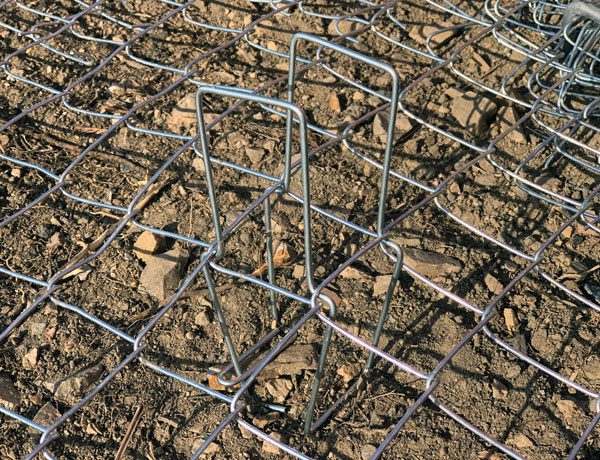
However, if you're going to install one anyway, you should use a spacer that's at least as good as the mesh, so that,
There is a possibility that we can reduce the number of cracks, even if only slightly.
As long as I am an engineer, I will strive to create and deliver the best possible products.
Since I want to minimize cracks as much as possible, I plan to pay close attention to this.
See you later.