



Hello, everyone.
This is Enta.
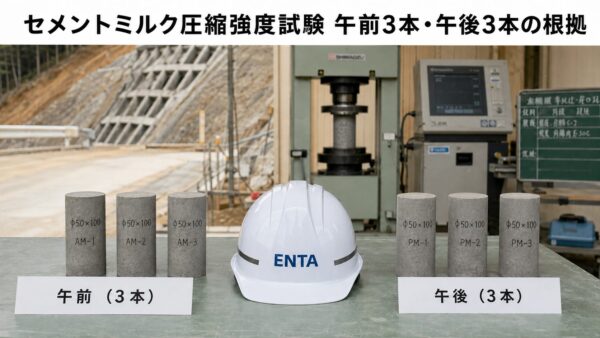
I’m often asked about the rationale behind the rule of “three specimens in the morning and three in the afternoon” for compressive strength tests on cement slurry used in rock bolting and ground anchoring projects.
A young director once asked me with a straight face, “Wouldn’t it be safer to shoot 12 takes a day?” lol
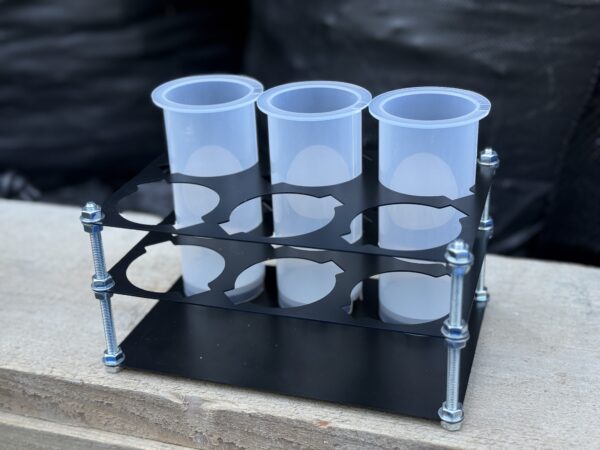
This time,Basis for the number of specimens in the cement paste compressive strength test (3 in the morning / 3 in the afternoon = 6 per day)And,Flatness of test specimens as specified in JIS A 1108:2018Regarding,
I'll give it a try.
That said, I’ve actually written about this before, lol.
So why am I writing this, then?
The reason articles get updated is that ways of thinking and standards change over time, but in reality, none of the standards have changed at all lol.
For those who already know this, it’s a refresher; for those who don’t, think of it as a chance to learn something new, lol.
The general rule is “twice a day, three bottles each time.”
According to the quality control standards for rock bolting and ground anchoring,Exams twice a day (morning and afternoon)That is the general rule.
In the case of ordinary cement,3 in the morning and 3 in the afternoon, for a total of 6 per dayIt is standard practice to collect [...].
Occasionally, some people say, “Just to be safe,” and take 6 tablets at a time—12 a day—but this is generally unnecessary.
The reason is,
- According to **JIS A 1108:2018 “Test Method for Compressive Strength of Concrete”**,The result of a single test is the average of the three test specimens.is stipulated as follows
- If you want to have a backup in case of strength variations, collecting additional samples is fine, but three samples are sufficient for calculating the average.
- It just creates more trash and drives up disposal costs lol
To put it simply,"3 bottles per session × 2 sessions per day = 6 bottles per day" is the standard in line with the intent of the JIS standard...that's the basic idea.
If you absolutely must take three additional doses because you're worried, please make sure to take them from a different batch—do not take them from the same batch.
It doesn't make any sense because even if you take them from the same batch, they'll just have the same strength.
Why divide the day into morning and afternoon?
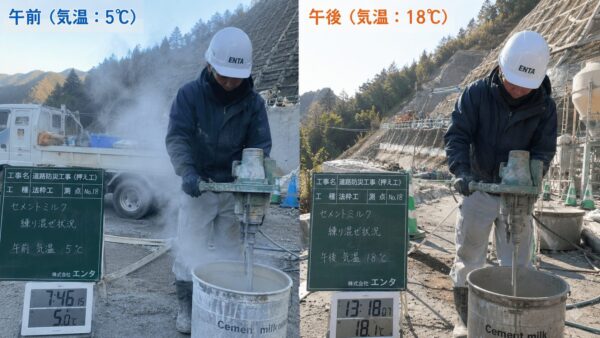
Cement slurry is a material whose strength is particularly prone to variation depending on the water temperature, ambient temperature, and batch composition at the time of mixing.
Because it is high-strength, there is considerable variation.
Quality may vary depending on whether the concrete is poured in the morning or in the afternoon.That is why the exams are held separately—to manage the quality of each time slot independently—which is the reason for dividing them into morning and afternoon sessions.
Especially during winter and summer construction,There is a difference of nearly 10 degrees in the final mixing temperature between the cement slurry prepared in the morning and the one prepared in the early afternoon.That happens quite often.
If we average this out based on a single test, it becomes harder to identify problems with the poorer batch.
Well, since sometimes we only pour concrete in the afternoon, it really depends on the situation, though~ lol
The standards differ between ordinary cement and high-early-strength cement.
The number of days required for strength testing varies depending on the type of cement.
In the case of ordinary Portland cement,Based on a 4-week (28-day) intensity scheduleLet's assume that...
According to the Standard Specifications for Concrete, the design strength is generally evaluated at 28 days of age. A one-week strength value is not required.
On the other hand, when using fast-setting Portland cement,Based on intensity over one week (7 days)Let's assume that...
If we look at the standard values for compressive strength in JIS R 5210, “Portland Cement,” as a basis,
| Types of Cement | 3rd | 7th | the 28th |
|---|---|---|---|
| Regular Portland | — | 17.5 or higher | 42.5 or higher |
| Early-Strength Portland Cement | 20.0 or higher | 32.5 or higher | 47.5 or higher |
Unit: N/mm² (JIS R 5210:2019)
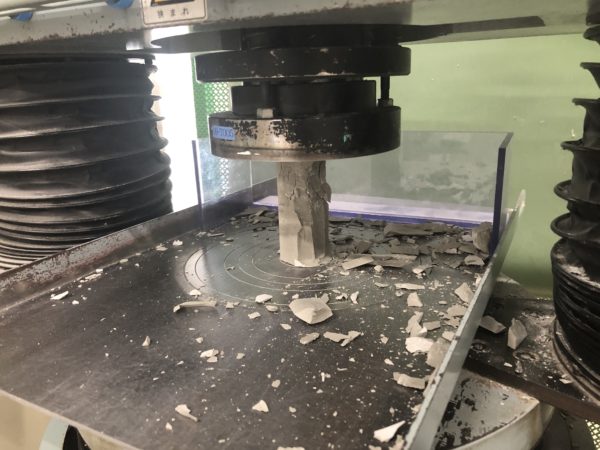
Based on the relationship between these standard values,The 3-day strength of the fast-setting concrete (20.0 or higher) is close to the 7-day strength of ordinary concrete (17.5 or higher)is located in,
Although the 7-day strength of the fast-setting concrete (32.5 or higher) falls slightly short of the standard 28-day strength (42.5 or higher), it comes close.You can see that it is set to...
For this reason, at slope construction sites,It is often used as a guideline, with “1 week of ‘Fast Strength’ training providing the same intensity as 4 weeks of regular training” and “3 days of ‘Fast Strength’ training providing the same intensity as 1 week of regular training.”
However, the equivalence relationship itself is not explicitly stated in the Concrete Standard Specifications; it is based on actual measurement values.So,
When asked to provide a basis for a design decision, it is safer to simply cite the standard values from JIS R 5210.
Procedure for Early Contractions
At construction sites where early prestressing is performed using ground anchors to shorten the construction schedule, it is necessary to verify the 3-day strength.
The general process is as follows:
- Check the strength on the 3rdand confirm that the design strength requirements are met
- Conducted Tension Work
- Check the weekly intensity as welland ensure the final quality
A common misunderstanding here is the idea that “since the specified strength was achieved in three days, the one-week test can be omitted.”
That's a no-no!
Since the design strength is typically evaluated at 1 week or 4 weeks of age,The 3-day intensity is, after all, merely a factor in determining whether or not to exercise.and,
A separate quality control test is required.
For the sake of consistency, we cannot omit the one-week exam.
It's okay if it's not 3 days, but it absolutely has to be a week!
Why does poor flatness reduce strength?
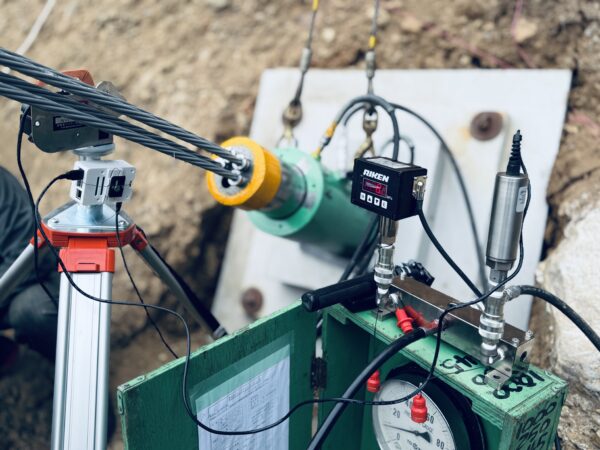
If the pressure plate of the compression testing machine does not make perfect contact with the end face of the test specimen,Stress is concentrated on a very narrow contact area (uneven loading)I will.
As a result,
- Exceeding the allowable stress in certain areasCracks appear early on
- More than its inherent strengthDestroy at a low value
- The test results areIt becomes more prone to variation
In short, if you conduct tests on test specimens with poor flatness,The results show values lower than the actual quality of the cement slurry producedSo,
While it may be better to err on the side of caution, it can also lead to a string of failing grades.
Before revising the mix design because you think “the strength isn’t coming out,” the standard practice is to first check the condition of the test specimen’s end faces.
Estimated Testing Costs and Avoiding an Increase in the Number of Tests
The accuracy of modern testing machines has improved, so unless something extraordinary happens, the strength results won’t deviate from expectations.
Increasing the number of units will only drive up costs.So, it doesn't really help improve the accuracy of quality assurance.
To be honest, we mess up a lot too, lol. (An old backup, lol.)
Rather than increasing the number of tests,It’s better to invest time and money in preparing the test specimens (de-airing and curing temperature) and ensuring their flatness when setting up the testing machine,
Variation in results will be reduced, which will ultimately lead to cost savings.。
First, take standard samples at a rate of “3 samples per session × morning and afternoon = 6 samples per day.” At sites using fast-setting cement, take a one-week strength sample; if early prestressing is required, take an additional three-day strength sample.
With this, we’ll ensure quality control for the cement slurry used in slope construction.
Before testing, the flatness of the test specimen’s end face is improved by polishing.
If you're still worried, get a spare from a different batch.
See you later.
[Related Articles]
- Guidelines for Diluting Cement Slurry with Hot Water Based on Finished Mix Temperature
- Methods for Maintaining a Constant Ambient Temperature During Winter Curing
- What Is a Reinforcement Installer (Rock Bolt Installer)? | 46 Practical Q&As [Complete Edition]
[References and Sources]
- JIS A 1108:2018 “Test Method for Compressive Strength of Concrete” (Specifications for End-Face Flatness, Perpendicularity, and Dimensional Tolerances)
- JIS A 1132:2020 “Preparation of Test Specimens for Concrete Strength Testing” (Provisions for Test Specimen Preparation and Curing)
- JIS R 5210 “Portland Cement” (Cement Types, Such as Ordinary and Rapid-Setting, and Strength Development Characteristics)
- The Japan Society of Civil Engineers, “Standard Specifications for Concrete”—Design and Construction Volumes
- Hokkaido Development Bureau, “Quality Control Standards and Specification Values”

I really wish they'd get rid of that "4-week intensity" thing, don't you?
It feels like management just for the sake of management—it's pointless.
I guess it’s okay to simplify things, right?