



Hello, everyone.
This is Enta.
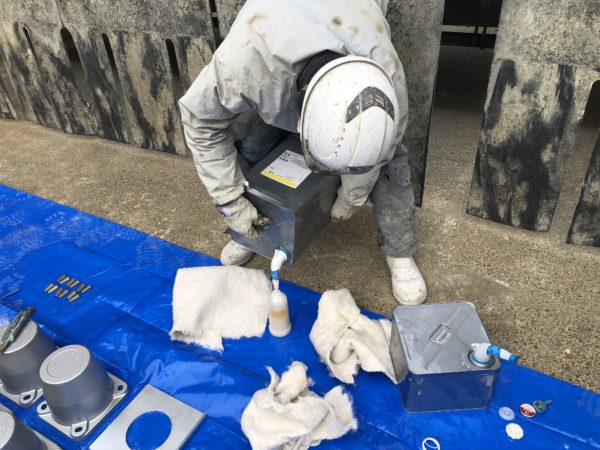
Are you using the non-corrosive material that’s a staple of KTB ground anchor construction?
Combine both ingredients and shake vigorously. (The KTB specifications say to use a mixer for at least 3 minutes lol)
It doesn't really matter which one you put in first.

I'll pick up an Euler like this at a home improvement store.
If possible, we recommend 500 mL or more.
The reason is that the amount of liquid under the cap is usually about 0.45 mL. (The 8-wire type contains more than that.)
Then, inject as much as possible until it seeps out from the wedge.
Euler becomes sticky and eventually turns into a rubber-like substance on the inside, so it's disposable.
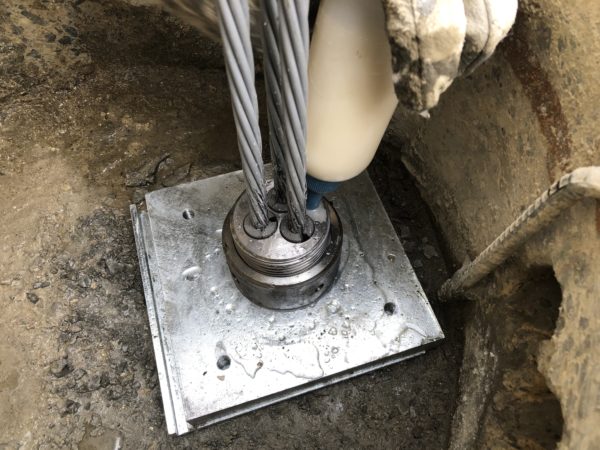
With the Euler, I recommend cutting off the tip to enlarge the opening before use, as this allows the non-corrosion solution to flow through all at once.
Of course, you’ll press it in firmly as you go.
Please fill it until it is full.
If you don't fill this up completely, it will lead to rust later on.
Please keep adding more here—don't stop.
After this, use an angle grinder to cut the prestressed steel strand and finish the ends.
How to Postpone Head Processing Just a Little Bit
It's just that this non-corrosive formula is kind of sticky and hard to use, isn't it?
Products like the Super Flotech Anchor, where both components come together in a single 3M package, are really convenient—and they don't get your hands dirty!
It would be great if an anchor app came along that combined the best features of all the existing ones, lol.
If you give the 3M pack a good squeeze all over, it’s easier to open the dividers inside, right?
This is the best filler for anchor head treatment!
By the way, here it is.
Proper head treatment is the key to ground anchor construction!
Let's give it our all!
See you later.



Thank you for your continued support.
I apologize for bothering you during such a busy time, but I am reaching out because I have a question I’d like to ask.
I have been involved in a construction project at a certain site where the ground anchor method and the Fit Frame method were used in combination.
[Details]
L = 18.00 m (Anchor body length = 6.5 m; Free length = 11.5 m)
Td = 159.5 kN
As for the overall process, the Fit Frame method involves installing formwork on the prepared anchors and applying “pre-tensioning (50 kN).” After that, ready-mix concrete is poured, and once the specified strength is achieved, quality assurance tests are conducted.
Now,
Should the initial load for the test be based on the 50 kN applied as preliminary tension, or should the fit frame be securely fastened, all loads removed, and the test started at 0.1 Td and 0.1 Tp as specified in the standards?
I found myself wondering things like that.
The parties involved at the site planned to conduct the test over four cycles (although the specifications state that five or more cycles are generally recommended), based on the fact that the initial load was set at 50 kN and additional temporary prestressing was applied, as well as the fact that the design load was very small.
However, since I just couldn't shake the feeling that something wasn't quite right, I decided to contact you.
I would very much like to hear your thoughts on this, Enta.
That said, I imagine you’re very busy.
You can reply at any time. I would appreciate it if you could respond as soon as you’re able.
Thank you in advance.
Thank you as always.
Although we have never installed Fit Frame due to association regulations, we do perform temporary prestressing in cases where the design calls for its use (with grout-filled cushion material).
Whether you unload it or not, the data remains virtually unchanged.
You could start by adding 50 kN, or you could simply use that value as the initial tension.
That is, provided the jack is fully tensioned.
If the jack is slightly loose, it’s best to start with a load of 60 kN or so.
All things considered, I don't think it makes much of a difference.
Conversely, we do not recommend securing the pressure plate, completely relieving the tension, and then beginning to retension it.
That's because it takes one or two extra steps to do that.
Also, even if you manage to secure it firmly, when you consider the effort and risk involved in realigning it if it shifts due to vibrations, I think it’s wiser not to unload it.
For the reasons mentioned above, if it were me, I would choose to load the cargo as is without unloading it.
You mentioned that the test was conducted over four cycles, but that's fine.
To begin with, if the design load is low, it doesn't really make much difference how much you increase the load.
Since the Ground Anchor Design and Construction Standards simply state that values of 5 to 10 are common, I think a value of 4 would be acceptable.
To be honest, part of me thinks this exam is pointless, lol.
Initial → Maximum → InitialYou can check the elongation there, and this is the only type of ground anchor work where PC steel strands are tested like this, isn't it? lol
I mean, the PC steel cables used for suspension bridges and such are tensioned in a single pull, lol.
I got a little off track there, but the point is that 4 is plenty.
If the load is low, it's hard to read the pressure gauge, too.
The content in the book is just an example, so you don't have to follow it exactly.
As long as construction management is carried out in accordance with books and guidelines, taking into account on-site conditions and experience, there is no problem.
It's important to be able to explain that thoroughly and logically.
That concludes my thoughts.
Maybe I have a slightly offbeat way of thinking, too. (Maybe it turned out this way because I have quite a bit of experience?? lol)
Please let me know if you have any other questions.
(If any part of this is off the mark, please feel free to ask again.)