Hello, everyone.
This is Enta.
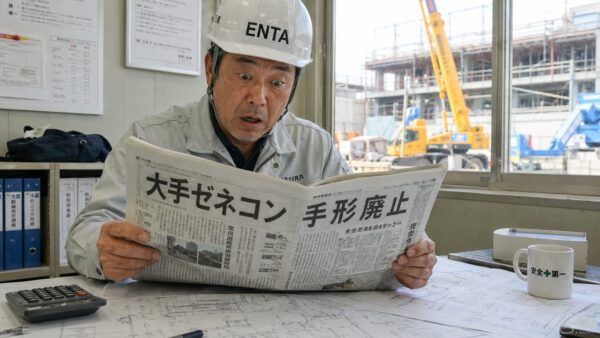
I saw this news story the other day.
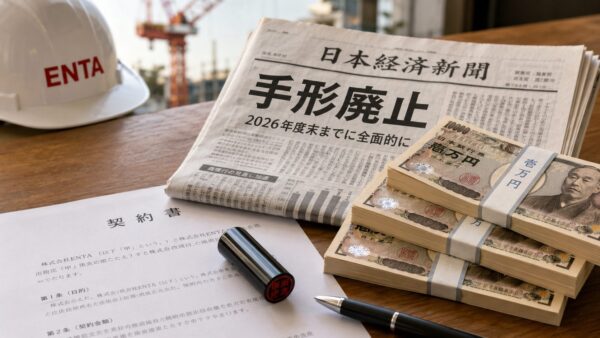
Major General Contractors Abolish Promissory Notes and Shift to Cash PaymentsThat's the story.
To be honest, I’m thinking, “It’s about time!” but this is actually a pretty big deal for small companies.
Why Did Major General Contractors Use Promissory Notes?
To begin with, why did major general contractors rely so heavily on promissory notes?
There's a reason for this.
The amounts of money major general contractors handle are just mind-boggling.
Every month, 100 billion to 200 billion yen changes hands at a rapid pace.
The question is, can you actually come up with that much cash every month without a hitch!?
There's no way the company would be hoarding that much cash in a safe, lol.
Even if a company is profitable, its net assets are not the same as its cash.
In our case, this refers to drilling machines and spray machines, such asFixed Assetsis set to.
So, even though the business should be profitable, it’s surprisingly short on cash.
In other words, they're borrowing the shortfall from the bank to keep things running.
You're probably wondering, "So where does all that cash go?"
That money has gone toward the cost of materials and machine repairs we paid for last month.
I'll be back eventually, but it's just not right now, lol.
A company with debt = a company with credibility
You often hear people say things like, “A debt-free company is a great company!”
This is half right and half wrong.
Actually,Most major companies operate by rolling over their bank loans.That's normal.
Being debt-free is impressive in its own right, but on the other hand,"We haven't built up enough credit."It can also be viewed this way.
Credit means social credibility.
It's the same with mortgages, isn't it?
Some people can borrow 30 million yen, while others can only borrow 15 million yen.
People who have consistently made payments over time have a high credit rating.
They won't lend money to people who repeatedly default on payments.
It's the same logic as not wanting to lend money to a friend who never pays you back lol (Don't lend or borrow in the first place!)
In other wordsThe fact that “a company can borrow anywhere from hundreds of millions to hundreds of billions” indicates that it has that level of social credibility.That's the proof.
For reference, according to aggregate data from the Research Institute for Construction Economics (RICE), a general incorporated foundation,The total interest-bearing debt of major, mid-sized, and medium-sized general contractors stood at approximately 4.3 trillion yen as of the second quarter of fiscal year 2024....This represents an increase of approximately 14.11 TP3T compared to the same period last year. (The fact that many businesses are taking on more debt suggests they’re likely making a profit! Banks generally won’t lend to companies that aren’t profitable!)
That's 4.3 trillion yen—4.3 trillion.
If you add the lease obligations to that, it's even bigger.
📊 Actual Amount Borrowed (as of the end of March 2025; on a consolidated basis)
| Company Name | Consolidated Interest-Bearing Debt | Non-consolidated Interest-Bearing Debt | Source |
|---|---|---|---|
| Kajima Corporation | 792.0 billion yen | 288.9 billion yen | Financial Results for the Fiscal Year Ended March 2025 |
| Shimizu Corporation | 591.3 billion yen | 488.4 billion yen | Financial Results for the Fiscal Year Ended March 2025 |
| Obayashi Corporation | 362.7 billion yen | (Individual disclosures are limited to specific points in time.) | Financial Results for the Fiscal Year Ended March 2025 |
| Taisei Corporation | 315.5 billion yen | (Limited to individual disclosures) |

In the end, a similar system ends up staying in place, lol.
So, the abolition of promissory notes this time.
The reason behind this isAs a government policy, the goal is to reduce the number of paper promissory notes and checks exchanged to zero by the end of fiscal year 2026 (end of March 2027).That's my goal. (I think I mentioned this in a previous post.)
Japan Bankers Association, “Voluntary Action Plan for the Full-Scale Digitization of Bill and Check Functions,” July 2021)
In the case of major companies, they can’t just suddenly announce, “We’re discontinuing this starting tomorrow!”
I think they’ve been working with the bank to restructure the accounting procedures, and it’s taken them over a year to finally get it done.
For a company as small as ours—one that could be blown away by a gust of wind—all we’d have to say is, “We’ll make the change starting next month!” lol
So, what appears after the handprint disappears is"Densai (electronically recorded receivables)" and "factoring"。
Even though the paper is gone, the underlying mechanism remains essentially the same.
And thenCommissions are being skimmed off here and there by contractors acting as middlemen.And so on.
It’s not like we subcontractors are the ones creating this kind of situation, so in the end, it’s mostly dictated by the major companies’ convenience and way of thinking, lol.
Don't underestimate the fees, lol
Some people say, “A small fee is no big deal.”
But when it comes to scale, that changes everything.
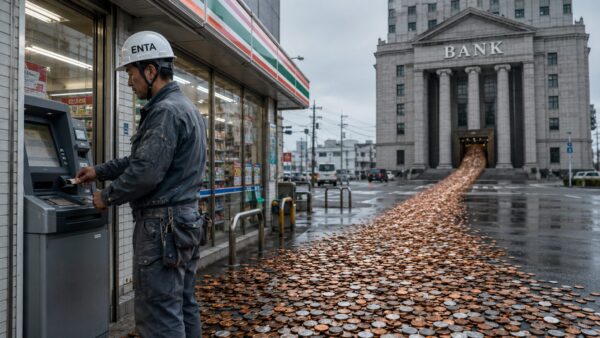
When an individual withdraws cash from a convenience store ATM, the fee is less than 200 yen at most.
For an individual, that’s the kind of amount where you’d just shrug and say, “Oh well, whatever.” (Don’t underestimate it!)
But when it comes to a company, though...An outrageous amount of moneywill be.
For a major general contractor, the annual commission amounts to several hundred million or more.
Even for a small company like ours, we lose around 1 million yen a year.
By the way,Seven Bank's standalone ordinary revenue for fiscal year 2024 (ending March 2025) was 135.7 billion yen.。
Most of them come from partner financial institutionsATM Acceptance FeeThat's it.
A single machine generates 135.7 billion yen for a fee of just a few hundred yen per transaction.
ATM fee: 200 yen per transaction.
While people are underestimating this as "just a little," a massive market for service fees is already in motion.
Electronic invoices and factoring will also gradually lose ground due to the same underlying structure.
Reading the Signs of the Times
It’s great news for us subcontractors that the payment terms from major general contractors are improving.
This is an indisputable fact.
However, while paper promissory notes are disappearing, mechanisms that have simply taken on a different form (electronic promissory notes and factoring) are taking their place....
It is precisely when the system changes that,"Who pays the fees, and who pockets them?"You need to calmly assess the situation around you—like that. Why is that? lol
These are becoming difficult times.
However, if you keep an eye on what these major players are doing, you’ll be able to see the broader trends in the industry.
One invoice, one bank transfer—and what’s really going on behind the scenes?
Just being aware of that will change the way you think, act, and approach things going forward.
These are tough times, and the effects of the war will continue to become increasingly apparent!
Be sure to gather all the information and take a good look at it.
See you later.