The Rising Star of Civil Engineering and 3D Construction
A 39-year-old man currently working at a small civil engineering firm with 13 employees is breaking new ground in civil engineering construction by making full use of cutting-edge technologies such as 3D data. His efforts have caught the attention of the Ministry of Land, Infrastructure, Transport and Tourism, as well as a number of prominent major corporations. Landlog, a venture company jointly established last year by Komatsu, NTT Docomo, and others, has also embarked on the development of new civil engineering technologies in collaboration with this man.
"The reason I pursue new technologies is to make money with minimal effort. If it isn't easy, then ICT and IoT are a waste. Many people have the wrong idea about i-Construction—it feels like something you're forced to do—but if a stick is more convenient, I'll use that without hesitation."
――How did a man who was once just an ordinary field worker become a key figure in civil engineering innovation? We followed Yohei Oya of Shoji-gumi, who has broken through the “status quo” in civil engineering and continues to pursue further “kaizen.”
Three Hours of Sleep While Teaching Myself Construction Management
Mr. Oya joined Shoji-gumi (based in Izunokuni City, Shizuoka Prefecture) at the age of 19, when he was at the height of his rebellious youth. He entered the civil engineering field because the father of the girlfriend he was dating at the time happened to be the president of Shoji-gumi. He went on to work as a construction worker on-site, shovel in hand, and eventually married his girlfriend.
When Mr. Oya joined the company, Shoji-gumi had focused exclusively on subcontracting civil engineering projects; since its founding in Showa 43, it had never once undertaken a project as a general contractor. Mr. Oya, too, continued to work as a field worker on subcontracted civil engineering projects for about five years.
However, when he was 24, he felt he had reached his limit with continuing to do only subcontracting work, so he appealed directly to the president, saying he wanted to try taking on projects as a prime contractor.
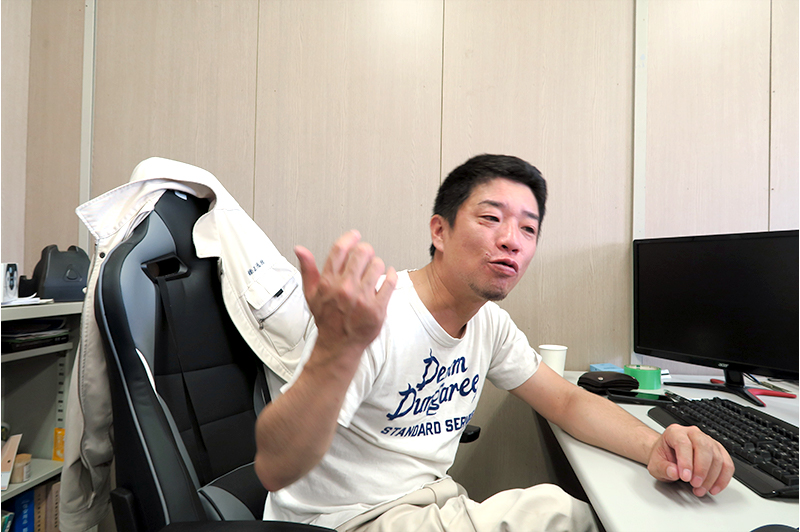
Mr. Yohei Oya, General Manager of the Civil Engineering Division at Shoji-gumi
"I was simply told, 'Well, give it a try,' and, on a whim, I secured a contract for a project commissioned by the prefecture. But there wasn’t a single person in the company with experience in construction management, and no one was willing to teach me. Even though I had experience as a civil engineering laborer, construction management was a completely new field to me, so I just threw myself into it and researched everything on my own," he recalls of that time.
"I taught myself everything from scratch—cost estimation, design review, safety management, schedule management, preparing actual budgets, and creating change order documentation. Arranging subcontractors and materials, negotiating with the client, increasing the number of work items, coordinating with local stakeholders… For the first three years or so, I was learning on the job, but I somehow managed to get by on just three hours of sleep a day."
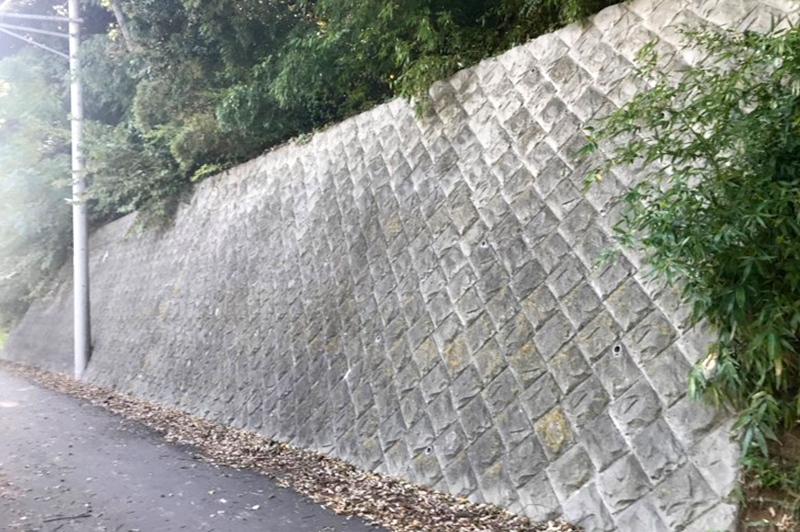
The construction site where Yohei Oya first served as construction manager
Mr. Oya, who had been managing construction projects in his own way, eventually began to wonder how engineers at other companies handled construction management. At the same time, faced with the grueling workload of his job as a site supervisor, he began to worry that his own approach might be inefficient.
“I was working alone as a construction manager in a remote corner of the countryside, with no senior colleagues to turn to for advice. The local construction industry association was, after all, made up of rivals competing for public works contracts, so they wouldn’t share the crucial technical skills and know-how I needed. In short, I felt very much like a ”frog in a well’ and was lonely."
However, precisely because he was self-taught, Mr. Oya was able to break free from traditional construction management methods and pursue “construction methods that make the work even a little easier,” leading him to take the fastest route to 3D construction.
A shovel and CIM software are both just tools.
There was something I realized very clearly during my very first field assignment: if we could streamline these two tasks—“field surveying” and “calculating coordinates and elevations”—we could significantly reduce working hours. It was around that time that prism-less total stations were just starting to appear on job sites.
"Back then, I was gathering as much information as I could on surveying and construction management—not just from the internet, but also from books and brochures. Among those materials, I happened to come across an ad for a non-prism total station. I thought, ‘This is it,’ so I contacted the manufacturer and asked them to come give us a demonstration. But as a tiny company in the countryside like ours, we were brushed off and they wouldn’t even take us seriously."
Taking this as a turning point, Mr. Oya—who felt more and more like a “frog in a well”—began working alone on surveying and creating 3D data using a prismless total station. Driven solely by the desire to reduce his own workload, he sought out highly productive construction methods.
Mr. Oya began working on 3D construction in 2001—15 years before the Ministry of Land, Infrastructure, Transport and Tourism launched the i-Construction initiative in April 2016.
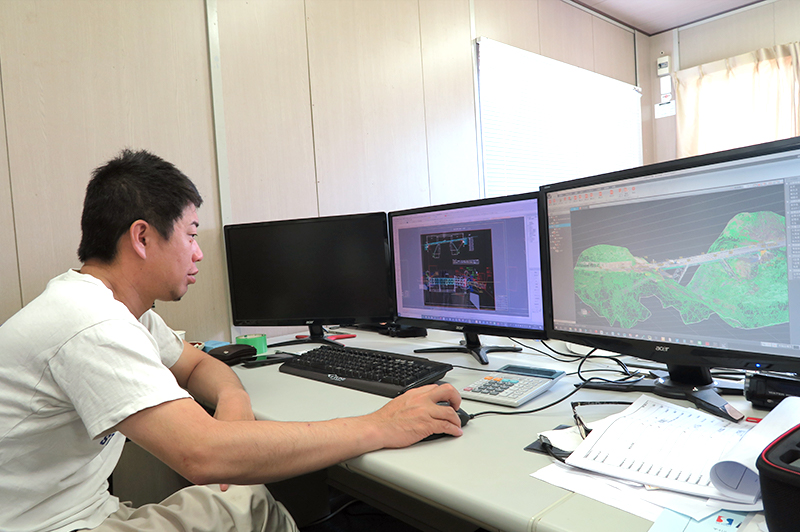
"From my perspective as a former laborer, shovels, heavy machinery, and 3D data are all just tools. An engineer’s skill lies in how well they can master the ever-evolving array of new tools. In that regard, I’m grateful to our president for investing in software and other resources just as I suggested. Of course, that means I have to make sure my own projects turn a profit (laughs)."
As Seiji-gumi began securing contracts not only for subcontracted projects but also for prime-contract projects, the company, through a process of trial and error, successively introduced cutting-edge technologies—such as 3D laser scanners, drones, ICT-enabled construction machinery, and 3D modeling software—into its road construction and riverbank reinforcement projects.
Of course, studying the digital field was essential, but for Mr. Oya, who had the makings of a gaming geek, it was simply an extension of his gaming experience and posed no difficulty at all.
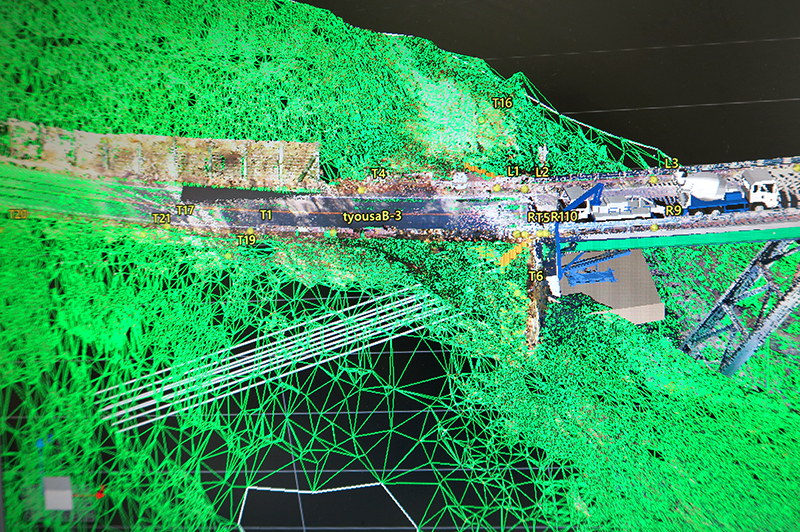
3D survey data for anchor installation work on bridge substructures. Visualizing excess or insufficient soil cover.
"To create a 3D model suitable for surveying, knowledge of ground pixel dimensions, image processing, SfM (Structure from Motion), MVS (Multi-View Stereo), and other topics was also required."
"But if I keep studying for an hour every day to make my work easier, it’s becoming possible for me to get home by 3:00 p.m. I want to break free from the stereotype that civil engineering is tough and doesn’t pay well."
Currently, the main “tools” Mr. Oya uses are listed below.
- CIM software "TREND-CORE" (Fukui Computer)
- "TREND-POINT" 3D Point Cloud Processing Software (Fukui Computer)
- "SiTECH 3D" 3D Data Creation Software (Construction Systems)
- Surveying App "Kaiso Navi" (Construction Systems)
- "GLS-2000" 3D Laser Scanner (Topcon)
- "Dropbox Business" Online Storage (Dropbox)
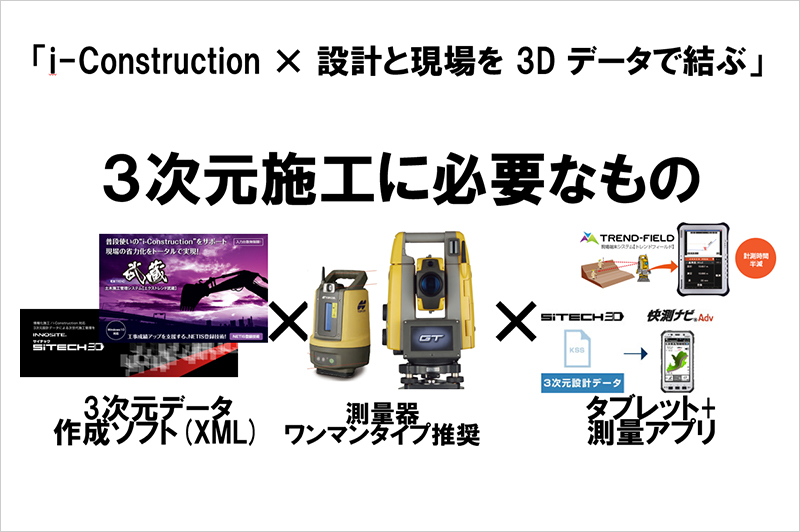
Items Required for 3D Construction (Compiled by Mr. Oya)
For the project listed below, which had been scheduled to take 285 days, we completed the work in 88 days and achieved a gross profit of 30%.
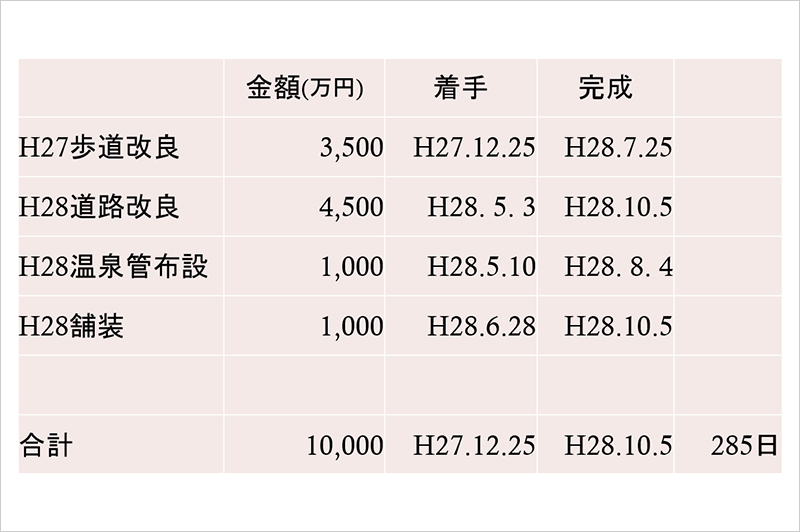
Achieved a gross profit of 30% through 3D construction
At Shoji-gumi, the four site supervisors other than Mr. Oya have also achieved record-high profits while working virtually no overtime.
The Drawbacks of 2D Drawings in Civil Engineering
To begin with, the fact that actual civil engineering structures are three-dimensional, yet they are designed and constructed using two-dimensional drawings, has caused numerous problems.
For example, even if there is a design inconsistency in road improvement work where a roadside ditch and a utility pole interfere with each other, the client or designer may not notice it on a 2D drawing. Furthermore, there are cases where it is obvious that construction machinery will tip over if work is carried out exactly as instructed by the client. In such situations, the contractor explains the proposed changes to the client, but it is often difficult to get the client to understand the inconsistencies based on 2D drawings alone.
In that regard, if you import floor plans, longitudinal sections, and cross-sections into “TREND-CORE” and convert them into 3D data semi-automatically, even a layperson can immediately spot any design errors. When explaining the construction details to local residents, a 3D video also makes it easier to gain their understanding of traffic restrictions.
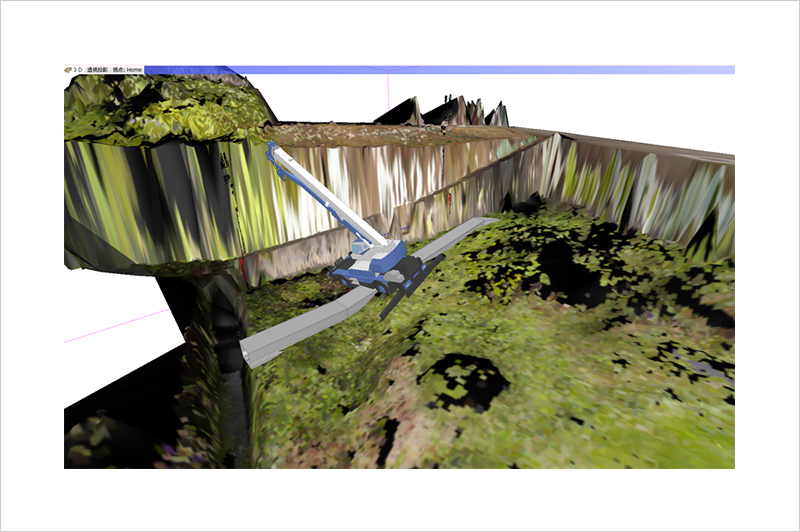
Creating a 3D model makes it easier to convey the risk of construction equipment overturning.
Furthermore, it is difficult for all on-site workers to visualize the same construction procedures as the foreman based solely on 2D drawings. It is also hard for them to grasp the planned locations and heights. For this reason, Mr. Oya uses 3D design data to create videos that illustrate the construction steps, which he shows to workers and the client before construction begins.
"Simply by ensuring that everyone shares a common understanding of the construction procedures, we can reduce unnecessary movements and rework on-site, which in turn increases profits without anyone losing out."
3D data is also used in ICT construction machinery's MC (Machine Control) systems.
3D Design Data and Dropbox
Cloud-based information sharing goes hand in hand with the use of 3D data. At Shoji-gumi, all employees use “Dropbox Business” to share construction plans, budget estimates, construction photo logs, construction drawings, and bills of quantities. This not only helps track project progress but also aids in employee training.
Even if a junior employee doesn’t understand something, they can view all of their senior colleagues’ construction data—including past records—so they can figure things out without having to ask questions every time. At Seiji-gumi, employees hardly use email with each other anymore. That’s because it’s more reliable to simply upload drawings to Dropbox.
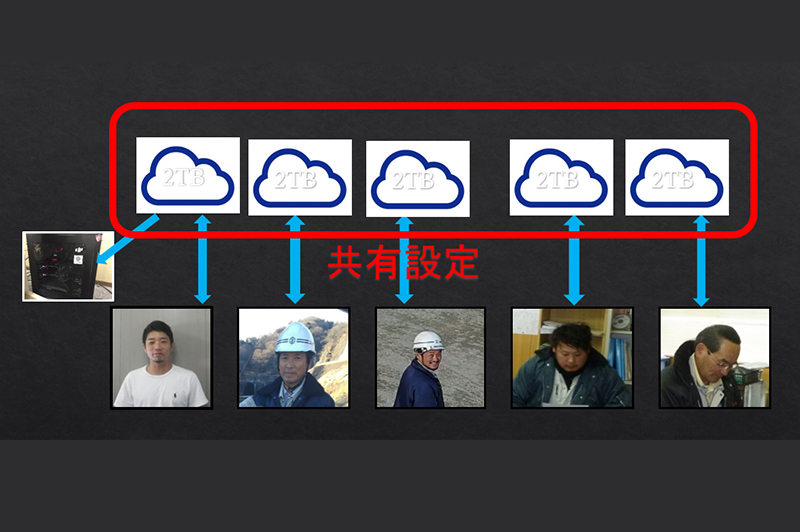
Shōji-gumi's Dropbox Sharing Settings
"Since Dropbox stores construction data in the cloud, you can recover it even if the server at the job site office crashes and the data is lost. I’ve known several engineers who’ve committed suicide after losing their data, so you should definitely use Dropbox to protect both the company and yourself."
Currently, at Shoji-gumi, an employee in his second year with the company is serving as the site representative for a weir construction project commissioned by the prefecture. In the past, this would have been a job that could not have been entrusted to someone without at least 10 years of supervisory experience, but Shoji-gumi’s standard practices—such as “utilizing 3D design data,” “eliminating the need for formwork,” and “sharing via the cloud”—have made this possible.
The Mischievous Civil Engineering Network (YDN) and i-Construction
Mr. Oya launched the “Yancha Civil Engineering Network (YDN)” on April 14, 2015. YDN is an organization dedicated to sharing insights on new civil engineering technologies among small and medium-sized enterprises, striving constantly to improve their technical capabilities rather than resting on their laurels.
“As I gained experience in on-site management, I began to ask myself: ‘Is it right to subject the younger generation to the same kind of excessive workload I went through? Is it right to pass on civil engineering—a field where hardship is taken for granted—to the next generation just as it is?’ I gradually found myself asking these questions over and over. And thinking that there must be civil engineering professionals somewhere across the country who share my feelings, I invited a few acquaintances to join me and launched YDN.”
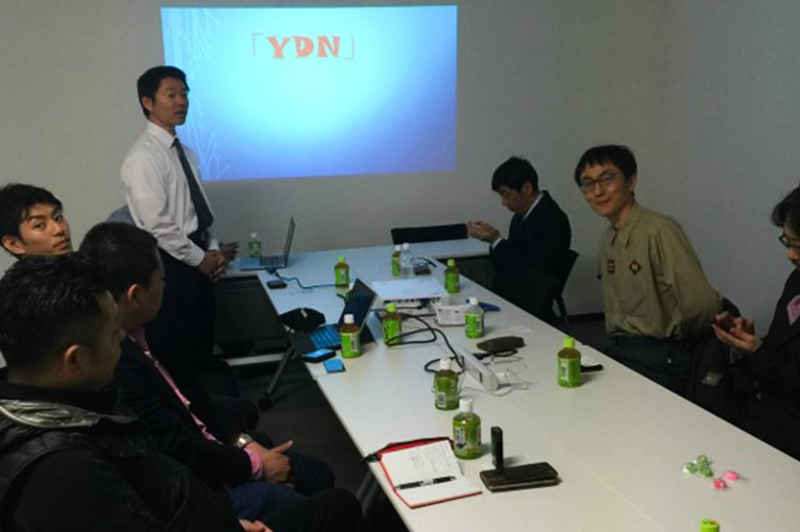
YDN Launch Ceremony
Then, one year later, in April 2016, the Ministry of Land, Infrastructure, Transport and Tourism (MLIT) unveiled its i-Construction policy. The policy’s content was entirely in line with the civil engineering construction methods Mr. Oya had been independently developing all along. It seemed as though the times had finally caught up with Seiji-gumi’s approach.
"The concepts behind i-Construction were exactly what I've been putting into practice for a long time. It felt a bit late in the game, but I finally felt that civil engineering was about to change."
From that point on, Mr. Oya—who had experience in 3D construction—began to be invited as a speaker to various events, such as lectures, study sessions, and networking events, by organizations including the Ministry of Land, Infrastructure, Transport and Tourism, major general contractors, and leading software companies.
"To be honest, at first I thought, 'Engineers at major general contractors aren’t all that great if they want to learn from someone like me, a former laborer.' While it’s true that some engineers do lack knowledge, as I’ve had more opportunities to interact with many of them, I’ve come to fully realize that there’s always someone better out there."
“In particular, when I met Shinya Sugiura (General Manager of the Civil Engineering Division) from Obayashi Corporation and Junji Gokan (Head of the ICT & CIM Promotion Office) from Kajima, I found myself learning so much from them that I became a fan. I felt excited, as if I had suddenly been freed from my narrow-minded perspective.”
As awareness of i-Construction has grown, YDN’s initiatives have also gained nationwide recognition, and as of July 2018, the number of YDN member companies had reached 19.
"The reality of YDN is similar to school clubs. There are clubs like the UAV Club, VR Club, CIM Club, Ground Improvement Club, and New Foundation Methods Club, where members share construction case studies in their preferred fields and learn new technologies driven by their curiosity. It’s not a world where people do i-Con just because the government says so, or where they feel forced to participate.”
For example, in the UAV Division, since we didn’t know how to set automatic flight paths for drone surveying, we ended up developing our own iOS app (Drone-ize ✕ YDN PRO). It’s an aerial photogrammetry support app that automatically generates report data once you set the survey area and lap rate on a tablet, and we’ve also registered it with NETIS.”
3D Civil Engineering Construction Feels Like a Video Game
In 2017, Mr. Oya was certified as an “ICT Advisor” by the Chubu Regional Development Bureau of the Ministry of Land, Infrastructure, Transport and Tourism in four categories: 3D surveying, 3D design, ICT-based construction machinery operations, and 3D as-built management.
At Shoji-gumi, he not only achieves the company’s highest construction volume and profit margin but, as head of the Civil Engineering Department, also contributes to increasing the sales of all the site supervisors under his supervision.
At the same time, he is involved in the organizational management of YDN and the development of new technologies such as VR and AR. Furthermore, he is currently conducting a pilot test in collaboration with the startup Landlog to develop a new technology that can visualize the placement rate of ready-mix concrete simply by installing a camera at a fixed location; this technology could potentially be applied in the future to visualize earthwork volumes in excavation projects and other applications.
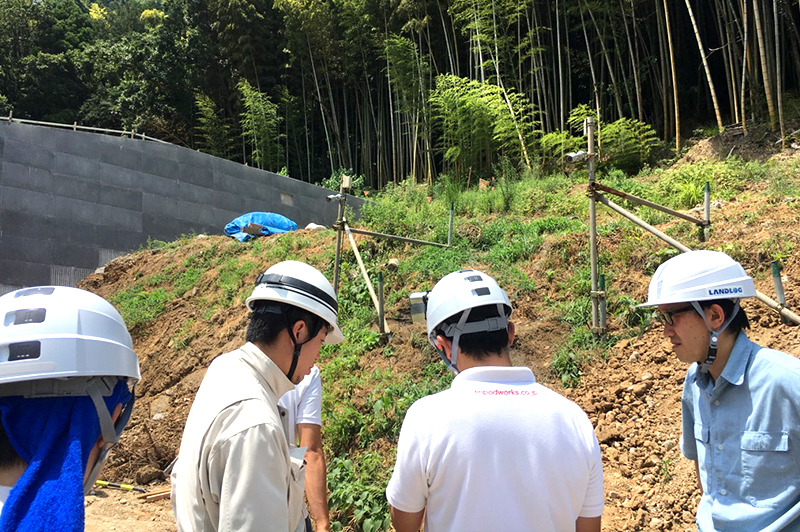
Landlog and Under Development/Testing
"It was tough when I first started out in construction management, but now I absolutely love civil engineering. Thanks to the latest technologies—like 3D software, ICT-enabled construction machinery, and CIM—I’ve gained more leeway in terms of money, time, and mental well-being. If I do things my way, I’m sure even today’s young people will want to get into civil engineering."
What I’m secretly thinking about right now is turning NEET gamers into civil engineers. I’d hire them as full-time employees, and since they wouldn’t need to come to the job site, they could work from home using point cloud processing software and 3D CAD to create 3D data. It’s their area of expertise, and I think it would be fun work for them—almost like playing a video game.
"These days, unlike when I first started learning 3D construction, there are so many handy software tools available that anyone can learn to do ICT construction with just a little study."
Mr. Oya lists the following as the necessary qualifications for civil engineers. This is the exact opposite of the traditional image of civil engineers.
- Don't Be Afraid to Fail
- Don't dwell on the past
- Try doing things you're not good at
- First and foremost, enjoy yourself
And then, the darling of the civil engineering world says this:
"The president is way more amazing than I am. He took me under his wing when I was a hopeless young guy. Even though he didn’t know anything about 3D or anything like that, he let me do whatever I wanted. I feel indebted to him for that, so I work hard to generate even more profits. I owe everything I am today to the president (laughs)."
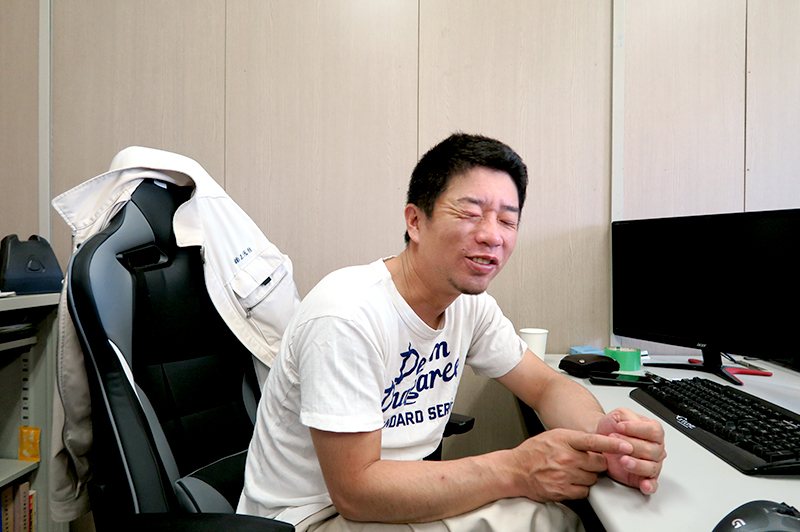
――When you look at the civil engineering industry through the eyes of Yohei Oya, a mischievous civil engineer, the labor shortage seems almost too good to be true.
In the near future, civil engineering may well become a cool and popular profession. To that end, I hope to see even just one more civil engineer—like Mr. Oya—who can break through “Kisei” and pursue “Kaizen.”
After all, “Civil engineering is just so much fun!”
P.S. I actually reached out to join this group too, but I had to give up because I didn't have a referral lol.
However, I also believe that the future of civil engineering is unthinkable without the use of 3D technology, so I’d like to support this effort.
Even though I say that, I’m secretly working on my own version of iConstruction at home, lol (though it’s just for slopes). It’d be fun if it actually came together, wouldn’t it?