



Hello, everyone.
This is Enta.
We've sold more than 10 boxes in the last few months!
The Ultimate Rubber Gloves Have Arrived!
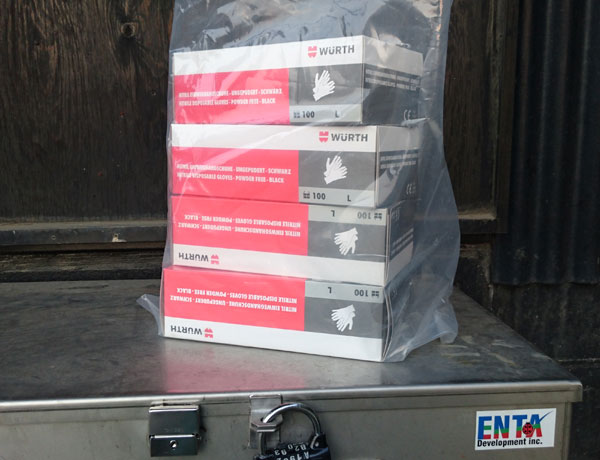
We received four more boxes today.
It's not for us to use.
All at the request of the craftsmen and managers I know—just scrolling sideways lol
According to a sales rep from the manufacturer of Ult, these gloves are in short supply nationwide and are flying off the shelves.
If you call Ult Japan directly and ask them to send a sales rep, I think they'll sell it to you for 2,500 yen per box.
You don't have to ask us to do it, lol.
See you later.
P.S. I'll be in Akita for about three days starting today. I'm looking forward to enjoying Akita lol



Good evening!
I always enjoy reading your blog, and I’m learning so much from it ^ ^
I apologize for asking a question unrelated to the article (since it was the most recent one), but we are currently working on a project using the on-site spray-applied formwork method (spraying vegetation substrate inside the formwork).
After spraying, the formwork is heavily soiled with base material, and I’d like to clean it before the final inspection. What methods do you typically use for cleaning?
If you don't mind, I'd really appreciate it if you could recommend some tools or other items (^^)
Thank you as always.
When you say the base material gets dirty with greenery inside the frame, are you referring to drainage mortar?
There's just nothing we can do about this, is there?
That doesn't mean, however, that we're doing nothing.
The easiest way to remove it is with a pressure washer, but it does spray water...
Depending on the situation, it might end up being extra work, and if it’s done before the inspection, it can be quite time-consuming.
There's no doubt that if you work your way down from the top using a low-water-flow high-pressure washer, you'll be able to remove quite a bit of it.
I've been through that before.
Other than that, I would either scrub the spots with a wire brush—if they were small—or remove them with the wire cup attachment on a mini sander.
Recently, it has become more common to undergo inspections without making any changes (keeping the color of the base material attached to the frame as is).
They explain that even if they remove it as the inspector instructed, the same thing will happen if it rains.
There are actually two types of pressure washers.
A method that uses a full flow of water and cleans at low pressure, and
This method involves cleaning with a small amount of water and high pressure.
For chipping away paint from exterior walls and the like, use low water volume and high pressure.
When cleaning up sand and other debris, using a high water flow rate and low pressure is more efficient.
It varies by model. An easy way to tell is by the thickness of the hose.
I'm not sure if this answers your question, but personally, I think it's best to clean up a bit and then be honest about the rest.
We look forward to your continued support.
The weather isn't great, but have a nice trip.
Thank you.
The weather isn't great, but actually, I...
I'm such a rain magnet, lol
So, it's business as usual lol
I'm glad there's still not much pollen around.
I have to work tomorrow too, but I’m thinking I’d like to go to the downtown area tonight—well, I’ll probably end up going anyway, lol.
We look forward to your continued support.
Thank you for your reply.
I'll use this as a reference ^ ^
We look forward to your continued support.