Hello, everyone.
This is Enta.
Have you ever installed SEEE's tie-back anchors?
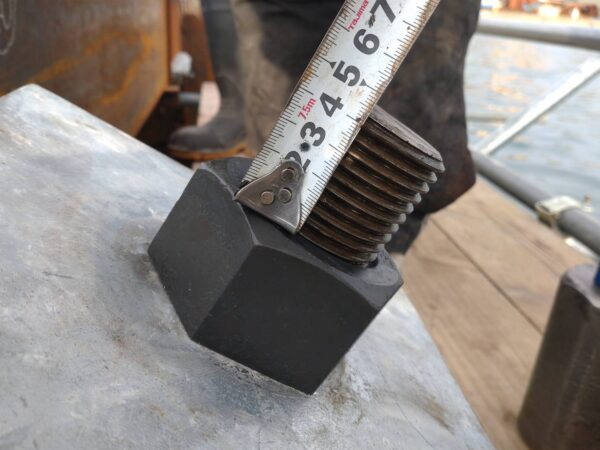
A distinctive feature of SE's table anchors is that their heads are threaded.
By tightening the screws while the tension is applied, you can minimize the loss of initial tension as much as possible.
This part of the screw is called the "apartment."
As for other ground anchor materials, since PC steel strands are available, there’s no need to worry too much about them, but,
With SE's table anchors, you really have to be careful about how much of the head is exposed.
Since the length of the threaded portion of the screw in the apartment unit is limited, the screw must be within that range.
Although there are differences in thickness and specifications, the range is approximately 100 mm.
You must fit your head within this space.
And the problem is Yoshihori.
| "Yohori" refers to the process of drilling approximately 100 mm deeper than the anchor tip to create a pool of slurry during drilling, with the aim of ensuring a secure anchorage for the anchor. |
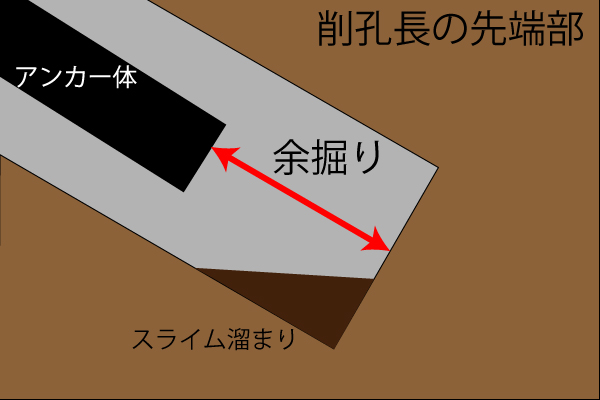
Although this is sometimes included in drawings, many designers include it without really understanding what it means, and
It has long been used in design consultingAncient BlueprintsSince I'm using it, I don't think I'm worried about it lol
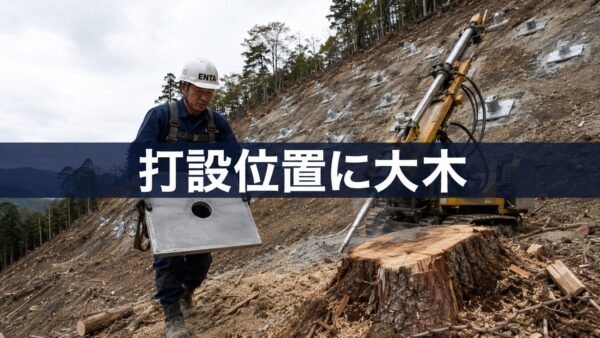
On-site, SEEE's tie-back anchors cannot be adjusted if there is excess excavation.
Some people might think, “Why not just raise it?”, but,
It's not easy to pull up an anchor that has cement slurry inside it—especially one that's embedded deep into the ground.
Even if you raise it, it's quite a challenge to keep it in place.
So, in terms of construction,For tie-back anchors, it is preferable not to dig an additional trench.That's it.
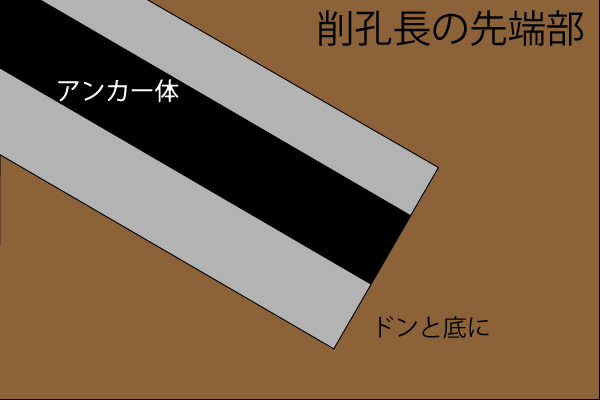
Inspectors sometimes tell me this, but,
It's perfectly fine if the story gives the impression that everything is being blown away using air.
Photographs showing the condition of the borehole cleaning at that time are required.
And be sure to blow it away thoroughly.
See you later