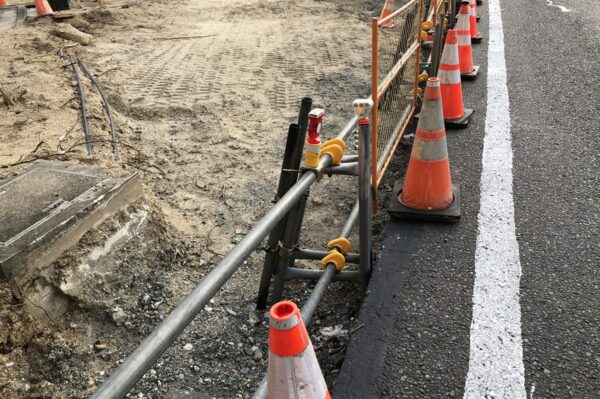
I came across an interesting scene at a retaining wall construction site
Right now, I’m working as a construction worker and CAD operator at a road construction site. It’s a large site with an incredibly wide variety of tasks. I took this assignment because I thought I’d be able to see just about every aspect of road construction here.
I immediately came across an interesting scene at the site.There was an incident in which grout leaked into the ground through the ground anchors used in the retaining wall construction.This was something I hadn’t anticipated during my time as a consultant, so it was very interesting to see how things unfolded.
Apparently, there was a large crack in the ground near where the ground anchor was to be installed. When the grout was being poured in, it should normally have overflowed from the hole opening, but even after exceeding the designed volume, it did not overflow, so it was impossible to confirm whether the hole had been completely filled with grout.
Based on this observation, we hypothesized that there were numerous large cracks in the ground and that the grout might be leaking into them. Consequently, we considered two potential countermeasures: (1) the use of gel-like grout, and (2) the use of friction packers.
In conclusion, we opted for Option ②, the friction packer. We also tested Option ①, the gel-type grout, as a pilot project. We had thought that a gel-type grout might prevent the material from migrating into the cracks, but the results showed that the gel-type grout also migrated into the cracks.
Based on this observation, it was concluded that the crack was larger than originally anticipated. Consequently, it was decided to use the friction packer described in (2).
A friction packer covers the anchor’s anchorage section to prevent the grout from leaking out. The material of the friction packer contains small gaps, and the grout seeps out through these gaps to create friction with the surrounding rock mass. This is how the anchor is secured to the rock mass.
I came across an interesting phenomenon during ground improvement work
We also observed some interesting phenomena during the ground improvement work.Rather than improving the underlying soil, it became necessary to carry out soil improvement as a water-stopping measure behind the retaining wall.
Among the various ground improvement methods using jet grouting—a high-pressure jet-mixing technique—a method capable of high-speed operation, large-diameter application, and creating a semicircular improvement area was adopted. This decision was based on the belief that it would reduce the volume of slurry discharged, thereby enabling faster and more cost-effective construction.
In this project, the goal is not to improve the ground itself, but rather to achieve a water-stopping effect. In other words, the objective is to construct a water-stopping wall behind the retaining structure, and the ground will be improved only to the extent necessary to achieve this water-stopping effect.
On-site, ”unexpected events” keep happening one after another.
While proceeding with construction on-site requires adhering to the design plans, not everything goes exactly as planned. It is necessary to move forward with construction while making design changes as needed based on on-site conditions.
Things that weren’t anticipated during the design phase can happen one after another on-site. The leakage of grout from ground anchors is one such example.
In fact, when I was working as a design engineer at a construction consulting firm, it never occurred to me that the grout for ground anchors could leak into the ground. Since I hadn’t anticipated this during the design phase, I didn’t include it in the handover notes.
When I asked an expert in slope stabilization, they told me that the migration of grout is not an uncommon occurrence. There are many things—including incidents like this—that you simply can’t understand unless you’re on-site. You can observe all sorts of things at the job site.That's exactly why working on-site is so fun!