



Hello, everyone.
This is Enta.
Are there any criteria for deciding whether to use temporary spray-applied coating?
Since material was wearing away too quickly at this site, we applied a temporary spray coat first, followed by the final spray coat.
When the ground conditions are poor
No matter how hard I try to stack the bricks, they just keep falling apart.
There are frequent rockfalls.
The slope is steep and slightly overhanging
You can still get scrapes even from a light, misty rain.
Excessive excavation during drilling (when correcting with sprayed concrete)
Is this what you had in mind?
In situations like this, we perform a temporary spray application. (Temporary spray application)
By doing so,Safe ConstructionNot only is it possible, but it also makes installation easier.
Rockfalls are particularly dangerous, so I recommend using a temporary blast.
After planing the wood, I'll nail down the lath, but,
A common question that comes up at this point is, “Aren’t the ‘temporary blow’ and the ‘final blow’ separate?”
That's certainly possible, but it's not a problem.
That's because mortar is sprayed to smooth out unevenness on slopes.
Since that mortar will be located beneath the designed structure, it is considered part of the natural ground.
Temporary sprayed concrete shall be treated as natural ground.That's the way it is.
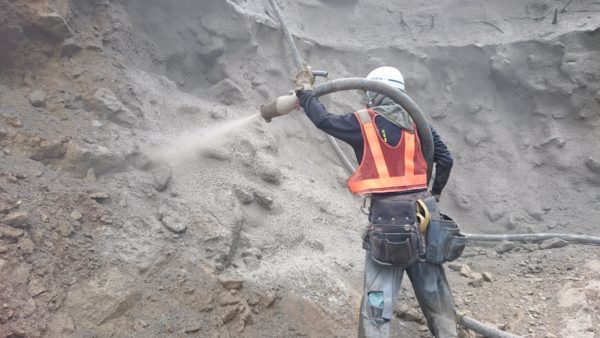
That means it doesn't need to be that strong, so even a low-strength mix is acceptable.
Well, if the quantity is small, I guess I'd just use the standard mix.
As long as the strength is equal to or greater than that of the natural ground, there is no problem.
It amounts to a "throwaway" mindset.
When the natural ground is unstable, install temporary shoring to ensure safe construction.
It’s also possible to bring the matter up for discussion at the local government office and have them review the design, so in some cases, having them review it might save you from having to come up with those “magic words” or get creative lol.
See you later.

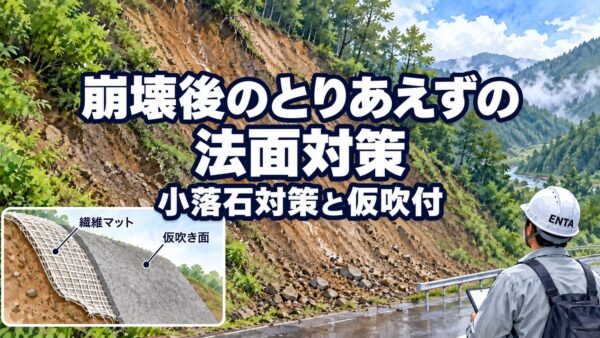

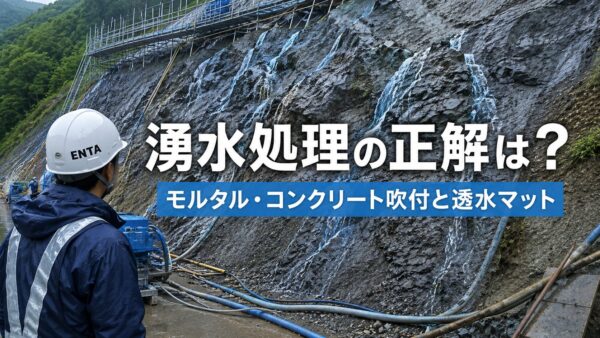
Depending on the soil conditions at the site, I also use temporary spraying for excavation work on the foundations of structures such as abutments and erosion control structures, in addition to spraying applications.
If you have a good project manager, they’ll budget for design changes, but if you get a cheapskate, they’ll pull out those magic phrases like “creative solutions” or “corporate efforts.” Of course, this assumes you’ve gone through the proper consultation process, but even though avoiding accidents is the most cost-effective approach, dealing with a project manager who refuses to make changes—citing excuses like “the budget won’t allow it” or “we need upper management approval”—is honestly exhausting (^^;)
Government agencies use way too many magic words! It’s like, “Is this Harry Potter or something?!” lol
When you prioritize safety, sprayed concrete really is important, isn't it?
I mostly work with general contractors, and while good site supervisors will tell me right away that they’ll make design changes, those who are too concerned about their superiors and colleagues will ask me to “use my creativity and initiative” or “make it work within the company’s resources.” But when the site supervisor is with colleagues or superiors at the office or elsewhere, I use the magic phrase: “Mr./Ms. OO, is there any way we could increase the budget for that OO project? ...and since I think they’ll get the hint, I use the magic phrase, “Mr./Ms. OO, you owe me one!” (lol). Since this is a rural area, there’s a huge difference between supervisors who can get things done and those who absolutely can’t (lol).
There's quite a difference at local government offices in rural areas, isn't there? lol
There are significant differences even among the prefectural officials, but they do tend to be somewhat flexible.
It has its pros and cons, but that's part of the technique, isn't it?
It's going to get hot, so let's do our best!