



Hello, everyone.
This is Enta.
Now that the Cherry Blossom Festival is over, things have settled down completely.
Things have calmed down a bit at work, but...
I'm thinking, "This is bad" (lol)
There are two scenes left over from last time involving Sakamaki that are really heartbreaking, but for some reason, I just can't seem to make any progress on them...
I can't help but wonder, "What's the deal with Sakamaki?"
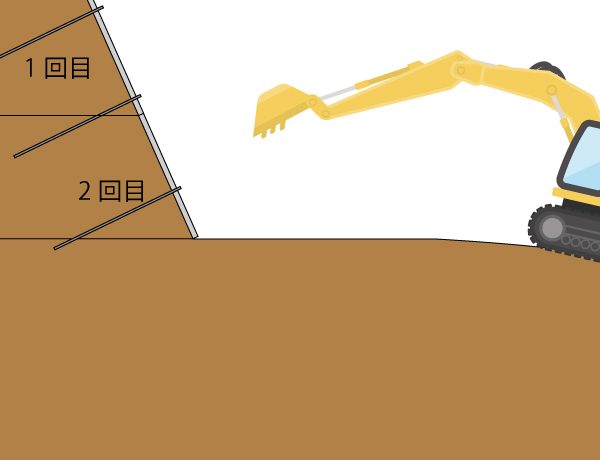
We handle the shotcrete and drilling in-house, so there are no delays there, but the earthwork is causing delays.
The same could be said for earthwork contractors, so I guess we’re all in the same boat.
Every time I do the Inversed Roll, I find myself thinking, “I wish I could do this more efficiently.”
But that's beside the point.
Here's the rod on the suspended core drill—it's broken (lol).
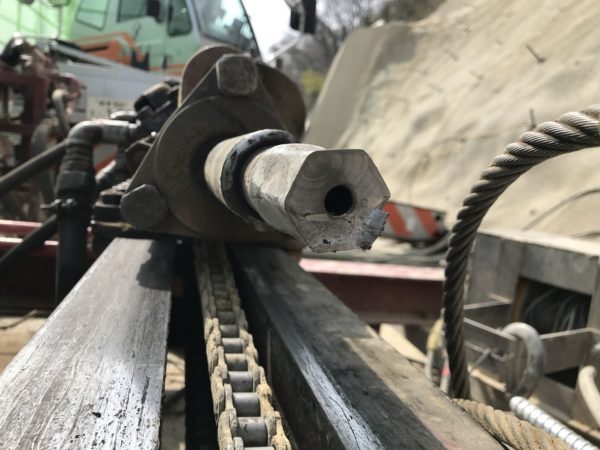
As you might expect, it breaks where the stress is greatest.
As for why they break, it’s either due to inadequate drilling techniques or metal fatigue in the rod itself.
When a rod breaks due to metal fatigue, it usually breaks at the base.
It often breaks at the junction between the sleeve and the threaded section, but this time it broke a little past the base.
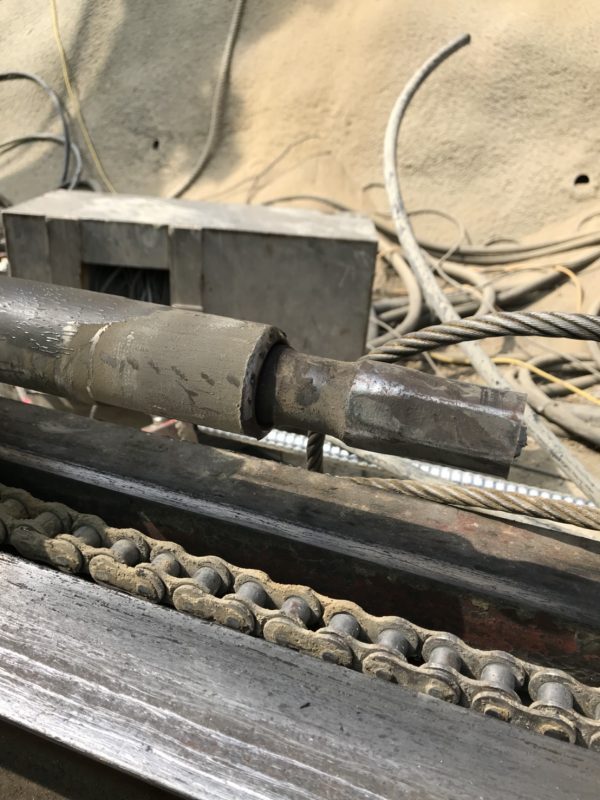
Since the sleeve was brand new, it’s highly unlikely to break.
In conclusion, this means that the drilling was not done properly.
This suspended drilling rig actually seems simple, but it’s actually quite difficult.
It's especially about controlling the force. Since it's air-powered, that's particularly important.
Because the impact is so powerful, the more you push, the deeper it tends to dig in.
Perhaps because of this, one of the features of this machine is that it allows you to drill holes to a certain extent even if you’re not very skilled.
A tip for drilling is not to press too hard.
If the rod looks bent, pull it back a little.
Do not practice empty swings.
Since we can't control the feed pressure, we'll check it visually.
It's best to drill the hole while keeping the rod straight and making sure it's not striking empty.
The key to determining whether it's a blank swing is whether the shank rod is being pushed down.
*If the tension wire is working properly, you can push it quite far.
My youngest had surgery, so I'll turn a blind eye this time (lol)
New operators should carefully check the condition of the rod before drilling.
See you later.


It's also important to keep an eye on the slime output!
If you make a mistake, the rod will get stuck, and the “drilling time << extraction time.” Even with self-drilling rods, there’s a higher risk of insufficient cement slurry filling. It’s not a world where “it’s all about how much you drill”; it’s all about the finish.
Thank you for your hard work.
That's exactly it!
It's all about the finish, isn't it?
I was actually thinking of posting a slime-spawning video next time~
Are you a psychic, by any chance?? lol