Hello, everyone.
This is Enta.
How are test specimens for compressive strength testing in sprayed concrete prepared?
If you're not familiar with the situation on the ground, I think you'd be like, "Huh?"
In this post, I’d like to explain how to make test specimens.
The procedure for preparing test specimens for basic shotcrete is as follows:

This is it!
I imagine there are some of you who haven't seen it before.
Here is a proposed method for preparing test specimens for compressive strength testing of sprayed concrete (mortar)!
This is just a suggestion, so it's not set in stone!
The opening at the bottom is designed to allow excess spray to fall out easily.
(JSCE-F 561-2005)
| Uses | a | b | c |
|---|---|---|---|
| Tunnel | 500 | 500 | 150 |
| slope | 300 | 300 | 200(4) |
| Repair and Reinforcement | 300 | 300 | 150 |
Here's an idea of the size.
It seems a little large in terms of size, but this is just a proposal based on JIS standards.
It's like, "Please do it in this kind of atmosphere."

Then, we lean these panel forms against the slope or wall and apply the spray.
Back in the day, even though this was just a proposal, there were contractors who just wouldn't be satisfied unless everything was done exactly according to JIS standards...
Memories of a difficult time
After all, it was so big that I often couldn't even hold it lol
This is the general proposal for the JIS standard, but what about the actual situation on-site?

This is it.
This is common practice at construction sites and other locations subject to legal regulations.
We use materials that comply with legal requirements.
Although some say it differs from JIS standards, since we use the legally required mounting brackets, the Slope Engineering Association’s publication states that it is acceptable.
Since this is mesh designed for actual formwork, it helps ensure that any waste from the spray application (mortar that doesn't mix well) is easily blown away.

It turns out better than I expected.
To make it easier for some people to dispose of this, they've designed it so the mesh can be easily removed, or added handles to make it easier to carry.
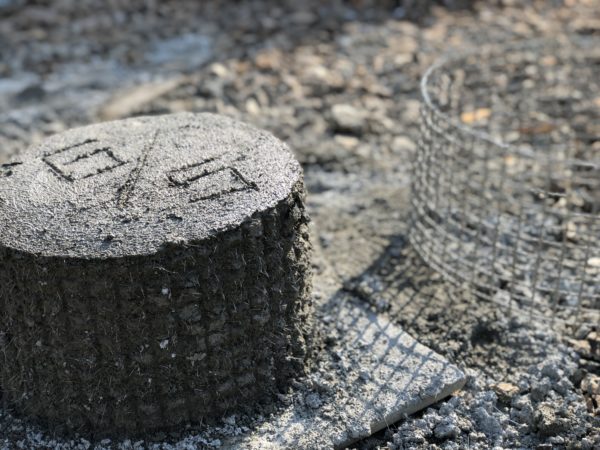
I'll shape the mesh into a circle and spray it on.
Then, once it has hardened to a certain extent, remove the string tying the mesh so that it can be sold as a bundle.
Having a net raises disposal costs, lol (A tip for cutting expenses as a director)
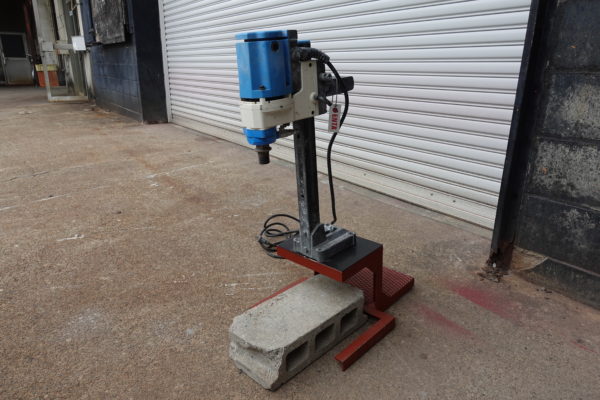
After that, we remove the core and perform a compressive strength test.
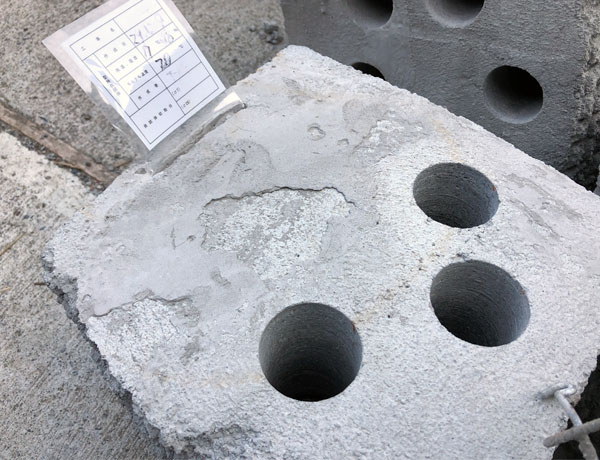
It's just a small thing, but since it might be hard for people who aren't familiar with it to picture, I decided to write about it this time.
See you later.