



Hello, everyone.
This is Enta.
Kagoshima really is hot.
It gets a little chilly in the mornings and evenings, but during the day, it’s the height of spring and the weather is lovely.
If only there weren't any pollen, though...
But compared to Shizuoka, the amount of pollen isn't that bad, so I'm really grateful (lol).
But that's beside the point.
Safety Measures for Spray Application
Usually, at our job sites, when we’re doing work like applying concrete to the shoulder, one person holds down the plywood to prevent it from flying around while the others are spraying, right?
But actually, the stones tend to bounce off the plywood and fly around more than you'd expect.
If you don't set the angle of the plywood at a sharp angle toward the slope, it'll bounce off the top and end up flying away.
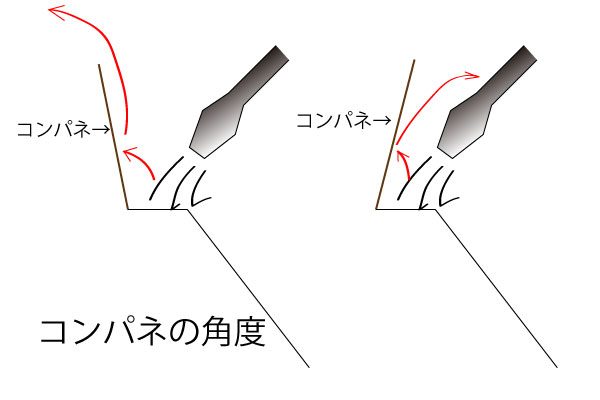
This is the general idea, but if there’s a residential street behind this plywood panel, it could be a real problem if stones fly back that way.
It would be fine if it were just a complaint, but in the worst-case scenario, it could escalate into issues such as compensation.
Someone created it in the style shown below, so I’d like to introduce it here.
It is designed so that the splash guard net can be easily moved and used by hand.
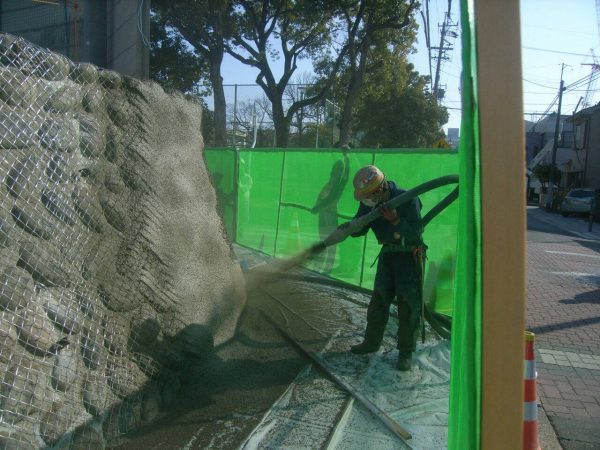
In this photo, there is a splash guard net in the background, but of course, it can also be used to prevent splashes from flying backward.
Since it's a splash-proof net, air can pass through it.
The spray application uses compressed air to apply the material.
If you block the airflow with a plywood panel, there is a possibility—albeit a small one—that the panel could be blown away.
There are also some risks involved. It’s extremely important that air can flow through.
It also prevents stones from flying off. The net absorbs the impact.
It just hits the net, loses its momentum, and falls. The stepping stones are hard to see with the naked eye.
Another important point is that mortar splatter sticks to the netting, preventing it from scattering.
There's usually a little splash, but it really splashes when it's windy.
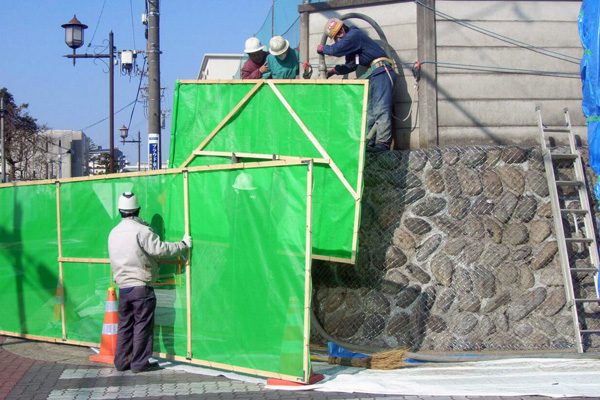
The mesh, which allows air to pass through, catches it, making it perfect for preventing it from scattering.
In fact, NEXCO also uses anti-scatter netting on the frameworks made of single-wall pipes along the roadside, doesn't it?
In our case, it doesn't have to be anything too elaborate, but little touches like this are nice, aren't they?
Even the smallest adjustments are incredibly important on-site, so I really love little tweaks like this.
Always think and always act.
It’s better to try and fail than to regret not trying at all.
See you later
There are products like this, but they aren't strong enough for spray application. Still, if an improved version comes out, maybe it'll work for spray application too?? lol I'm looking forward to it.
*If you share your on-site tips with me, I’ll be happy to publish them.
I hope that we slope contractors can share our best practices with one another.
However, I can't promise that it will definitely be published. (I'll decide based on the situation.)


That was a real eye-opener! I’m always in awe of the ingenuity and resourcefulness of the people on the front lines.
Thank you as always.
The people on the front lines really come up with all sorts of creative solutions, don't they?
Tricks like this really come in handy!