Hello, everyone.
This is Enta.
Are there times when the compressive strength test results aren't available?
That's happened to me a few times in the past, too.
I’d like to write about the measures we took at the time and how we went about identifying the cause.
Generally, we do a test application before proceeding with the actual work, but there are some areas where that isn’t done, right?
However, if the required strength is not achieved in the area where the work is being performed, we cannot proceed with the main construction, so we need to identify the specific causes that led to this outcome.

When a problem occurs, it is important to clearly identify the cause.
In the case of cement slurry
Ingredients
Cement: Is it fast-setting or regular?
Water: Is it just regular water? A hot spring area? A river? A lake? Tap water?
Machinery
Mixing: Hand mixer? Stand mixer? Large mixer?
Environment
Temperature: Below freezing? Scorching hot? Comfortable?
Method: How was it made?
Test Center: Public? Private?
Condition: Sulfur capping? Polishing? Other methods?
I think the above breakdown is generally accurate.
I think the cement should be fine.
This is getting into some pretty fundamental stuff, lol.
I don't think the water will be a problem unless you're in a hot spring area.
We use a hand mixer for small-scale projects or when we can’t bring in machinery at that time.
Please take care to pay close attention to the mixing time and other factors during this process.
I get the feeling that, in most cases, it tends to depend on the environment.
In the case of grout, if it is cured on-site in the open air and the surrounding temperature drops below freezing, the development of strength will not be significant.
However, as long as the strength is sufficient under more severe conditions, there’s no problem, but,
This is a matter of the supervisor's judgment, so if the required strength cannot be achieved, using styrofoam formwork (for underground applications) might be an option.
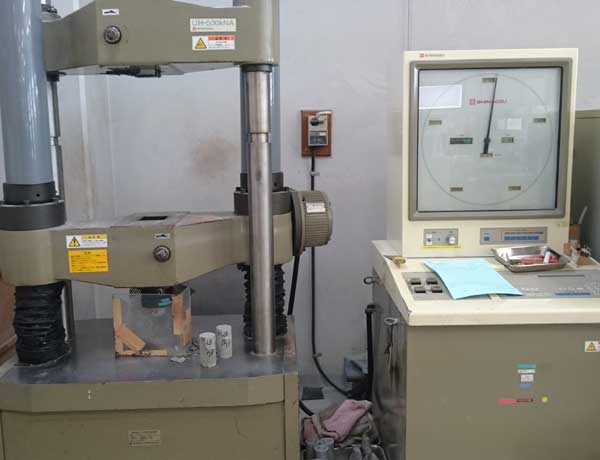
Whether the testing center is public or private is very important.
For public facilities, calibration tests are conducted regularly, and a concrete engineer always performs the crushing test.
If this were in the private sector... I can't even begin to say lol
During mock exams, it’s a good idea to separate public-sector and private-sector questions and use them as a sort of “second opinion”!
It's only natural to be suspicious of the lab as well.
Issues with machine calibration—is it automated or manually operated?
The same goes for capping—it’s something anyone can do, but depending on how it’s done, there’s a good chance it won’t be strong enough.
I recommend making it a little longer and polishing it.
What do you think?
Are there any other topics that can be broken down?
By doing this, we can clearly identify where the problems lie and apply that knowledge to future construction projects.
We need to be especially careful here, as it is essential to ensure compliance with quality standards.
When a problem arises, it's important to isolate the cause!
Of course, you should be skeptical of the person who created this, too, lol.
Please don't ever think that you, at least, will be fine.
See you later.