Hello, everyone.
This is Enta.

When you first become a director, it’s surprisingly just a matter of showing up on set and taking the photos you’re told to, isn’t it?
I, too, just followed my senior’s lead and did what I was told, and before I knew it, I was working as a director, thinking, “Well, I guess this is how it goes.”
If one of them ends up working on-site alone, it can lead to some serious problems.
Even though it's the same technique I used before, it's a different mountain! lol
Sometimes what the government office tells you isn't even in the book!
There are some things you should keep in mind when you're just starting out, so I'd like to share them with you today.

1. Carefully review the standard values and construction methods specified in the common specifications for the construction methods being managed
This is an absolute must.
It's pointless to even discuss this if you don't know the standard values.
You need to stay within the specified limits when using the standard values on-site.
For example, it might be a little too big or a little too small.
Civil engineering allows for quite a bit of flexibility (on-site ingenuity), so those standards serve as the benchmark.
These are the criteria for determining how to refine the final product.
It means that if you don't know that, there's no point in even talking about it.
2. Carefully read specialized books on construction
At our slope engineering firm, we have plenty of resources, including the Road Earthwork Guidelines, the Design and Construction Standards for Ground Anchor Works, and a wide range of other specialized books.
If possible, I recommend reading through it carefully beforehand. (You can do this when you’re ready to install it.)
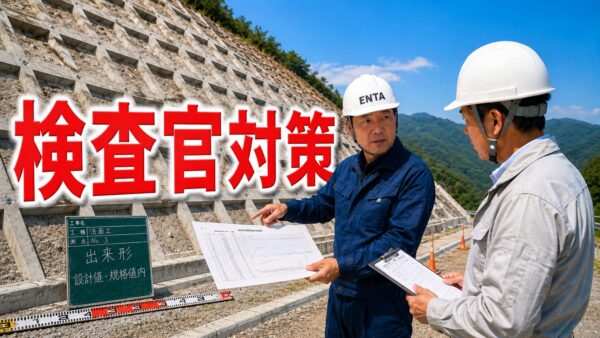
The reason for this is so that we can answer questions from government officials immediately when asked during inspections or similar situations.
I think whether or not you can answer this right away will affect how the government agency perceives you.
For example, let's say a salesperson comes by to sell something.
When you ask a salesperson, “What does this mean?” there are those who answer immediately, and
How much trust do you place in a salesperson who says, “I’ll get back to you a little later”?
That's not the whole story, but it does make a slight difference in how it comes across.
And if you know what’s written where in the book—or roughly where in the book it’s written—then,
It's very useful when drafting a memorandum of understanding.
Generally speaking, government agencies don't like doing things for the first time.
The memorandum states, “The technical documentation reads as follows,” and “Past performance records are listed here.”
By scanning, attaching, and submitting the documents, it will be easier for the construction supervisor to explain them to the section chief or deputy director at the municipal office.
As public works contractors, we are inevitably bound by our past track record and the literature, so,
Please be aware of what is written in each book and how it is presented.
3. Since real-world applications aren't covered in the book, you should be familiar with a wide range of interpretations of the material in the book.
The finer details of the field aren't even covered in specialized textbooks.
However, sometimes it’s included in a subtle, understated way.
It doesn't say "absolutely," but rather gives off a vague impression that "this is sometimes done."
Since it can also be interpreted in the opposite way, how you phrase it is important.
How you interpret this is where your skills as an engineer really shine. (Writing skills are important.)
For example, even if there are some locations where the anchor installation positions exceed the standard values,
In cases where the pitch is smaller in certain sections within the total length, and only a portion exceeds the standard (with the number of piles remaining unchanged),
If we have no choice but to do so, we will discuss it accordingly. (The number of cross-sections will remain unchanged in the design.)
While there are some methods that are a bit forceful, the direction you take will depend on how you interpret the book.
Please try to mentally reconcile what you see on-site with what you read in the book.

4. Carefully review the construction plan
Surprisingly, many people tend to overlook this aspect, but the construction plan is extremely important.
Construction at the site will proceed based on the Basic Construction Plan.
However, these are not just documents to be submitted to the government office.
"We will use this construction method, these materials, and this equipment, and follow this sequence of steps."
"Take photos here, bring industrial waste here, and the route for transporting excess soil and the safety measures are as follows..."
It's stated in the construction plan!
If I use a copy of a construction plan my senior made, something is bound to go wrong lol
Be sure to review the construction plan to confirm that it truly fits the site conditions and that there are no issues, and then proceed with implementation.
To put it another way, when a company declares, “This is how we’ll carry out the construction!” to a government agency that has approved it,
That means you don't need to do anything else.
"Since that wasn't included in the original construction plan, we can't do that."
"We can confidently say, 'If you give us the go-ahead for the changes, we'll draw up a revised construction plan and carry out the work!'"
Of course, since money is involved, it’s very important to get a written instruction.
(I'm only human, so I don't approach everything in a completely detached way, but this is just my way of thinking, lol.)
If you keep the above in mind when you're just starting out, you'll run into fewer problems in your future career as a director.
There’s a world of difference between knowing and not knowing. (The gap between knowledge and experience is quite huge.)
Once you reach the mid-level, I think you'll need skills like design calculations and cost estimation, but I'll save that for next time lol
See you later.