

Hello, everyone.
This is Enta.
The three-day weekend, which included the Coming-of-Age Ceremony, has come to an end.
All over the place, all kinds of 20-year-olds were appearing on TV lol

It's great to have that youthful energy!
I know that, in reality, a lot of those kids are actually pretty serious and well-behaved.
When you're young, it's better to stand out and go all out,
I feel like as I get older, I’ll be able to be a little more tolerant of younger people, lol.
But that's beside the point.
Compressive strength tests can be pretty inconsistent, can't they?
Don't you ever find yourself thinking, "Isn't there something we can do about that?"
A long time ago, when an inspector asked me, “Why is there variation?” I couldn’t answer.
After that, I spent all my time in the ready-mix concrete company’s testing lab,
I grilled the concrete engineer with all sorts of questions and asked him a million things, lol.
It was a huge help that you even recommended some books to me.
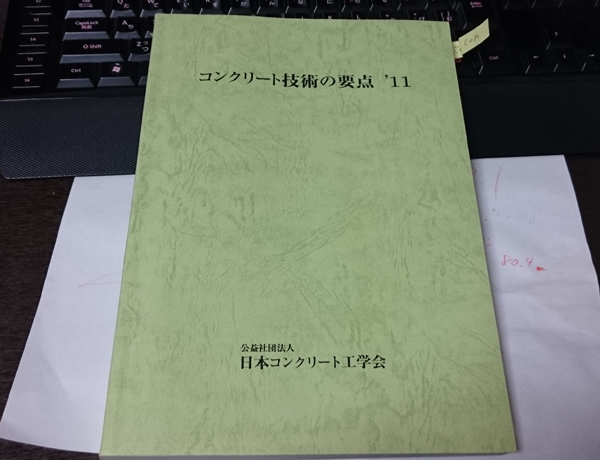
They even have books like this—which you wouldn't expect from a construction company lol
It's full of niche books.
But it really does benefit me, doesn't it?
I can learn things down to the very depths, but my "special talent" for forgetting things in the exact order I learned them is really in full swing lol.
- In fact, one cause of the variation is that the test specimens burst all at once due to their small cross-sectional area (small cross-section under compression).
- The smaller the volume, the less viscous it is.
- The side of the borehole undulates during core sampling, causing an uneven load.
Points 1 and 2 have their drawbacks due to the small cross-section, but I really don't want to make this one φ100 or anything like that lol
So, I'll just have to be patient here.
If you remove the core carefully, the sides won't warp that much, but,
I just can't help but press down on the corer.
I just want to get it over with, lol.
When you accept that this, too, can't be helped,
If you want to stabilize things quickly,
This applies only to underwater curing.
Immediately after sampling, the specimens are cured in water and removed one day before the strength test.
By conducting the test at a later date, we can recreate the same conditions as on-site.
Doing so will significantly reduce variation.
In addition, it is possible to increase toughness and improve ductility by incorporating fibers and other materials.
By letting it set, it won't crack instantly, so it becomes more stable.
Fiber has recently become a go-to material for creative and ingenious ideas.
It's about time fiber optics reached the city hall.Of courseI hope no one says something like that, lol.
By the way,Of courseThe antonym of *is* isThank youThat's it.
See you later.