Hello, everyone.
This is Enta.
There are often people who say, “Just give me some drawings—even if they’re for a similar project, that’ll do for now.”
Even if the construction projects look similar, the details are totally different (lol)
But I guess I don't like the way they handled it, so I'm acting a little weird, lol.

But handing over drawings like that wouldn't do any good, and it would be a hassle if they asked for revisions later on.
If you don't understand, that's fine—it's actually easier to just talk directly to the government office or the general contractor lol
However, for some reason, people who say that rarely let me speak with them directly.
I wonder why... lol (Oh, maybe it's because I haven't signed a contract?)
It doesn't really matter either way—I just want to do a thorough job since we're going to the trouble of doing it, right?
Please give me all the design calculations and other documents before any trouble arises! lol
But that's beside the point.
Doubting
People often talk about disaster prevention construction, don't they?
The other day, I was talking to someone and it helped me let go of my resentment, but,
"I knew it!"
You probably think our slope stabilization company does disaster prevention work, right?
But I was wondering if that wasn't actually disaster prevention work.
Usually, the construction work is done after a landslide, right?
What's more,A mountain that has collapsed once is actually safeThat's just how it is.
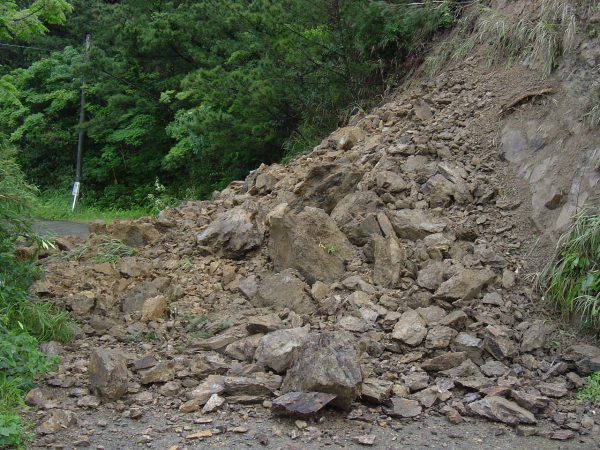
Slope contractors specialize in slope protection work.
Building a new one is a whole different story.
It’s protecting the collapsed slope, but since the slope has already collapsed, there’s nowhere left for it to collapse any further. (Although the overhang will fall.)
I know I’ll probably get a lot of flak for writing this, but it’s the truth. (It’s necessary to protect the damaged surface.)
If someone asks, “So where is it going to collapse?!”—it might be the right slope, which hasn’t collapsed yet. Or it might be the left one.
No one knows for sure. However, one thing is certain: the slope remains intact.
Disaster prevention refers to measures taken to prevent disasters before they occur.
As mentioned on this wiki, people these days seem to refer to the entire process—from the disaster itself to recovery—as “disaster prevention,” but,
From the perspective of true disaster prevention, there’s a general sense that prevention means stopping things before they collapse, right?
Sure, if you think of it as disaster prevention—making sure things don’t collapse any further after they’ve already collapsed—then I guess that’s what it is, but… it just makes me go, “Hmm.”
However, in Japan, measures are taken only after a landslide has occurred or signs of instability have appeared; so, from the perspective mentioned above (that a landslide-prone mountain is safe),
It doesn't really feel like disaster prevention. (Though there are other reasons as well.)
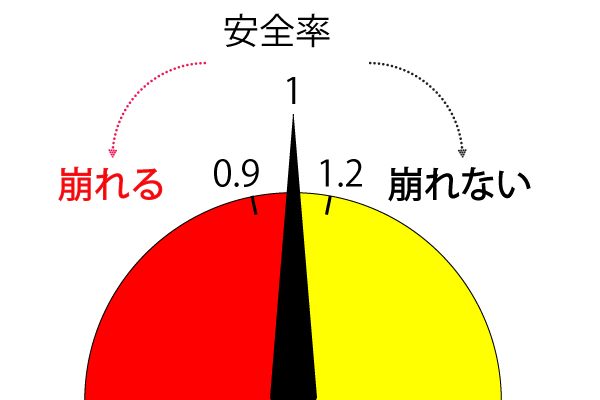
Also, when designing, there is a safety factor; we use 1 as the baseline to determine whether a structure will collapse or not.
This is a state where 1 has not yet collapsed. We consider values between 0.98 and 0.93 to indicate that collapse has begun or that some deformation is present.
To put it simply, the probability is 50%.
For major roads, we will raise the safety factor to 1.2.
Methods for lifting include installing steel frames, inserting rebar, and installing ground anchors.
In other words, they raise it in various ways.
I'm not necessarily disputing this, but sometimes figures as low as a safety factor of 0.6 even appear in the current situation.
Wait... aren't there any mountains left?? ... (Is it okay to interpret this as them collapsing the moment you start digging? lol)
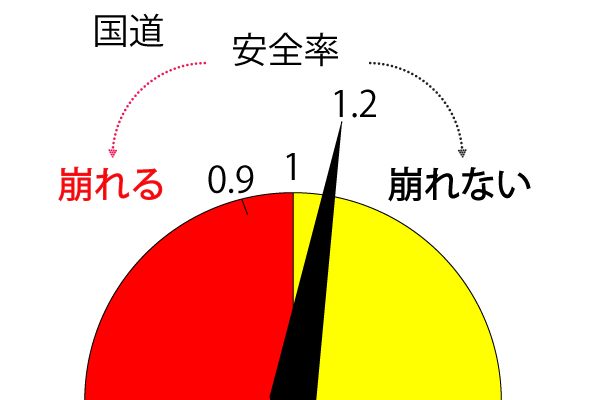
We apply the same safety factor to mountains that have already collapsed. (Even if a collapsed mountain has stabilized, we add a 20% safety factor as a precautionary measure.)
Since I, too, have been designing and constructing projects exactly as I was taught, there’s no doubt about it, but,
I’ve been wondering about something someone told me a long time ago.
That little encounter I had this time made me realize, "Ah, so that's how it was after all," and turned my hunch into certainty.
That said, it’s not as if anything is going to change from now on, but,
I realized once again how important it is to ask questions.
It really is important to question everything that exists right now.
I think it would be fun if I could change that, even just a little at a time.
See you later.