Hello, everyone.
This is Enta.
The other day, I spent a day on site. It had been over half a year since I’d been there (lol).
Working on-site really is tough!
That's the bottom line.
I really appreciate it!
Whether it's hot, cold, or tough, they're doing a great job.
I can proudly say, “Our employees are the best!”
But I'm already swamped, so I can't take on any more work, lol.
But that's beside the point.
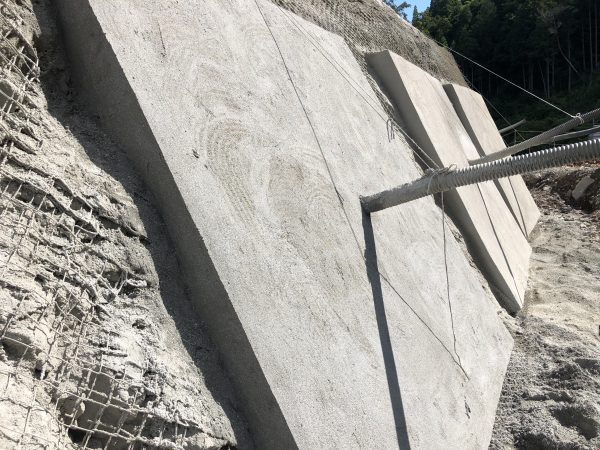
When drilled using the double-pipe drilling method, the borehole becomes self-supporting.
Even on a slope that would never be stable with a single borehole, a double-pipe system leaves a gaping hole in the slope and makes it stable, doesn't it?
Often, when a test borehole is drilled in the presence of government officials to prove that a single borehole is not self-supporting,
Assuming that single-hole drilling is not possible, we will bring a standard rotary percussion drill and perform a test drill.
Since it involves the effort of transporting the equipment, if you ultimately decide to use the double-pipe drilling method,
We'll also bring a rotary percussion drill for the test drilling.
However, there’s a major miscalculation here, but,
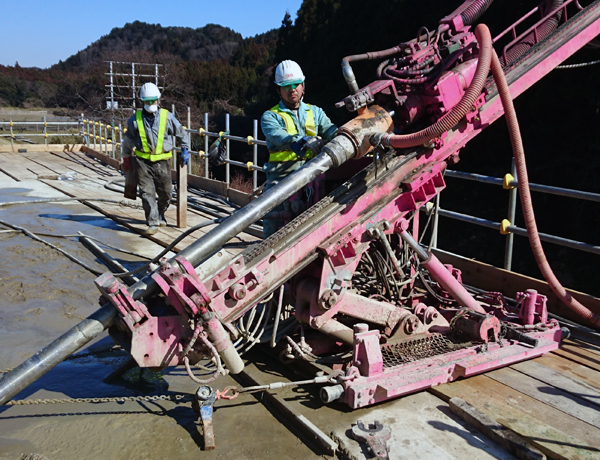
When drilling a φ65 hole with a single-spindle drilling machine versus drilling with the inner bit of a rotary percussion drill,
It does not stand on its own with a single-hole drilling machine, but it may stand on its own with a rotary percussion inner drilling machine.
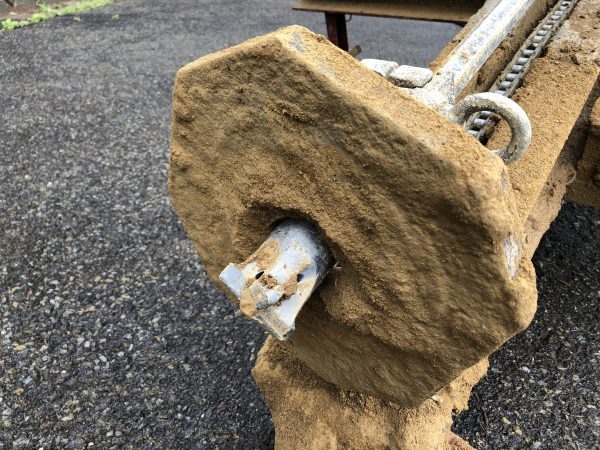
It's a little hard to see, but the rod on the single-hole drilling machine is about 30 mm in diameter, and the drill bit is 65 mm.
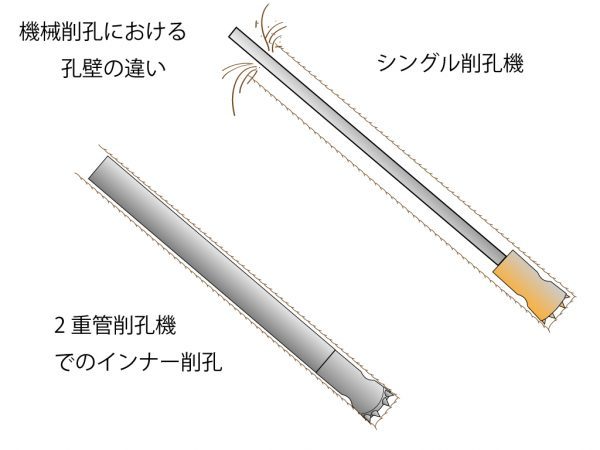
The top part of the picture is single.
The bottom part is an inner bore.
Although the difference is obvious at a glance, double-pipe inner drilling allows you to drill while simultaneously forming the borehole wall.
That said, it's only temporary.
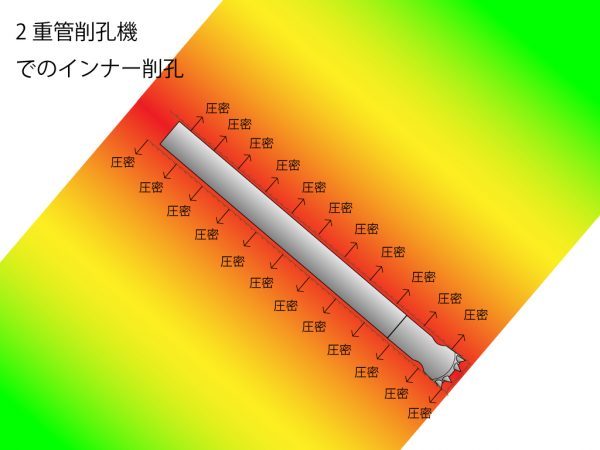
Because the inner drilling rod is thick, it can advance while consolidating the borehole wall.
Drilling slurry is discharged, but some of it remains on the borehole wallAs consolidation occurs, the borehole walls become self-supporting.That's the way it is.
For test drilling, rather than using a rotary percussion drill for the inner bore, use a reducer (rod adapter) to
It's better to drill the hole using a self-drilling rod or similar toolShowing a non-self-supporting borehole wallYou can do that.
A long time ago, when I was on-site for an inner core drilling project, someone from the local government office said to me, “Huh? It stands on its own!” (lol)
However, please keep in mind that even though we say it’s becoming self-sufficient, this is only a temporary situation.
See you later.