

Hello, everyone.
This is Enta.
The 65kg core drill I introduced the other day has turned out to be an ultra-lightweight core drill that can be operated with a crab crane, lol.
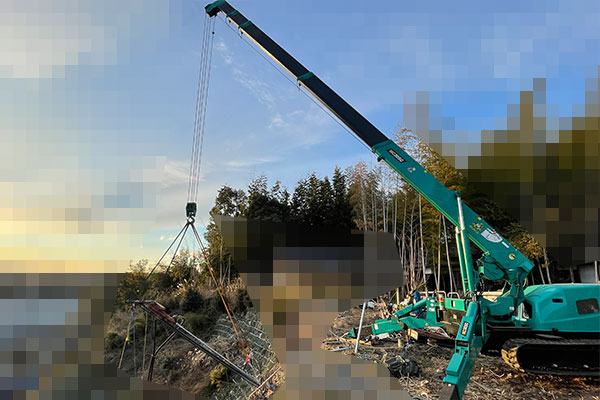
Since construction is currently underway, I can't show you too much of it, but this is what it looks like.
The crab crane shown in the photo is the MC305C-3 model manufactured by Maeda Seisakusho, and it weighs approximately 4 metric tons.
Personally, I didn't have much confidence in the crab crane—I thought it would tip over easily—so I opted for a larger model for the installation.
In fact, even the MC285C-3, which is one grade lower, seems capable of handling the load adequately.
The Crab Crane is especially safe—it’s so stable that it won’t tip over unless you do something really stupid, lol.
Old crab cranes used to tip over a lot, so I made some modifications to the legs... (I'll leave it at that)
For now, I'm using a winch to feed the material, but I plan to switch to an air motor.
Since this design would likely be easy to build as a skid-type system, we could take it straight to the job site if we just need to drill holes in the single-pipe sections, and,
At worst, you can just take it apart and carry it by hand.
This is probably best suited for small lots.
Currently, for a borehole diameter of φ65 × 4.0 m, the maximum number of boreholes that can be drilled per day using the suspended drilling method is approximately 8 to 10.
If the work is done manually, you can complete a maximum of 4 to 6 units per day. (Once you get the hang of it.)
Since manual transport is quite difficult, the amount of work we can complete decreases.
Since it’s essentially a rock drill, it performs well on hard rock, but it struggles on soft, crumbly mountains.
After all, the mountain can't stand on its own, lol (I'll try to make design changes as much as possible)
Since it swivels, it's convenient that you can use it near water.
Since the unit is just under 3 meters long, it fits in a HiAce, making it easy to transport to the job site—that convenience is definitely a plus.
DemeritIt really isn't very powerful for a drilling machine.
If you push too hard, the air pressure will cause it to stop.
I guess you just get used to making those kinds of adjustments.
So, I guess I shouldn't expect too much—I should just think of it as a machine that can drill holes for now, right?
It's a bit of a hassle because it's so light that you have to make sure to apply enough counterforce.
Anyway, this is the kind of drilling machine I have, lol.
I'm going to try making a few more improvements to make it easier to drill holes.
If I get lucky, maybe I'll try selling it~ lol
We're also testing another hydraulic drilling machine, but,
I'm looking forward to it, since the guide cells for that will be finished this week.
I'm not sure if it's okay to post (or show) this, so I'll hold off until I can confirm it.
Things seem to be settling down overall, so I guess we'll be seeing more of these kinds of machines being built and repaired, lol.
Also, since the government seems to be issuing carryover orders left and right, I’ve been helping out more and more with the cost estimates and design work related to those projects.
With today included, there’s just one month left in this fiscal year.
Let's make it safely through the end of the fiscal year!
See you later.