Hello, everyone.
This is Enta.
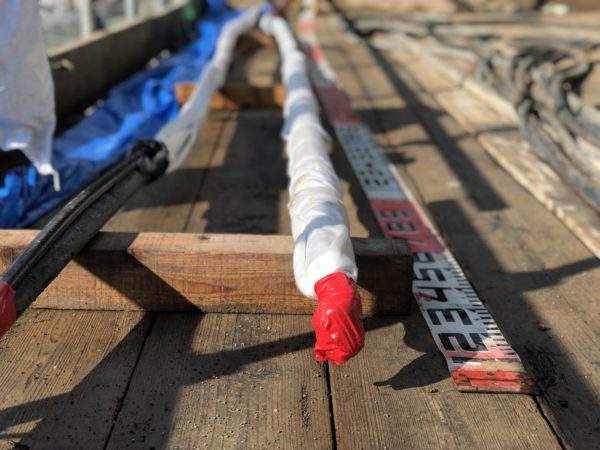
In ground anchor construction, cement slurry is injected into areas with numerous cracks (joints).
And with it leaking all over the place, no matter how much milk (I'll just call cement slurry "milk" from now on) I have, it's never enough lol
That's where the packer comes in, right?
Well, there are other ways to do it, of course, but for now, I'd suggest using a packer as a quick and easy solution.
Perhaps due to a common misunderstanding—or a lack of knowledge—some people seem to say that when using a packer, you can just do the injection all at once later on!
When using a packer, the injection must be performed immediately after the anchor is inserted!
I'll write down the flow here.
Installation Process When Using a Packer
1. Place the packer over the anchor body to prepare it (fasten it, etc.)
2. Double-pipe drilling
3. Retrieval of the Inner Casing
4. Insert the anchor with the packer
5. Outer Casing Recovery
6. Cement slurry injection
7. Done
This order is, in a sense, set in stone! lol
I'm not sure if I can say "absolutely," but cement slurry injection must be done immediately after the outer casing is retrieved!
For example, instead of injecting this, move to the next anchor, drill a hole, insert it, then move again, drill another hole, and insert it.
Injecting three doses all at once at some point during the day is an unthinkable procedure.
For ground anchor workers, the rule—or rather, the ironclad principle—is to finish one anchor, no matter what!
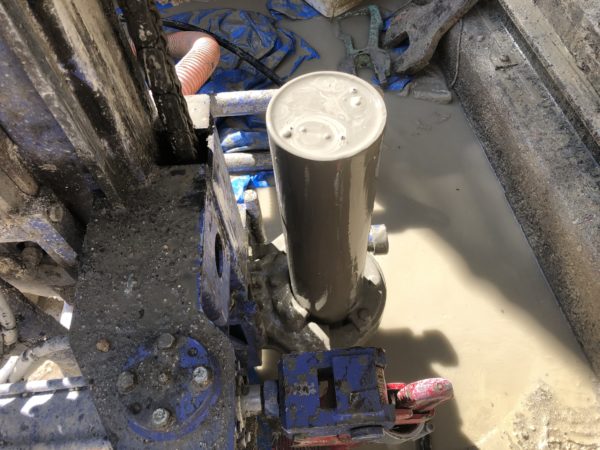
There are some exceptions out there, but when it comes to packers, this is the golden rule.
The basic premise for using a packer is that the application site has many joints and cracks.
It is also used in cases where a cement slurry cannot be set because it is being washed away by high-pressure groundwater or strong internal flow within the groundwater.
First, regarding the purpose of double-pipe drilling: it’s used because there’s a risk of the surrounding rock collapsing, and the double-pipe configuration allows for the precise construction of the anchor body.
We don’t know if the natural ground in the free-span section is stable, nor do we know where the anchorage is located.
That is precisely why, once the anchor is inserted, it must be injected into the packer immediately to inflate it.
In particular, there is a real possibility that the anchoring section could be softened by the drilling fluid.
Making careless statements and performing shoddy work will have a negative impact on our fellow professionals.
After all, if you're going to do it, you want to do a good job and do it right, don't you?
To do that, you need knowledge, so you have to equip yourself with a certain amount of it.
I really want to make sure I don't get misled by half-baked knowledge.
Is this an era when even slope engineers need a second opinion?
See you later.