Hello, everyone.
This is Enta.
Slope Stabilization Problem 2 (Ground Anchor Installation Process)
Here is the answer to Problem 2 from the previous slope engineering assignment.
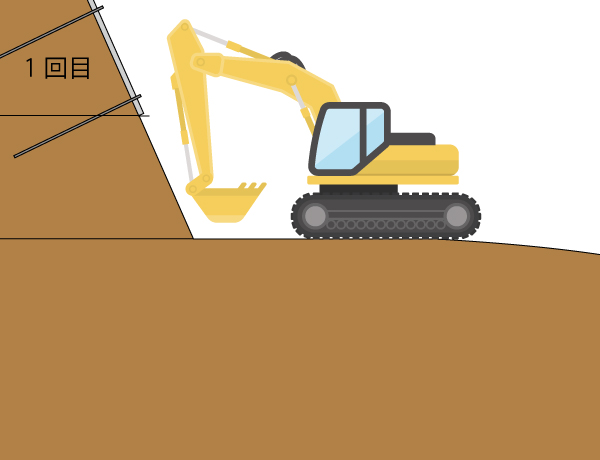
The issue is the 30 anchors and the reverse-wrap installation method
So, I'll list out, in order, how many days each task will take.
Excavation of the first level: 3 days
Drilling: 1 stage / 10 holes ÷ 2 holes per day = 5 days per stage
The tension begins three days after the last day of drilling.
After the tension was released
Second-level excavation: 3 days
Once you see the first row like that, you'll probably get the idea.
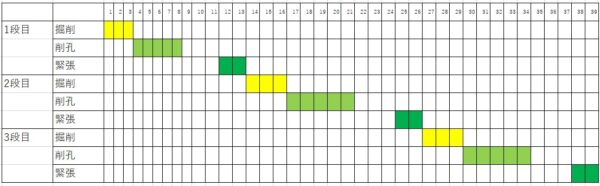
At a glance, construction will be completed in 39 days, but we’ll factor in construction delays here.
Since it takes an extra day per level, that means there's a three-day delay, right?
That means42 daysThat's the general idea I have—I think that might be the right answer.
Since this varies from person to person depending on their experience, I can't say this is 100% correct.
After all, site conditions can vary in all sorts of ways, and there are weather conditions to consider as well.
Please think of this as a rough guideline.
And the key to shortening the construction time is to use fast-setting cement.
In standard ground anchor construction, the cement used for cost estimation is ordinary cement.
With ordinary cement, it takes at least about two weeks to reach the design strength. (Conditions underground are generally quite consistent.)
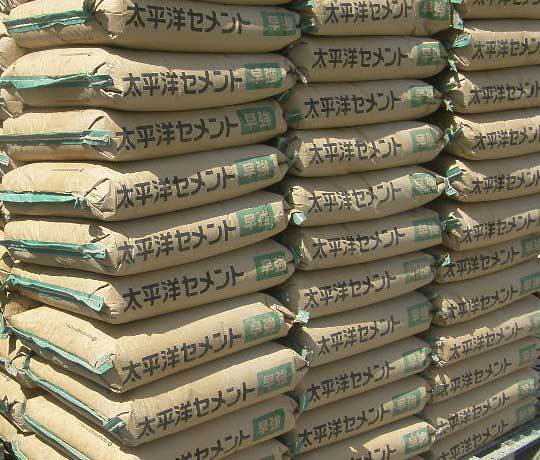
By using fast-setting cement, you can expect the concrete to develop strength early.
That's about three days.
Since it generates more than 23 kN in three days, it’s possible to perform tensioning work.
If, for some reason, the specified design strength cannot be achieved here, please check the 7-day strength.
If the strength still isn't there, the conclusion is that either the curing method is wrong or, in the worst case, the mix design is flawed...
Since the actual subsoil maintains a consistent temperature and has moderate moisture content, it is believed that the development of strength occurs more quickly than in the test specimens.
In addition, the standard requirement is a 4-week strength of at least 23 kN for ordinary cement.
The idea that strength develops in 3 days or 7 days is based on empirical observations with fast-setting cement.
Therefore, it's not an absolute requirement.
See you later.