

Hello, everyone.
This is Enta.
The other day, while checking my blog subscribers, I was surprised to find that...Over 1,500 peopleI was doing that!!
Thank you.
Recently, even the client (the government office) told me, “We’re keeping an eye on this,” so I’m updating this while feeling a tremendous amount of pressure.
I'm truly grateful.
I'd really like to try not to write too many complaints, lol.
I’ll continue to write articles that are even slightly helpful to those working in the field.
We look forward to your continued support.

But that's beside the point.
I’d like to introduce a technology that I forgot to mention at the recent Construction Technology Fair 2019 in Nagoya.
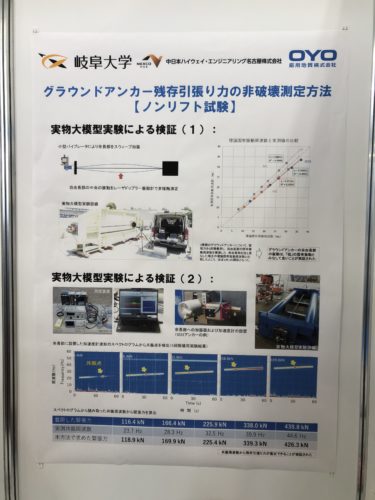
This is a non-destructive method for assessing the condition of ground anchors.
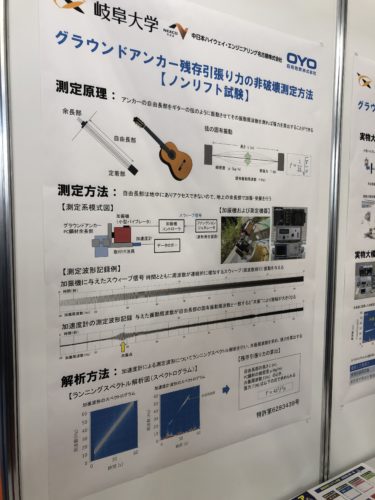
It’s a method that uses sound waves transmitted through PC strands to estimate the residual tensile force remaining in the strands based on their resonance frequency.
Until now, we’ve been creating jigs to apply direct tension to the anchor head for verification purposes.
Back then, since we needed a large jack or something similar, I imagine it must have been quite a struggle to carry everything by hand at job sites without a crane.
However, in the case of this test machine, it may be possible to make it quite small.
Eventually, it looks like all you'll need is a vibrator and a tablet, right?
I think this kind of technology is amazing, and it’s indispensable for research and the like, isn’t it?
Furthermore, as the scale becomes smaller, the investigation progresses; therefore, we need to assess the structural integrity of the completed slope (cliff) and determine whether or not to carry out additional work.
It can also perform determinations such as these.
The problem is the cost, lol.
I used to conduct pile condition surveys myself as well. (Detecting cracks in piles using ultrasonic testing)
We'll conduct the investigation over one day and compile the investigation report within two days.
That alone came to 1 million.
Given factors like patent rights and development costs, it’s hard to say outright that it’s expensive, but this does tend to result in fewer requests.
If they became a little cheaper and more widespread, research would probably move along much faster.
It’s not just about doing the construction work; we should also be thinking about things like maintainability down the line as we go about our work.
It would be nice if I could make something like that, though.
It might be worth giving it some thought.
See you later.