Hello, everyone.
This is Enta.
Today, I’d like to take a closer look at the term “buckling.”
Buckling.
Did you know?
| Buckling(Buckling) refers to the phenomenon in which, as the load applied to a structure is gradually increased, the deformation pattern changes abruptly at a certain load, resulting in significant deflection. In a structure,BucklingThe load that causes the phenomenon in that structure’sBucklingIt is called a load. BucklingThe load depends on the structure's rigidity and shape, and may occur even at levels below the material's strength. |
For example, suppose a skid-mounted drilling rig is mounted on single-tube scaffolding.
This refers to a situation where a single pipe bends or breaks when the load exceeds its buckling strength.
So, to prevent this skid-type drilling rig from breaking when it’s mounted,
The only options are to space the single pipes more closely together (narrow the pitch) or to increase the footprint of the drilling rig.
In short, it means that as long as the contact area is large enough, buckling won’t occur. (This is commonly referred to as the bearing area.)
I went to a cell phone store to get my cracked iPhone screen replaced.
Even the shop clerk seems to be thinking, “Not again!?” (This happens quite often.)
I used to really like applied mechanics. (I still do, though lol.)
I used to love calculating buckling, uniformly distributed loads, concentrated loads, and simple beams.
Based on my experience, here's what happens when a screen cracks!
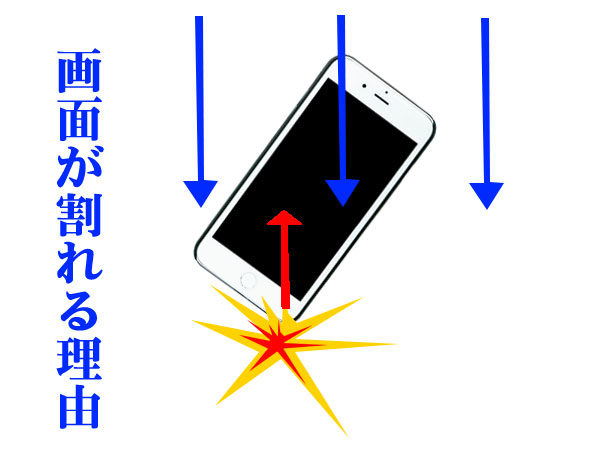
It breaks because the corner of your phone applies a concentrated load to a single point on the glass surface!
In fact, the corner of my cell phone was cracked, too. (Every time.)
When a load is applied to the corner, the glass surface buckles and breaks.
It is believed that this result is due to the fact that the glass itself is made of high-strength material.
People often put on those super-hard 9H glass screen protectors, right?
It’s actually incredibly strong when it comes to withstanding loads on the surface of the glass! That’s because it has a large contact area!
But even that high-strength glass will shatter with a single blow if you hit it at the corner, right?
You know those videos on YouTube and stuff where they stick a nail into the surface or saw back and forth, like, “See? It’s fine, right?”
Actually, that's not really a big deal.
When you drop it, calculate the weight of the smartphone and the acceleration due to gravity based on the point of impact, and
...It makes sense if you're applying a concentrated load to a single point on the surface of your smartphone!
Force (N) = Mass (kg) × Acceleration (m/sec2)
That phone will probably break, lol.
In my opinion, when a smartphone is dropped, resin-based screen protectors are better than glass ones,
When the glass surface is about to crack, it exhibits toughness (resin-based materials do not crack)
I think it might be a good idea because it seems like it would allow the force to be dissipated (by the resin film bending).
It's just that the feel and texture are a little off, you know~

And when it comes to protecting your smartphone, it’s all about the corners!
How to Defend the Corner!
That's exactly it!!
This is the only option!
I'm installing a bumper, but the inside has been hollowed out (to absorb impact).
Whether it falls on its side or upright, it definitely won't break, right?
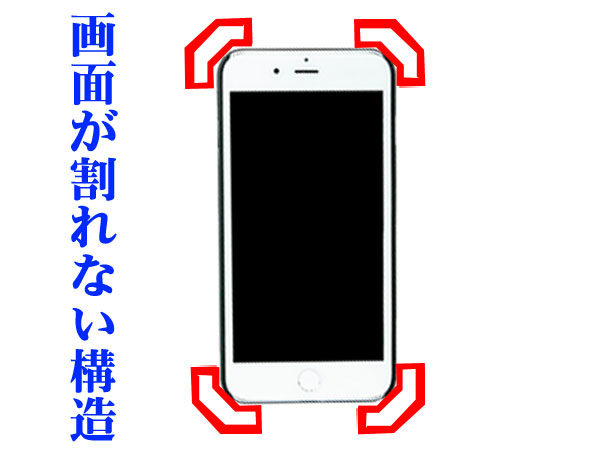
However, there is just one problem.
If there are sharp pieces of gravel or similar objects on the surface when it falls, there’s a high probability it will crack due to a concentrated load!
If it falls normally, there's no problem at all!
But it's so uncool... and it's huge...
When I think about it this way, I guess it’s better not to have a cell phone... because I’d just end up dropping it, lol.
I don't like wearing it around my neck because it makes my shoulders stiff, but I don't want to take it off either...
I really hope microchipping becomes more widespread soon.
Or maybe the return of the flip phone!?
See you later.