In the civil engineering industry in Japan, the following units are used: ㎜ (millimeter), ㎝ (centimeter), and m (meter).
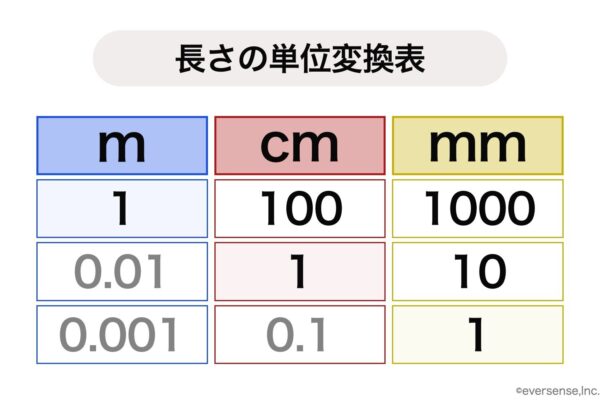
Choose the appropriate unit depending on the situation. Use “m” for long distances, “cm” for medium distances, and “mm” for small objects.
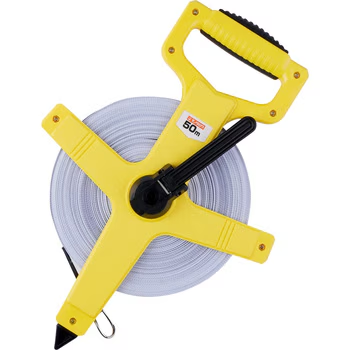
Tape Measure (Makijaku)
Tape measures are a common type of measuring tape in Japan, used to measure long distances, and the unit of measurement is typically “m.”.
Using "mm" or "cm" in this context could easily lead to confusion.
In slope construction work, we use a tape measure to measure area, using the unit “m.”.
Example: 10.53 m converts to 1,053 cm or 10,530 mm.
As the number gets larger, it becomes hard to visualize. For example, if it exceeds 10 meters, it becomes 10,000 millimeters! It’s hard to wrap your head around, isn’t it?
Therefore, when measuring long distances, use the unit “m.”.
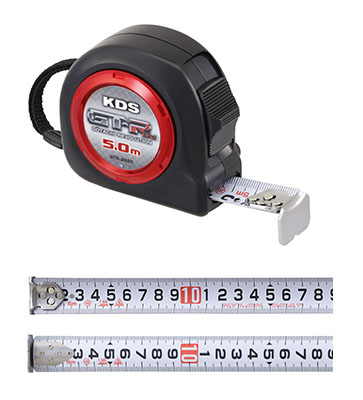
Convex Ruler
The “Convex” folding ruler (also known as “Scale”) is commonly used to measure distances of less than 6 meters.
Depending on the person, they might say “m” or “cm.” Of course, it’s also possible to measure in mm, so some people use that unit as well.
As long as you find a unit that’s easy to understand, feel free to use it, but it’s still best to be able to convert units immediately when you hear any of them.
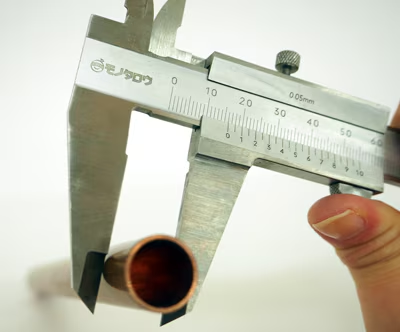
Vernier Caliper (ノギス – Vernier Caliper)
When using a “vernier caliper,” the unit ㎜ is almost always used. It is very rare for anyone to use the unit m in this context.
When measuring small objects, the unit "mm" is easier to understand and more accurate.
Unit Conversion Table
Please memorize this conversion table carefully. For example, 1 cm = 0.01 m, and 1 cm = 10 mm.
If you're not sure how to read the chart, look at the ruler and compare the two to get a better idea. You can also count the lines on the ruler to understand it better ^^
Taking measurements is extremely important. Especially in our industry—construction—it’s an essential skill!
You need to accurately measure many different types of materials. Make sure you understand 100%!