Hello, everyone.
This is Enta.
Last weekend, I held an informational session on drainage rock bolts, and personally, I’m glad I was able to share this information for now.
I'll be running around all over the place again this month so I can finish up one more perk for future visitors by the end of the month lol
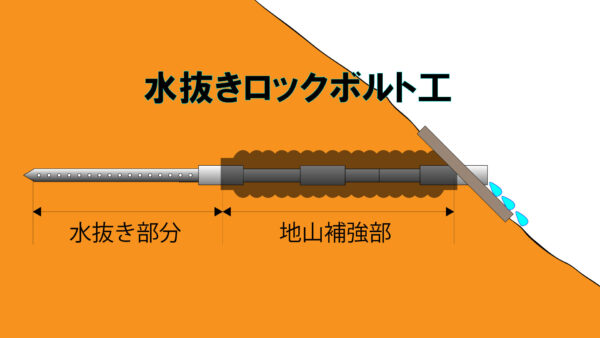
This is a fundamental question, but when it comes to the design of rebar insertion work...
It consists of movable and immovable soil masses.
In the context of ground anchor construction, these are the anchored section and the free length.
However, in reality, nothing like that exists in the mountains.
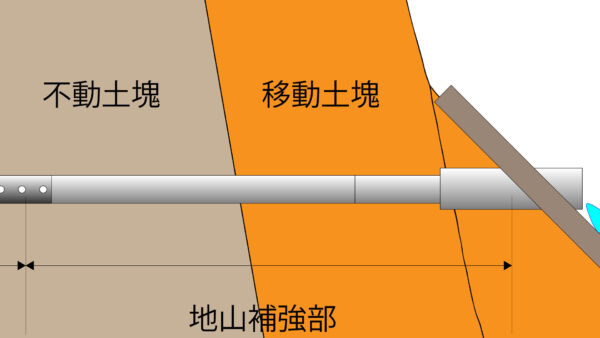
The illustration above shows what everyone imagines a rebar inserter to look like (there’s a drain at the tip, but don’t worry about that).
To put it simply, you insert the rebar into the solid soil section, and it stays put!
Next, ensure that the section of soil being moved does not collapse.
That's the idea. From a design perspective.
But in reality,
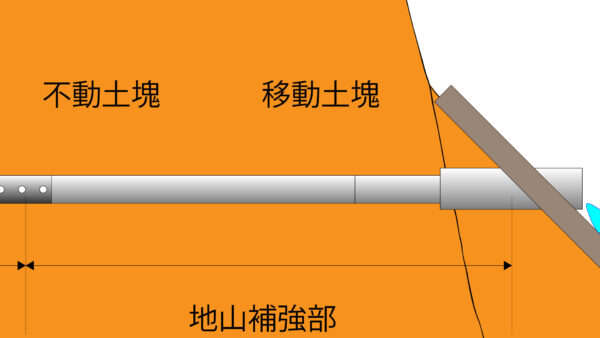
There's no such thing as an immovable lump of earth.
Even among the inspectors, there were occasionally some who would ask, “Did the rock (gan) show up?”...
I've always said, "There's no such thing~ lol," but lol.
Since the current design calculates them separately, should we rethink this approach?
Since that’s probably out of the question, I’m trying to come up with other ways, but the reality is different.
I don't think it'll work out so well from now on if we just sweep the fact that it's different under the rug and try to carry on as usual.
Until now, it was an era when you could spend as much as you wanted on people.
However, there won't be anyone left in the future.
We're already short-staffed as it is.
There’s no doubt that the construction methods we’ll need going forward are those that prioritize efficiency and longevity.
In today's slope stabilization industry, what can be eliminated?
Which construction methods can be omitted to achieve a positive outcome?
I think that's what it means.
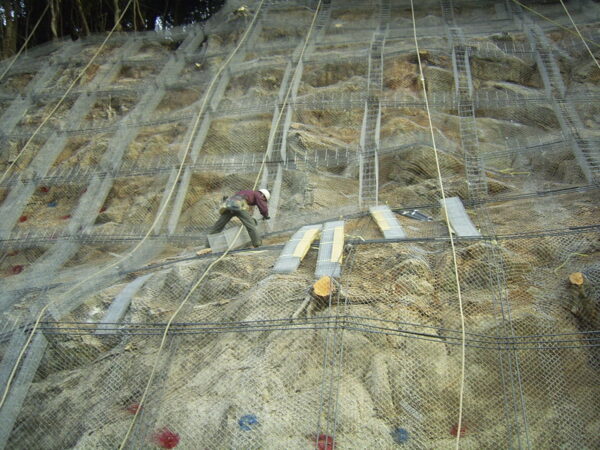
For example, spray-applied mortar is easy—you just install the lath and spray the mortar—but formwork is a lot of work.
You'll need people, and you'll need a certain amount of experience.
It’s also important to aim for construction methods that don’t require a great deal of technical expertise.
We don't need a legal framework, do we?
I think we'll need to consider that option in the future as well.
What should you do in a situation like that?
What construction methods are there?
Is this design sound?
That's what will be necessary.
I’ve been wondering if it might be a good idea to start thinking about a new design method for rebar insertion just in case that time comes.
I plan to conduct experiments by leveraging the various networks of the relevant companies and individuals ^^
I have absolutely no intention of overhauling the current design; it's all about how we can make them coexist.
I think it’s fine to have a variety of perspectives, just as there are various design methods and philosophies.
In my case, I’d like to approach the design strictly from the perspective of a contractor.
In the era ahead,What won't you do? What will you stop doing?
I think we're entering an era where we'll be making decisions like that.
I can't take everything with me.
Companies, individuals, and business partners alike.
See you later.