Hello, everyone.
This is Enta.

Every now and then, we receive questions like the one below.
How can we make this a good workplace?
Or can you manage it well?
I think that's the biggest challenge for young directors.
There are various ways to interpret what makes a good job site—for example, one that’s profitable, one that scores high, or one that produces high-quality results.
"Running things smoothly" means exactly that.
The scene was
Site Inspection ⇒ Order Receipt ⇒ Construction Planning ⇒ Budget Preparation ⇒ Subcontractor Selection ⇒ Site Entry ⇒ Construction ⇒ Project Completion
That's basically how it goes. (The order of the items may vary slightly depending on the company.)
What do you think is the most important part at this stage?
That’s an on-site inspection. (To determine if we can accept the order.)
What do you do during a site inspection?
Are you just going to watch?
The important thing is to look at the original design drawings to see where everything is located, what the scope of the site is, and how the heavy equipment will move,
Where to get water, where to set up temporary facilities, where to locate the office, and so on
Imagining the construction site at this pointThat's it.
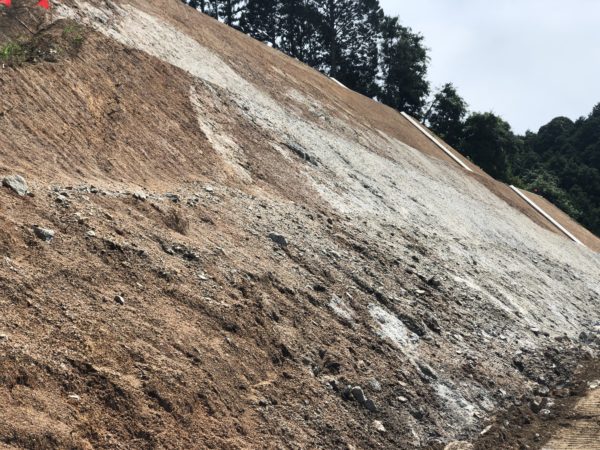
I think that by visualizing the construction process, it becomes easier to picture the steps leading up to that point.
After all, the site should already be running smoothly during construction.
Next,Visualizing the project from the planning stage through to completionThat's right.
Please include your impressions from the site inspection when preparing the construction plan.
This ensures consistency between the job site and the construction plan.
And then we incorporate that into the budget.
That said, for us slope engineers, there are cases where a set construction plan is sufficient to handle the situation—but even so, we still have to imagine it!
By doing so, any minor issues that arise during construction won’t become a big deal, since the project will generally proceed according to the original construction plan.
After all, they should be carrying out the work based on the fundamental assumption that everything is proceeding according to plan.
There may be some cases where things don’t go exactly as planned, but that’s generally within acceptable limits. (This is because the installation direction may sometimes be reversed due to workability issues.)
We can accommodate this by revising the construction plan.

Is the ability to visualize the final product to some extent what a young director needs?That's the point.
We can’t just leave what we’re about to build up to the contractors.
Once a specific location (area) is designated, the contractor will proceed with the work more or less as usual.
We almost never discuss the contract drawings. (Due to subcontracting.)
The instructions on site are just something like, “Put an anchor at the intersection within the legal limits from here to there,” right? lol
"The width of the small section must be exactly 1 meter," "The shoulder starts right here," "I want to keep the length of this section at XX," and so on.
Craftsmen often don't know, and in many cases, they aren't aware of the specific reasons.
The supervisor must mentally align the blueprints with the actual site, identify any issues on-site, make adjustments, and proceed with construction.
If you coordinate the drawings, the site conditions, and the client’s intentions as you proceed with construction, the site will run very smoothly and turn out to be a great project.
Also, with public works projects, you have to coordinate with local residents, which is a pain, lol.
Imagine it before you start construction
Visualizing the Construction Plan
Imagining the finished product while it’s being built
Imagine the whole process from start to finish
By imagining it, you can become aware of it.
If you don't pay close attention, you'll miss it! That's for sure!
By being mindful of this, you can prevent oversights from happening in the first place.
When the project is finished, how does it compare to what you imagined?
Are they way off? Or do they match up pretty well?
I think you'll come to understand both the good and bad aspects of it.
Please fully acknowledge your mistakes and feel at least a little regret.
By reflecting on my regrets, I make sure to firmly imprint that lesson on my understanding of the next project.
By consistently doing things like this, you’ll definitely improve accuracy on the job site!
Even veteran site supervisors all went through the same experience when they were young.
He wasn't a great director from the start.
Director Dekiru is not only good at showing off his skills, but he’s also great at bouncing back, lol.
And his imagination is off the charts!
Let's all make a conscious effort to create a positive work environment.
See you later.