Hello, everyone.
This is Enta.
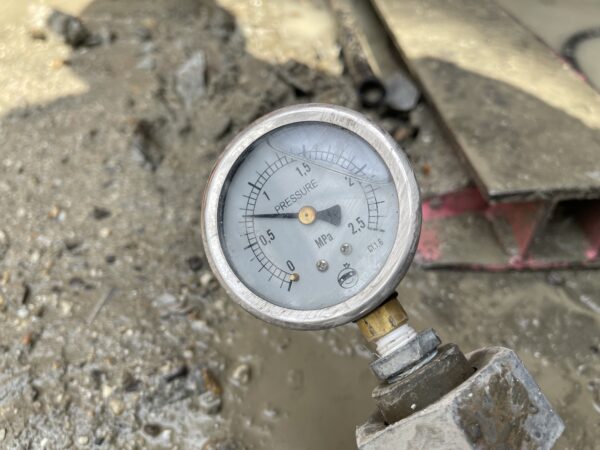
Pressure gauges are commonly used in our industry. They're what we call pressure gauges.
How do you go about selecting them?
Didn't you even start the selection process yet? lol
Actually, it can be dangerous if you don't set it up properly before using it. (It'll just break, though lol.)
They aren't as expensive as they used to be, so they're easy to use these days, but it's still a good idea to have at least a basic understanding of how to use them to avoid breaking them.
For example, let’s consider the maximum reading on a pressure gauge used for spray application.
What size pressure gauge do you use inside the spray machine's tank?
To put it simply, I think 3 MPa should be plenty.
The reason for this is,
The standard compressor used with the spray machine we use has a capacity of 100 horsepower and a pressure of approximately 0.7 MPa.
Well, 190 horsepower would be fine, but the pressure is the same.
If the work site is far away, we may use a high-pressure compressor, so I think the maximum pressure is around 1.1 MPa.
If the gauge shows a pressure that's too high, it's hard to read, and if it's too low, it breaks in an instant, so,Select based on a safety factor of approximately 2 timesI will.
1.1 MPa × 2 = 2.2 ≈ 2.5–3 MPa
If you choose based on these guidelines, I think you'll be able to use it without it breaking.
If you apply too large a safety factor, the result will be difficult to read when actually used.
By the way, when injecting grout, it’s best to use the same pressure gauge as the pump to reduce the risk of damage.
However, since the injection hose would burst if that much pressure were applied, it won't actually deliver any fluid, but it does reduce the risk of the gauge breaking.
Also, please use a gauge protector whenever possible when using this product.
If you use the gauge directly with anything other than air, it may rust; if you use cement, it will harden and become unusable.

Among gauge protectors, this product from Toyo Shoji is the most affordable, easy to use, and easy to maintain.
One thing to keep in mind when purchasing is the size of the pressure gauge mounting screw.
For smaller sizes, there’s a 1/4 size (2-bun), and for larger sizes, there’s a 3/8 size (3-bun); I think most are 1/4 (2-bun).
The diameter of 1/4 (2 bu) is about 13 millimeters, and that of 3/8 (3 bu) is about 16.5 millimeters.
Even if I mess up, I can just lower or raise it with the bushings, so it’ll work out one way or another, lol.
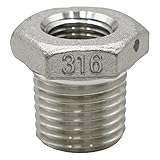

Either use a stainless steel bushing like this, or
So, should we use a special reducer socket?

Assemble everything and pour any kind of oil into it (as long as it doesn't cause rust, it's fine).
Just attach the gauge to the gauge protector—which is full of oil—and you're all set.
This is a gauge for seeing things that are invisible.
Precisely because we can’t see it, let’s manage it carefully using data and improve quality!
See you later.