Hello, everyone.
This is Enta.
I just got back from Kagoshima the other day, and today a junior colleague from Kagoshima came to Nagoya and stopped by our office lol
He’s a junior from the Kagoshima Jitsugyo High School swim team who now works for a major construction company specializing in slope stabilization and foundation work—and he’s the branch manager in Kagoshima!
I just can't hold a candle to them anymore, lol.
It really makes me happy when a junior comes all the way from far away, doesn't it?
I really appreciate it ^^
But that's beside the point.
I believe there is an illustration like this on page 79 of the Design and Construction Standards for Ground Anchors.
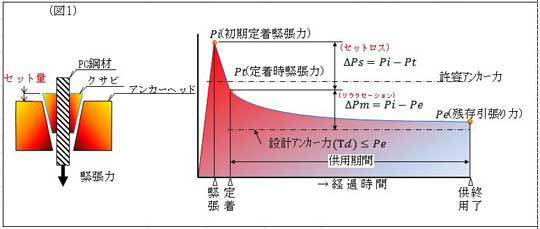
Only the right side is shown here; I’ve written down the amount for the left side.
↓
Insert a wedge into the anchor head
↓
Unload the jack
↓
The wedge sinks in(Set loss)
↓
The amount of indentation is less than the specified load
↓
The steel wire loosens due to relaxation
↓
Falls below the specified load
↓
There's a risk of a landslide (exaggerated)
To prevent that, tension is applied from the start, taking into account steel wire relaxation and set loss.
I've always thought that it's better not to factor in set loss.
The reason is that I think it’s better to be about 80% nervous rather than 100%.
It means, "Under no circumstances should you move it when the load is at 100%!"
However, this is because if the device is moved by a temporary earthquake, there is a 100% chance—or rather, a 110% chance—that it will become slightly over-tensioned.
When I think about it, I wonder if the right approach might be to keep it at around 80% and save some for a rainy day.
See you later.
*The format for the set loss report is available for download on the Shioda Development Co., Ltd. website.