Hello, everyone.
This is Enta.
It seems to be getting a little cold again, doesn't it...
The seasons in Japan are all over the place! lol
By the way, how about working at Enta? I'm serious! I really mean it!!
I do get some prank emails asking, “Are you hiring via email?” lol
We're seriously looking for people who want to work in entertainment!

But that's beside the point.
Where Do Anchor Installers Make Mistakes?I'm going to write about that.
1. Drilling
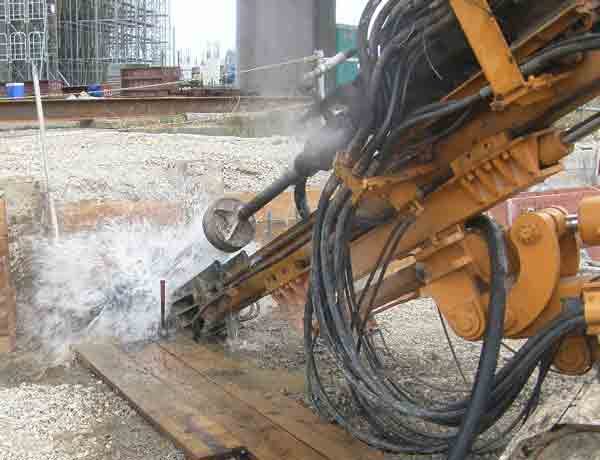
I assume that after drilling, the inside of the casing is cleaned.
The term "cleaning" here refers to removing the slime left inside the casing.
But it's hard to say just how effective the cleaning really is—I guess it's better to do it than not, right?
That's about the level of it. By the way, I didn't do that when I was younger.
That's because drilling with water alone doesn't produce as much flow as when using a compressor.
It ended with me twisting the inner part around and around while letting the water flow out. (A little bit of slime comes out.)
These days, though, since you mix water and air, you can really make it spray out with a bang.
Therefore, just because you can't do this doesn't mean it will lead to an installation error.
It’s just that, while the books all say to rinse with water, none of them actually say to blow it off with air, lol.
2. Tendon Insertion (Anchor Body)
Insert the tendon.
If you don't use a bell mouth at that point, the poly hose in the free-length section may become damaged.
If grout adheres to that area, the free end will become fixed, and the intended elongation may not be achieved.
Also, it’s a big problem if there’s oil residue at the tendon attachment point before insertion.
Since friction is absolutely essential for the attachment section, any reduction in friction is highly likely to cause the part to come loose.
You should also be careful about gloves when inserting them. (Be sure to remove gloves that are covered in oil.)
This is where you might make a mistake.
Be sure to protect the mounting area thoroughly!
3. Cement slurry injection
What do you think of the formula?
Isn't there too much water?
The Key to Ground Anchor ConstructionThis is the part
Without a doubt, this is the most important part.
If the cement slurry is too runny or you're worried about its consistency, it's definitely better to make a new batch!
If you mess this up, you're more likely to slip out! This is absolutely crucial!!!
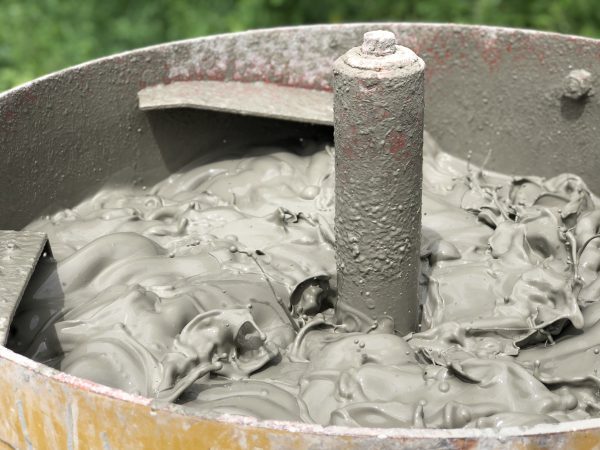
A strength of 24 kN is easily achievable with standard manufacturing, but some people try to adjust it with water because they think it’s too hard.
If the mixture is too stiff, use a plasticizer to loosen it up!That would be better.
Because water and cement slurry have different specific gravities, they may not mix well.
Construction managers, please make sure to double-check this one thing.
Also, be sure to inject starting from the deepest (lowest) point.
This is a golden rule for anchor installation. The same applies to grout injection.
*"Dob-zuke" grouting refers to a method in which, after drilling a hole, grout is injected into the casing first, followed by the insertion of the tendons.
Please inject the fluid from the very bottom to replace the drilling fluid.
If a thick stream of cement milk comes out of the mouth, the bonding area is likely fine.
However, the dip-coating process makes the work area very dirty.
There are also ways to prevent it from flowing out.
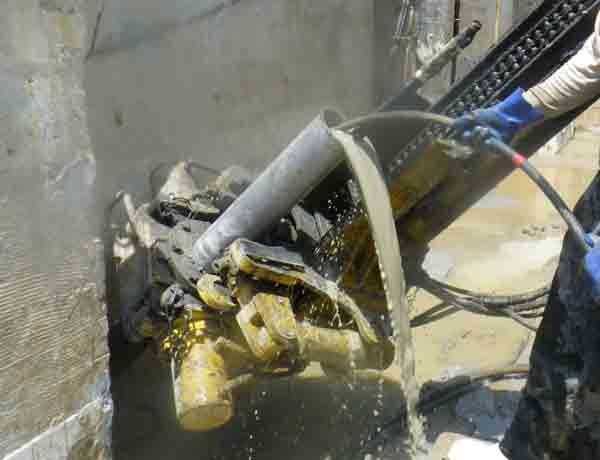
You can't use thin milk like the one in the photo above! lol (Wait for the cement slurry to thicken.)
Next is the pressure, but I don't really care about that. (Just my personal opinion.)
In the publications of the Japanese Geotechnical Society,
"The work shall be carried out using methods appropriate for the ground conditions around the anchor body."
...is how it's phrased. It feels very vague.
The reason is that, according to the Anchor Association’s publications,
"It helps prevent the hole walls from loosening, but if you overdo it, it can actually cause them to loosen."
It is often performed at pressures ranging from 0.1 MPa to 0.5 MPa, and
"When the anchor is deeply embedded, the applied pressure must be greater than the groundwater pressure and less than or equal to twice the equivalent water level assuming the water level extends to the ground surface."
It states that...
So, basically, applying pressure is the fundamental approach, but,
In reality, tremendous pressure is exerted on the tendon attachment site due to the difference in height.
Even though pressure is already being applied—without any need to apply it on purpose—
I'm simply questioning whether it's necessary to spend any more than that.
See you later.
The Moment the Anchor Breaks Free!
What to Do When Cement Slurry Is Too Thick (Part 1)
Using "Plus" for grout replacement makes it less prone to staining.