Hello, everyone
This is Enta.
I dropped my iPhone.
But! My iPhone is protected by a tempered glass screen protector and a shock-resistant case, so I have nothing to worry about!

And it broke right through the Enhanced Crow...
The material that was dumped there is RC (Recycled Crusher Run)—commonly known as crushed stone.
It seems the sharp tip struck the target with pinpoint accuracy...
I'm so lucky!!...
But that's beside the point.
This is a continuation of my previous post.
4. Tension Work
If there was a mistake here, it was more on the construction management side.
About 80% of managers have a misconception about stress management, but
The maximum test load is set so that it does not exceed Td × 1.25 based on the Rank A design anchor force.
It's okay not to exceed that amount. However, most people calculate using 1.25 times that amount.
Japanese is difficult, but,
"Go Beyond"="Excluding the reference quantity, it must be greater than that amount."
"Don't go over"="Not including the reference quantity, but being less than that"
Based on the interpretation above, that means the maximum load is 1.24 times the standard load. (Not that it really matters, lol.)
Well, I guess you could call it nitpicking, but dealing with someone who’s that picky would probably get annoying at this point, lol.
Inspectors who nitpick every little detail, lol
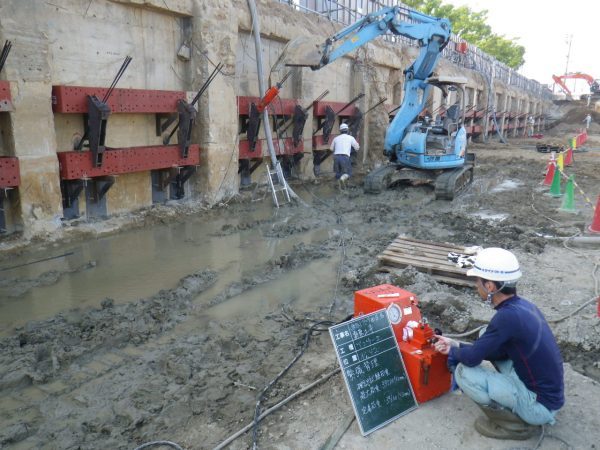
But that's not actually the point.
The misunderstanding lies in the fact that tests are conducted at 1.25 times the standard value regardless of soil type.
If the anchorage is in rock that's as hard as a rock, then sure, that would be fine.
But what if it’s a slimy mudstone that’s hard to drill through when water gets in?
No matter how long the fixation period is, I think it’s a bit risky, and you’d probably want to keep it a little shorter, right?
It's okay to use that feeling as a benchmark, right?
This means you don't have to apply a load equal to 1.25 times the maximum test load at every anchor site!
"The maximum design load specified in the standards is an upper limit; since testing is conducted using anchors that will actually be used in service, the responsible engineer may, based on the actual conditions at the site, set the load below this limit."
Design and Construction Standards for Ground Anchors, and Commentary Thereon, p. 190, Japanese Geotechnical Society
That's what it says.
There’s no need to subject something that will be in service for decades to such rigorous testing.
Simply put,As long as it can withstand loads greater than the design load, that's fine.That's the point.
However, considering set loss, it’s best to keep it between about 1.10x and 1.20x.
In my case, I use the same safety factor for both the qualification test and the verification test, so the maximum test load is the same.
It makes writing on the blackboard easier, lol (though we use a digital whiteboard now).
I actually use a multiplier of 1.15 to 1.2 times (to ensure it exceeds the set loss).
Even if you submit a contingency plan to the government office, they usually won’t say anything, and if they do ask why,
The mountain was rough, so I played it safe. I'll just go through here.
Since the government office will be using it later as well, I’m not saying you absolutely have to pull it.
Outsourcing construction management seems like a bit of a hassle, but let's push through with it.
(You wouldn't want to be told what to do by a construction manager who has neither the authority nor the knowledge, would you?) lol
These are the areas where construction errors can occur when using anchor bolts.
What do you all think?
See you later.
The Moment the Anchor Breaks Free!
What to Do When Cement Slurry Is Too Thick (Part 1)
Using "Plus" for grout replacement makes it less prone to staining.