Hello, everyone.
This is Enta.
It sure is hot, isn't it?
I just went from Tokyo to Shizuoka the other day.
It's a hot summer day, and I'm drenched in sweat!!
I'd really like you to take a ride on the Shinkansen sometime this fall, lol.
But that's beside the point.
This is a discussion about what constitutes an appropriate flow rate value, but basically, it means a value within the specified range.
For example, according to the guidelines, it’s 10 to 18 seconds (14 seconds ± 4 seconds).
However, it is actually possible to configure this at each site.
Optimal Flow Rate
First, we will conduct a test mix of the cement slurry.
This test mix measures the mix design, flow value, specific gravity, temperature, and strength.
Temperature and specific gravity (mud balance) are optional. (This is standard practice at Nexco.)
Set the mix design to W/C = 50% and admixture = 2%. (This is an example.)
Accurately add water, add the admixture, add the cement, and mix.
Measure the flow rate.
That data isStandard values for this site. (Appropriate values for this site.)
The same can be said for Mad Balan.
For example, if that figure is 15 seconds, we’ll arbitrarily set ±3 seconds or ±2 seconds from that number as the target value, standard value, and optimal value for on-site construction.
While the maximum construction management value is 10 to 18 seconds (typically), the figures above are merely target values.
We will ensure that we do not exceed the construction management limits.
How do we actually view trafficability?
As long as it's thick cement slurry that can be pumped, it's okay even if it's thick.
The stiffer the concrete, the less likely it is to leak, and a lower water-to-cement ratio results in higher strength.
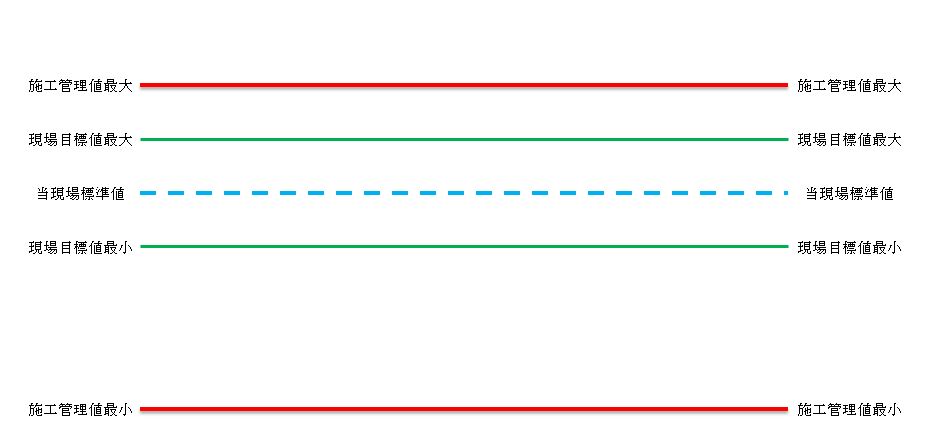
It's just a way to show off that we're keeping quality control on-site consistent during construction, lol.
In this case as well, even if there is some variation, it doesn't really make much difference in terms of strength.
I suppose the biggest factors are the ambient temperature and the pouring time, right?
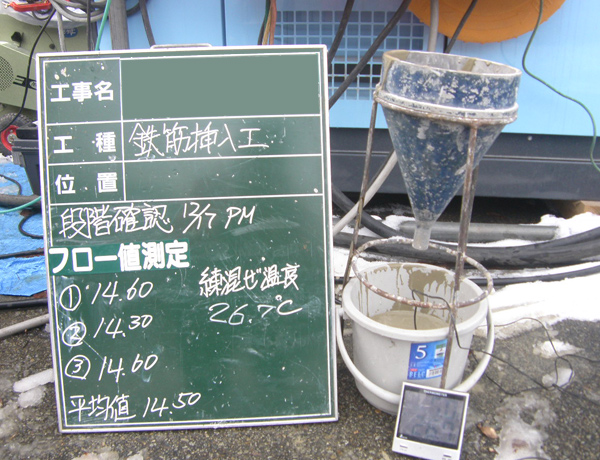
There’s basically no “correct” number of seconds, but
If I had to say,
"The 'correct' flow rate is whatever the site arbitrarily decides as the standard value."
I think this is the correct answer.
Even if the government agency calls us out on it, as long as we explain that we’re doing this to minimize inconsistencies, no one will complain, and
Not that anyone would ever bring it up, though.
However, if possible, you should calibrate the standard values at least once a month.
The reason is that the environmental conditions—such as temperature—are completely different between summer and winter.
Since we sometimes need to conduct precise test runs on a monthly basis, it does take a bit of effort.
I generally complete the work within the construction management budget.
I do handle the details when necessary (if asked).
See you later.