Hello, everyone.
This is Enta.
How do you manage batches for vegetation engineering?
Back when I was aiming for extremely meticulous management, I used to have them mix the seeds for each batch into individual bags and deliver them to me.
(One batch is the amount that fits into a single tank of the spray machine. This is the amount of seeds and fertilizer used when four bags of substrate are used.)
For example, if you plan to use 1,000 batches on-site and are using a mixture of five seed varieties, weigh each variety separately and place an order for one bag containing all five varieties.
Of course, there will be a packaging fee. (Maybe this could be used as an example of creativity these days?)
We use the delivered seeds on-site, and we compare the quantity used on-site, the remaining quantity, and the quantity specified in the design.
That way, you can see how much more or less was used compared to the design, how much waste there was, or that there was less waste, and so on.
Plus, when it comes to construction management, I can manage things down to the smallest detail—which lets me feel all smug, like, “Look at me, I’m really on top of this!” lol
But that’s all in the past—these days, do they really go to such lengths to micromanage? Or can this even be called micromanagement?
Along with that question, I found myself wondering, "Does this even make sense?" lol
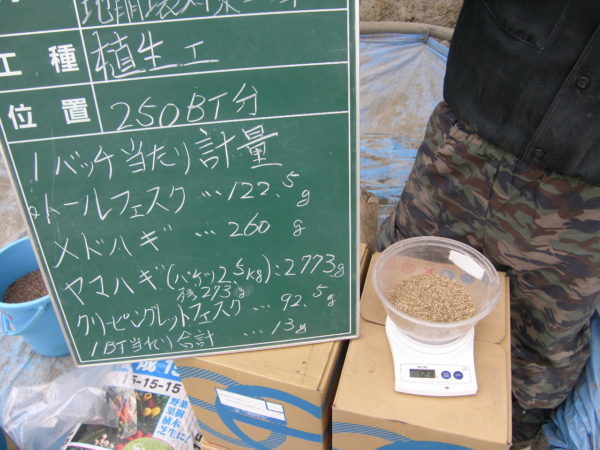
As a result, we ended up just ordering enough seed to cover the entire batch and mixing it into buckets on-site lol
We also measure ingredients on-site using a kitchen scale.
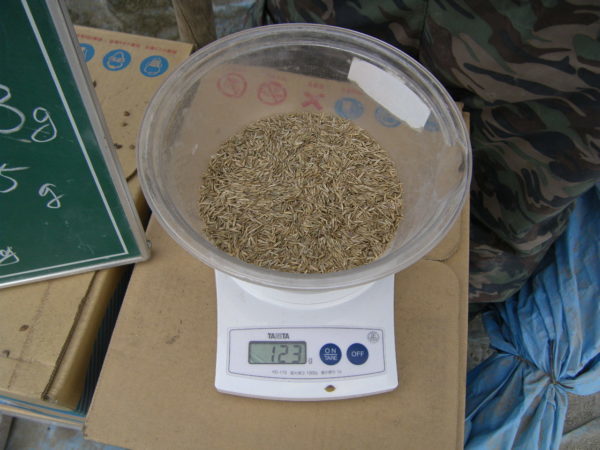
Fractions are rounded up.
I feel like even when I do the little things, it just ends up being for my own satisfaction, lol.
Isn't this good enough?
(Even when I was dumping everything into this bucket all at once, I still made sure to stir it frequently and divide it into smaller buckets.)
It doesn't cost anything, and the city government isn't really interested in that (landscaping) anyway, lol.
After all, there are quite a few government offices that don’t seem particularly interested in greening initiatives.
We slope engineers can’t help but wonder, “What if it doesn’t grow?” But at our age (and with our experience), maybe we’re just numb to that kind of thing?? lol
If we calculate the seeding rate based on a 5 cm depth, but the layer gets thicker in areas with severe unevenness because it’s covered by a wire mesh, won’t the actual seeding rate differ from the calculation?
In that case, wouldn't it be more in line with the design to carefully control the thickness? (Like using spacers, for example.)
If it weren't for wildlife damage, it would grow even without seeds!
I actually tried this out a while back.
Generally speaking, rather than artificial things,Nature possesses overwhelming powerIt really shows off its capabilities.
As part of the experiment, we provided a greening service (to the local government) for a slope of about 30 square meters at a disaster site, outside of the designated construction area.
We applied fertilizer to that area without adding any seeds.
Since we first completed the work in the service area without using seeds and then carried out the work in the design area, the entire project was completed without using any seeds. (The work was done in the summer.)
As a result, nothing grew for one to two months, but around the three-month mark, native species began to sprout, and by about half a year, they had grown enough to provide some cover.
The construction site was full of grass. However, when winter comes, the color is clearly different.
The seedless areas are full of native species, but the landscaped sections look like withered pasture.
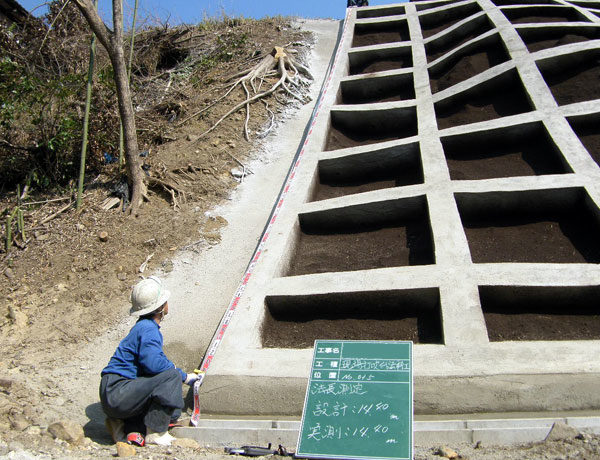
I understand the importance of initial slope protection through vegetation, but the point is that there’s no need to be that strict about it.
To put it another way, if the idea is that it’s enough to just hold out until the native species take root rather than carrying out early greening, then,
Seedless Vegetation Mat with Fertilizer PouchSometimes I find myself thinking, “Isn’t that good enough?” lol (Does something like that even exist in the world?)
If there are nutrients in the soil, there’s no way plants won’t grow!
I went into this in excruciating detail, which is why it turned out this way, but,
If you've never tried it, you should give it a shot sometime, lol.
I totally get that it doesn't really make much sense.
Of course, there are people who prefer to go into great detail, but that’s a different matter altogether.
I suppose, depending on the situation, there’s some merit to that coach’s way of thinking.
See you later.