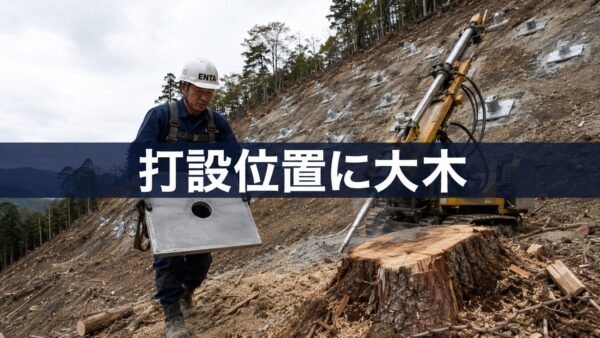
Hello, everyone.
This is Enta.
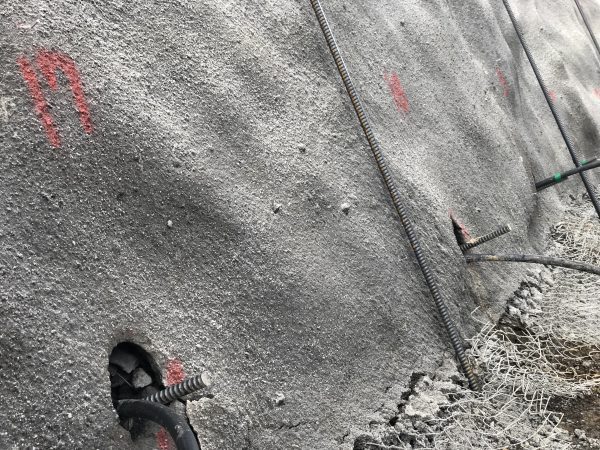
Do you know about the loads used in verification tests for designs based on empirical methods in rebar insertion work?
It’s easy to forget, but the basis for this design method is the NEXCO specifications.
We perform rebar insertion work on a daily basis, and the pioneer in this field is NEXCO—that’s right, the former Japan Highway Public Corporation.
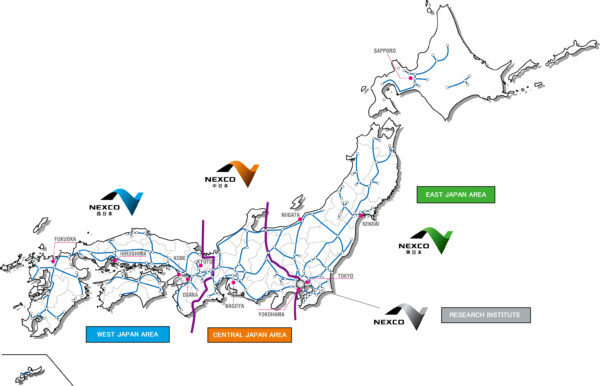
NEXCO is the organization that performs and manages the most rebar insertion work in Japan.
Although the branches are now separate, the technical documentation has been consolidated. (Well, it does say things like “Central Japan” and “Western Japan,” though.)
There are some differences between regions where it snows and those where it doesn't.
Among those technical documents, there is a document titled “Civil Engineering Construction Management Documents.”
The verification test load is listed there.
Generally, a design load (Td) is specified, so tests are conducted based on that value, but
If it states that the figure was calculated using an empirical method, use this number.
If the site drawings use a scale of 1.0 m to 1.5 m, I think it’s reasonable to question them. (They may have been designed using an empirical approach.)
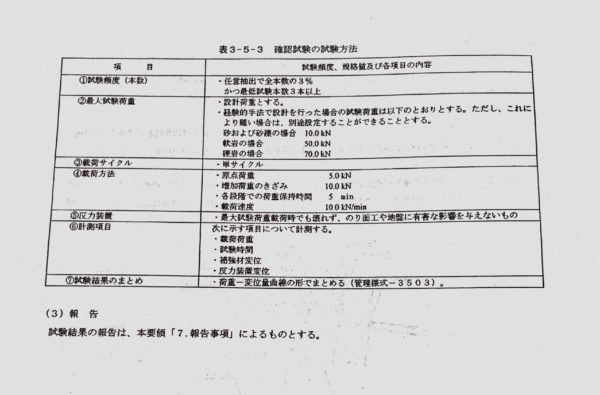
For sand and gravel: 10 kN
For soft rock: 50 kN
For hard rock: 70 kN
It is stated as shown above.
Please use this table as a reference to create a verification test plan.
See you later.