Hello, everyone.
This is Enta.
Everyone's busy this time of year, right? lol
We're really busy here, too, but sometimes we suddenly have a gap in our schedule due to on-site circumstances.
Starting tomorrow, lol
We are committed to machine maintenance.
But that's beside the point.
Is your company making progress with its digital transformation?

No, no, there's no way there's a slope contractor!
You're probably thinking that, right?
Actually, that's not really the case.
Well, when it comes to construction management, we already have electronic whiteboards, don't we?
Remote government agency attendance, which is expected to become widespread in the near future.
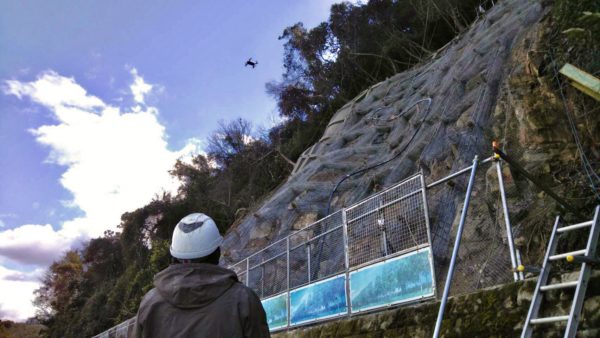
Drone surveying, which is already underway, is a good example.
As for potential future digitalization initiatives,
1. Quality control for drones (since there is currently no legal framework)
The recently released iPhone 12 Pro is equipped with a feature called the LiDAR scanner.
This makes it possible to walk around the site, shoot videos, and create drawings.
It seems the current accuracy has an error margin of about 3 to 5 percent compared to actual measurements, but by setting precise coordinate points—as is done in current drone surveying—accuracy is likely to improve in the future.
Maybe someday, all we'll have to do is take photos from the same spot every day using that 3D data to figure out the volume of work completed! (Technically, this is already possible.)
Depending on how you use a LiDAR scanner, it seems like you can do all sorts of things.
2. All material orders are placed online
As things stand now, ordering materials still involves calling or emailing sales reps—or, in the worst-case scenario, sending a fax, right?
It is said that within the next three years or so, people will stop going out to shop.
In those days, email would’ve been one thing, but phone calls and faxes? Haha.
To be honest, I’d like to get rid of faxes altogether. But there are still companies that send things that way, can you believe it!?
I really wish they'd cut me some slack.

In the future, building material suppliers will likely accept orders exclusively online.
What's more, since each company is setting up an online store, customers will be able to buy items from suppliers they couldn't get before, so this might even spark a bit of competition.
That said, given that suppliers are struggling to make ends meet these days—unlike in the past—any price discounts we can negotiate will probably be negligible.
However, this is an opportunity to introduce our products to many customers.
There’s a possibility you might be approached by someone from a completely unrelated field—and vice versa.
3. You can scan contracts and invoices and send them by email.
We've been using electronic seals for 10 years now.
For invoices, simply create the company's square or round seals in GIF format, paste them onto the document, and print.
As part of the government's policy, they've already been working on the "Let's Get Rid of Seals" bill, lol.
But older people keep saying, “Just stamp it and send it by mail,” don’t they?
Even if I say, “I understand,” and print it out using my digital seal as usual and mail it, no one will notice.
What's the difference between sending it by email so they can print it out there and sending it by mail?
Well, sure, the recipient has to deal with the cost and hassle of printing it out, but when you consider the hassle of having to call or email to ask them to send it sooner or to fax it because the invoice hasn’t arrived, I wonder how that really stacks up?

What's more, we live in an age where personal seals can be easily forged.
If you scan it and 3D print it, you can make an exact replica.
This is a fact that was revealed by the results of an experiment conducted by a certain bank.
That just goes to show how little credibility a personal seal has.
Besides, even if a third party were to forge an invoice, our purchase order, or our order confirmation, as long as there’s no misunderstanding between us, it’s fine without a seal or anything like that, right?
I hear people say that seal shops are struggling, but times are changing.
A business that needs to evolve with the times.
It means we must always be changing.
There are a lot of businesses out there that have been on the decline, aren't there?
That's what it means when times change.
Of course, we're no exception. I, too, am mindful of the need to constantly adapt.
4. I'm not going to work
As I mentioned the other day, going straight to work and straight home is now the norm.
We handle company system issues online and use social media for work-related communication.
If you want security, you can easily get it by spending a little money.
Meetings with other companies are also held via web conference.
We resolve coordination issues with material trucks at the job site by calling each other or sharing our locations.
Handle all your work data, shared files, drawings, and everything else in the cloud.
5. For anything I don't understand on site, I turn to online videos.
When you don't know what to do, it's become common practice to look up videos online.
It seems there are already apps like that in the construction industry, and it’s only a matter of time before they make their way into our civil engineering industry as well.
The big players might already be doing that.
What’s more, we’ll likely see veteran craftsmen of a certain age who are always available to provide online instruction in the future. (This is already the case in the construction industry.)
That is how the passing down of skills takes place.
Furthermore, if the accuracy of “remote government office attendance” mentioned above improves, the chain of command will likely become even faster.
When you're in a bind, government agencies tend to respond more quickly and provide faster confirmation. However, there is one downside to this: since they are constantly being recorded on video, and given that they are using taxpayer money, they simply cannot afford to make mistakes.
Especially for young, inexperienced people. Also, the issue with paperwork and dates will likely be a challenge going forward, lol.
The Challenges Facing Us Veterans
I've written about various possibilities for the digital shift.
And then you must have thought, “So what about us—the slope maintenance guys—what are we supposed to do!?”
Today's veteran slope contractors are valuable. (I'm not saying this applies to all of them.)
What's Next for the Veteran?Power to EducationPlease enter the information.
How can I teach young people to drill holes effectively?
Can we put together a legal framework effectively and quickly?
How are legal frameworks determined?
Vertical beam? Horizontal beam??
What's wrong with the machine?
I often say things like, “A veteran driller drilled XX meters in a day,” or “They used XX bags of cement in a day.”
To put it bluntly, this is something anyone can do.
If you keep doing that for decades, you'll eventually get the hang of it, right? Work is all about getting used to it, isn't it?
And anyway, bragging about the volume of work we’ve done is completely irrelevant,
How will we pass on this wonderful technology in the future!?
It is important to consider how to pass on the skills and intuition of experienced professionals.
Think back to when you were younger and your master told you, “If you do it like this, with this much of a feel, this is what will happen!” and you had no idea what he was talking about lol
Don't rely on gut feelings—teach using numbers.
For example, if the air pressure gauge here reaches 0.7 MPa, open this valve; or if this gauge exceeds 3 MPa, there might be a blockage.

For veterans to become even more seasoned veterans in the future, they must become educators.
Highly experienced instructors who can teach thoroughly and carefully are well worth the money!
In a sense, highly experienced veterans are shaping the company’s future. It’s only natural that they receive a salary.
And you should look for a company that recognizes that and is willing to offer it.
You absolutely must not keep applying the material by hand with a nozzle or drilling holes with a machine indefinitely.
That said, everyone has their strengths and weaknesses, so it’s hard to generalize, and it also depends on the size and circumstances of the company you work for.
If you want to aim high, you should become an educator in that field.
This is the part where value is created for people!
This is where the values that are the exact opposite of the digital world lie!
Given the current state of the civil engineering industry, wouldn’t you say this is a new type of job that doesn’t exist in our field of slope stabilization?
We, too, need to constantly renew ourselves and keep changing, don't we?
Let’s create new value while successfully evolving and adapting in this era of digital transformation!
Thirty years from now, you’ll have students studying slope engineering all over the world. (That’s pretty exciting!)
See you later.