Hello, everyone.
This is Enta.
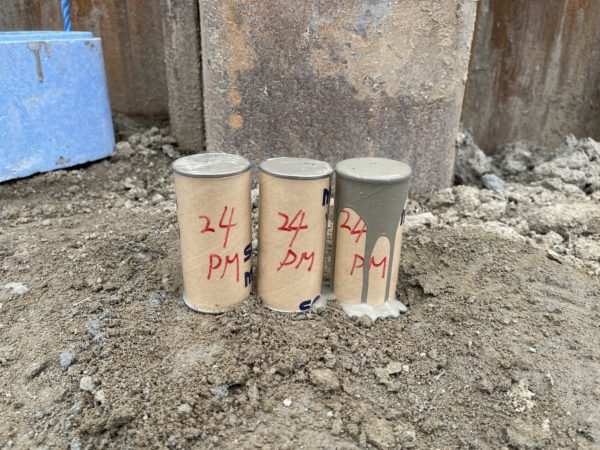
You’ll be collecting test specimens (cement slurry) at the site, right?
Well, things like ground anchor installation, rebar insertion, and piles.
There are all kinds of construction jobs, but when you’re making these test specimens, you just throw them away if they’re way too soft, right? lol
But what do you do if it’s on the firm side?
Well, I guess I probably just got the amount of water wrong, lol.
However, you shouldn't add water here to make it more fluid.
The reason is that once the cement slurry has set, it becomes very porous, making it quite difficult to mix even when water is added.
That's why, even when I add water, it just bobs around on top of the cement slurry lol
You could try mixing them, but that would throw off the water-to-cement ratio (W/C), so water is generally not recommended. (It’s fine if you know the W/C ratio.)
If the mixture is too stiff, adjust it by adding a high-performance water-reducing agent such as Leobild 4000.
If you pour the water-reducing agent into a mug and slowly add it to the mixer, it will dissolve into the cement slurry and soften it.
Let's stop at a level of firmness that allows for some give.
Since high-performance water-reducing agents can be added at a maximum of 4%, you can add up to about 8 liters to a cement slurry made with 8 bags of cement—but keep the water-to-cement ratio in mind.
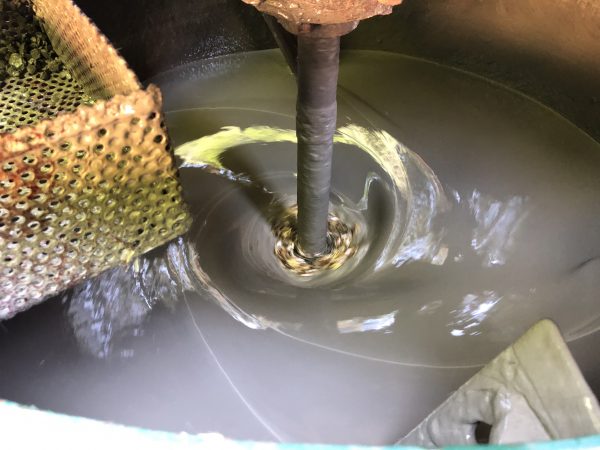
This is just my personal opinion, but when it comes to cement slurry, even though there are control parameters like flow rate, I think it’s better when it’s stiffer.
As a construction manager, I feel more at ease when things are a bit stricter, lol.
We're conducting a compressive strength test on these test specimens, but if they feel way too loose, it makes me nervous lol
The stiffer it is, the less deviation there is during injection, the less bleeding occurs, and the higher the strength—so you can feel confident.
So, in my workplace, I tend to give instructions that are on the stricter side.
That said, if the consistency is so thick that it can’t be pumped, or
Since this causes a significant drop in workability, I'd say the flow value is around 17.
That amount might actually make it easier to stop the leak, even if there’s a hole in the bedrock and the cement slurry is seeping out, lol.
By the way, even if you thin the cement slurry a little (so that it retains a certain degree of hardness),
Please keep in mind that it’s impossible for the pressure to seep into the surrounding rock when pressure is applied to the anchorage point lol.
The idea that it seeps in and causes that area to grow is a misconception.
There’s also the matter of construction plans and mix designs, but I think that’s something you learn through on-site experience.
What do you all think?
See you later.