Hello, everyone.
This is Enta.
It's been raining steadily for the past few days!
It finally feels like the rainy season, doesn't it?
But it's already July!
We've reached the halfway point of the year...
I'll keep giving it my all in the second half, too!

This has nothing to do with the article, but we’ve added our branch offices to the “Access” section of our website.
It will serve as both an office and a warehouse.
I don't have a desk or chair yet, lol
From now on, let's hold our meetings there... lol
But that's beside the point.
It is said that applying pressure during grout injection concentrates the grout and increases its strength.
I don't think I'll change, lol, but...
Does concentration increase strength?? And it doesn't maintain pressure after pressurization, either.
As I mentioned in a previous post, grout that is heavier than water has already been injected into the hole, and
Considerable pressure is being applied to the fixing section.
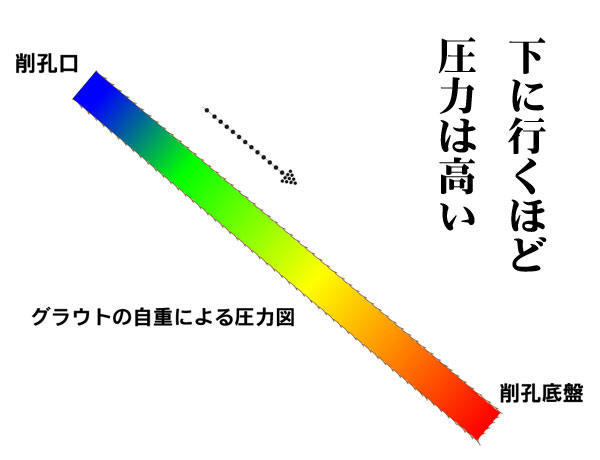
I think it would look something like this if I were to draw it.
As for the anchoring sections, it appears that some of them exceed the design strength.
The orifice is probably rated for the design strength.
However, thatSince there were no experimental results, I decided to conduct an experiment.
We have prepared test specimens for that day's flow rate, so we'll use those as a reference.
Although there are only a few test specimens, it would be interesting to see if there’s a clear difference.

We will make a 1-meter test specimen.Friction Packer (Moriya Koki) for φ115

We produce both pressurized and non-pressurized versions.
There are also standard test pieces, but for now, let's use the same conditions.

The injection is complete.The maximum pressure is 0.2 MPa, and the material is cured while maintaining a pressure of 0.2 MPa.

Pressurized | Diameter: 150 mm

No pressure; Diameter: 110 mm
See you later.