Hello, everyone.
This is Enta.
I conducted an experiment the other day.
That is the compressive strength test.
The experiment examines changes in early strength using the same mix design.
That said, it’s simply a matter of whether we collect the test specimens and leave them as is, or not.
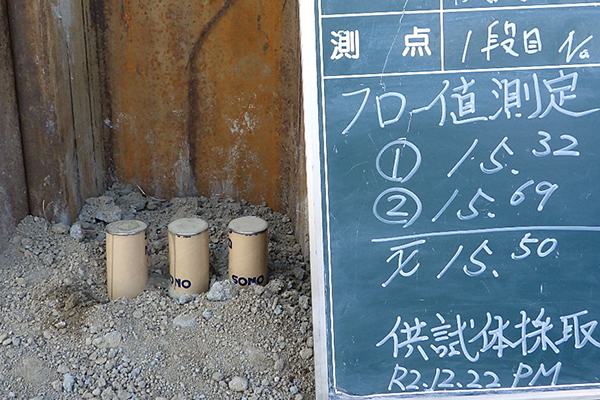
We left this test specimen as is until morning.
It was quite cold, and there was a light frost on the ground.
So, here's the intensity for that day:
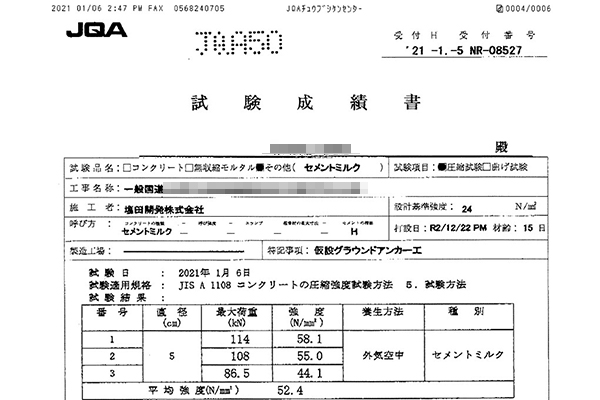
Due to the New Year holidays, this is quick-setting cement, and although the date I mixed it was around the 15th, please cut me some slack on that.
Next, this test specimen
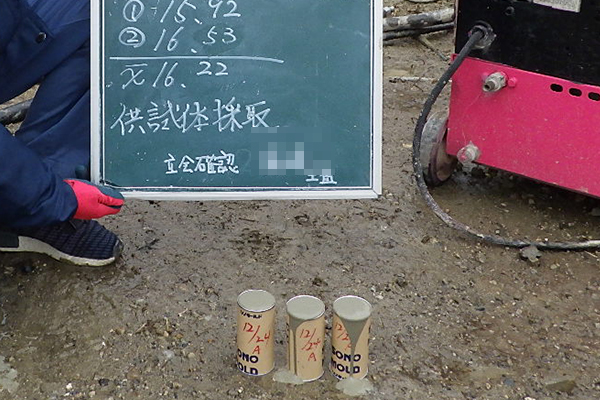
This is a test specimen that was inspected by government officials.
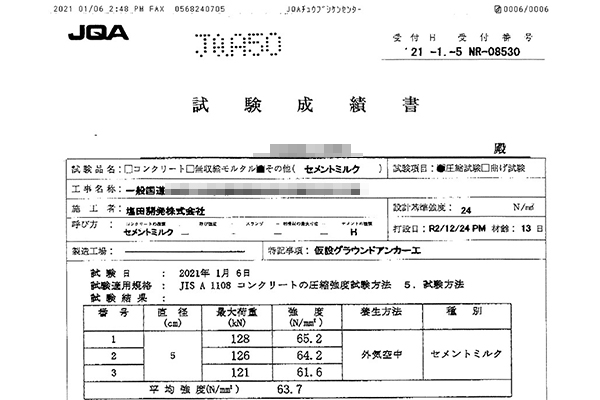
I made a little mistake here, too—the collection date was in the morning, but I wrote it as "PM" on the test center form by mistake. It's actually AM, lol.
I took the test specimens home on the 24th, placing them in Styrofoam for curing.
That's all there is to it.
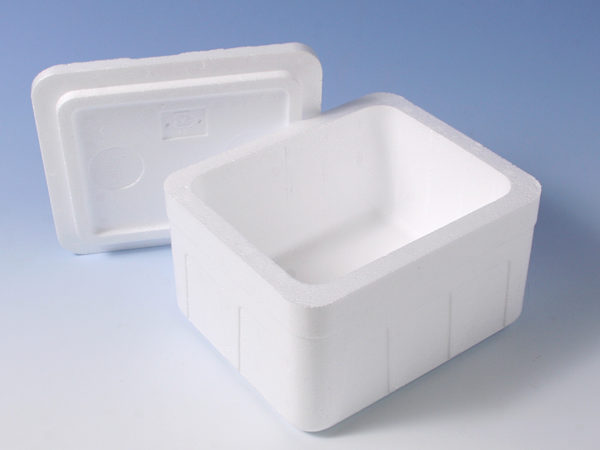
Thanks to the insulating properties of the expanded polystyrene, there were no sudden temperature changes, so it had set firmly by morning.
The test specimens that were left as is still showed delayed surface hardening even by morning.
The curing method results in a difference of approximately 10 N/mm² in early strength.
Actually, as long as it exceeds 24 N/mm², there’s no problem at all, but I’d really like to see a compressive strength of at least 30 N/mm² in the test… lol (just for the sake of it).
When curing test specimens after preparation, it’s best to use conditions that match those on-site as closely as possible; in the case of cement slurry like this, a curing temperature of around 15 degrees might actually be preferable.
In ground anchor construction, the cement slurry hardens underground.
I hear the average temperature underground is around 16 degrees.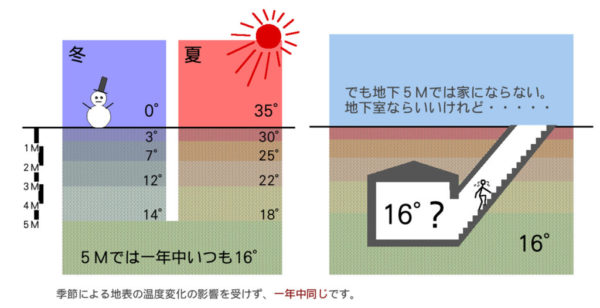 Cement slurry hardens under ideal conditions.
For this reason, the test specimens are, in a sense, being cured under harsh conditions.
For this reason, protective covering made of expanded polystyrene is recommended.
That's the conclusion, lol.
It might be a good idea to use Styrofoam for protection in both summer and winter.
See you later.