Hello, everyone.
This is Enta.
Somehow, the pollen seems to have calmed down quite a bit!
It's nice not having to take any medicine.
I'm so incredibly sleepy that I get really drowsy in the afternoon and evening.
Well, I do take naps, though lol

Napping is considered very beneficial.
According to a survey of NASA astronauts,
A nap of 20 minutes or less can boost afternoon decision-making ability by as much as 35 percentThat's right.
Please note that this is strictly limited to 20 minutes or less.
But that's beside the point.
Why Do Cracks Form?
Whether it's a newly constructed slope or an existing one, there are areas where the soil cracks easily and others where it doesn't.
I’d like to consider why cracks occur in sprayed concrete.
(Please note that this is based solely on my own experience, so please let me know if you have any comments or corrections.)
1. Spraying during periods of extremely high temperatures
2. The rock lines in the rock section and the sedimentary section were clearly visible.
3. Overhang (a section of a rock face where the slope extends over your head like a roof overhang.)
4. Spray loss occurred
5. Plastic spacers
6. A pile of material slid down while we were spraying.
7. Nighttime temperatures drop to near 0 degrees (or below freezing).
8. The sand is bad.
Is this what you had in mind?
It seems that the spots most prone to cracking here are numbers 1, 2, 5, and 8.
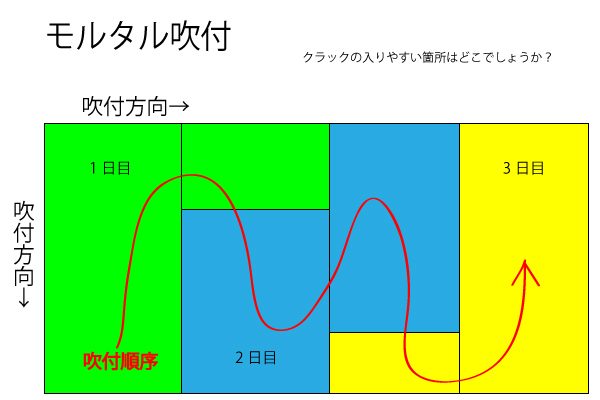
Cracks are more likely to form during periods when the temperature is high (as in #1) and during periods when it is not.
It changes even throughout the day. Is it nearly impossible to avoid that?
Even if you water the surface before spraying, it will still be just as easy for the material to penetrate.
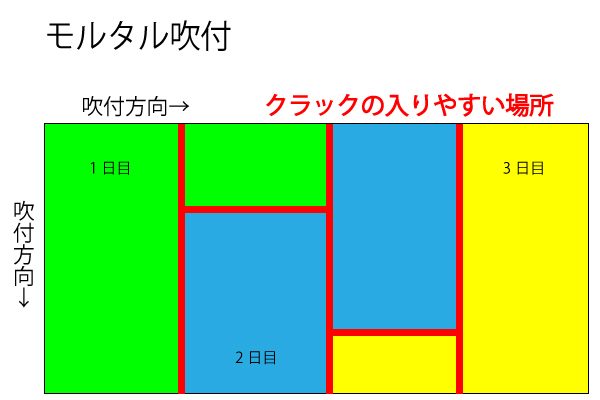
The thick red line indicates areas where cracks are likely to form.
"Isn't it all just that?!"I can just hear someone saying that (lol)
Second, even if the cross-section is the same, if there is soil present, the soil will absorb the moisture from the mortar in that area the moment it is sprayed, and
Differences in strength and moisture content cause cracks to form.
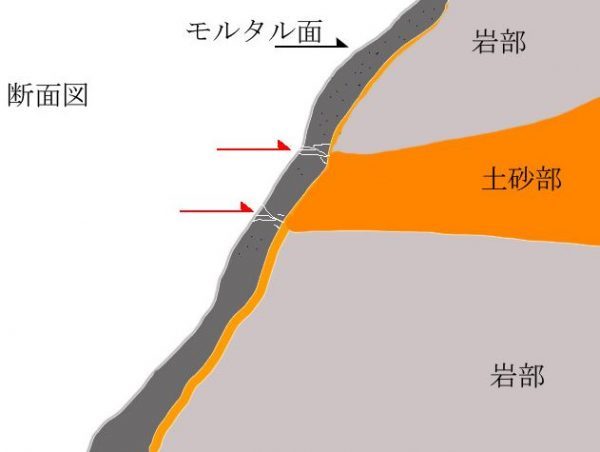
While it’s true that the sand on the 8th hole is bad—and the same could be said of the 4th—it’s just that...Fine sandIf that is the case, when spraying,
This makes it more prone to scattering, resulting in increased waste.
In addition, it tends to become sticky inside the hose, making it difficult to spray.
However, while the finish looks very nice when done with a flat iron, the hair tends to stick to the flat iron, which can be a bit of a hassle.
Coarse sandIn such cases, it tends to separate more easily from the cement, so I believe this also tends to increase waste.
The surface also appears rough when finished with a trowel, which creates an aesthetic issue.
Personally, I think a blend ratio of about 6:4 is probably best for sand used in spray applications.
Fine sand: 6, coarse sand: 4That's right. I guess a 50-50 split would probably be fine, though... lol
I once heard that, a long time ago, a sand supplier in a certain prefecture worked with a slope construction contractor to determine the optimal sand mix through experimentation.
See you later.